
The founder has a short list of companies that could transform the business, but the sales team keeps working whoever fills out a form or replies first. A conference speaker calls this account based selling, and suddenly the question is whether it belongs to marketing, sales, or an expensive RevOps project.
For an under-resourced B2B team, that confusion is costly. Account based selling isn't a bigger prospect list with more elaborate email copy. It's a focused sales motion built around named accounts, stakeholder coverage, relevant triggers, and disciplined follow-up. The practical challenge is making that motion work without a large SDR department, perfect data, or a full-time operations team.
What Account Based Selling Actually Is in 2026
Account based selling treats a high-value company as a market of one. Instead of handing a rep one lead at a time, the team selects specific accounts, studies their context, identifies the people involved in a purchase, and coordinates outreach around the account's priorities.
That changes the seller's starting question. Traditional lead-based selling asks, “Who downloaded something, and how quickly can someone contact them?” Account based selling asks, “Which companies should become customers, what problem might they be solving, and who needs to support a decision?”
The distinction matters because a single contact rarely controls a complex B2B purchase. Multithreaded outreach connects with several relevant people across email, calls, LinkedIn, and live meetings. Each person receives a reason to engage that fits their role, rather than receiving the same template with a different first name.
A sales discipline, not an inbound label
Marketing can support an ABS motion with content, events, advertising, and account engagement data. Sales still owns the commercial execution. A rep or account team should know which named accounts matter, why each one fits the ideal customer profile, and what action should happen after a reply.
Account based selling emerged as a distinct B2B strategy in the mid-2010s, developing from account-based marketing. By 2020, Gartner projected that it would become the basis of sales for most technology vendors, with the market exceeding $5 billion per year, as documented in the history of account-based selling. A 2024 benchmark found that 64% of marketers said their teams already had an account-based approach, with adoption ranging from 57% to 67% across major industries, according to the same reference.
That history shows why ABS now appears in founder conversations. It moved from an emerging enterprise concept into a mainstream operating model within roughly a decade. The 2026 practical question isn't whether the method exists. It's whether a small team can remove enough operational waste to use it consistently.
Practical rule: Start with the mechanics, not the software. A weak account list stays weak after adding intent data, automation, and AI-generated copy.
Intent signals, enrichment, and AI drafting can make focused account work more accessible to lean teams. They don't replace judgment. Someone still has to decide whether a trigger is meaningful, whether the offer fits, and whether the message gives a buyer a credible reason to respond.
How Account Based Selling Differs From ABM
ABM and ABS share the same account-first mindset, but they answer different operational questions. Account-based marketing creates coordinated awareness around selected companies. Account based selling turns that account context into direct conversations and deal progression.
Founders often confuse the two because both use named-account lists, personalization, and engagement metrics. The mistake is assigning one team responsibility for both motions without defining the handoff. Marketing may create attention while sales waits for a conventional lead, or sales may send cold outreach while marketing spends resources on a different group of accounts.
Consider a 200-person fintech trying to land a deal at Fidelity. An ABM motion might run display advertising, invite relevant stakeholders to a webinar, and produce custom collateral for the account. The ABS motion would have a rep identify the VP of Risk and adjacent stakeholders, send role-specific emails, follow up with calls and LinkedIn touches, and convert interest into a discovery meeting.
ABS vs ABM at a glance
| Dimension | Account Based Selling (ABS) | Account Based Marketing (ABM) |
|---|---|---|
| Purpose | Create conversations, qualified opportunities, and revenue within named accounts | Build awareness and engagement across a selected buying group |
| Ownership | Sales, SDRs, account executives, and sales leadership | Marketing, demand generation, content, events, and advertising teams |
| Core activity | Stakeholder mapping, personalized outreach, discovery, negotiation, and deal progression | Targeted ads, content, webinars, events, and coordinated brand exposure |
| Primary metrics | Meetings, opportunity creation, pipeline value, win rate, and account penetration | Account engagement, content interaction, event participation, and buying-group reach |
| Operating style | Rep-led and one-to-one or one-to-few | Marketing-led and one-to-many or one-to-few |
A useful reference on the account research and data layer is Pipecorn's guide to B2B data for account based marketing. The point isn't to collapse ABM into ABS. It's to make the data useful to both teams while keeping ownership clear.
Complementary motions, separate scorecards
ABM warms the room. ABS books the meeting and advances the opportunity. The two motions work better when they share account definitions and buying-group insight, but they shouldn't share every KPI.
If sales measures success by impressions or broad engagement, the team may celebrate activity without creating pipeline. If marketing is judged only on meetings, it may underinvest in the awareness work that helps sales conversations land. Keep the motions connected at the account level, then let each function own the outcomes it can influence.
The Four Operational Pillars of an ABS Program
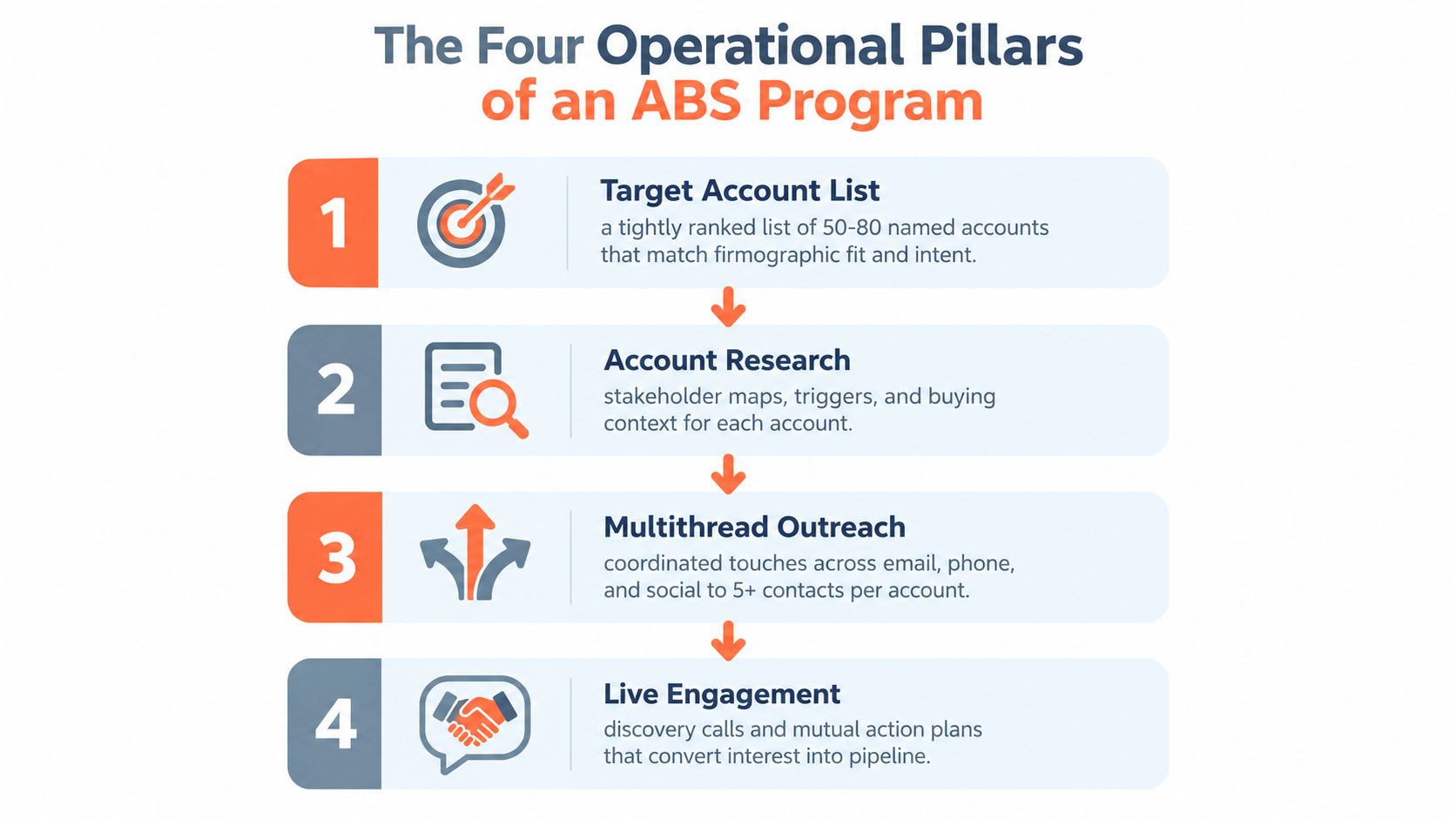
A functioning ABS motion follows a sequence. Targeting comes first, research follows, coordinated outreach comes next, and live engagement turns response into pipeline. Teams often stall because they launch all four activities at once, without giving each stage enough quality to support the next.
Targeting
The target account list should be tight enough that sales can explain why every company belongs. A practical pilot can use 50 to 200 accounts, but the number matters less than the selection discipline. Filter for firmographic fit, use case relevance, commercial potential, and a buying signal that gives the team a defensible reason to act.
A scraped database isn't an ABS list. It's raw material. The strategist should remove companies that look attractive on paper but don't have the problem, budget context, market position, or access path required for a credible sale.
Research
Research turns a company name into an account plan. Capture the relevant business priority, recent trigger, likely decision-makers, potential champion, blocker, and reason for contacting each person.
The output doesn't need to be a long persona document. It needs to help a seller write a useful message and run a sharper conversation. If the research can't explain why the account might care now, it hasn't done its job.
Multithreaded outreach
Outreach should coordinate email, calls, and LinkedIn touches across the buying committee. The message changes by role, while the account thesis stays coherent. A finance leader may care about predictability, an operations leader about execution, and a technical evaluator about implementation risk.
The sequence also needs ownership. Someone sends the first message, someone follows up, and someone decides when a reply deserves escalation. Teams evaluating the operational side can review sales cycle automation case studies for examples of how automation can support that handoff.
Live engagement
A response isn't the finish line. The closer needs the research, stakeholder map, and account thesis before the meeting. Discovery should test the original assumptions, identify the wider buying group, and establish what a sensible next step looks like.
Weak research produces generic outreach. Weak outreach produces few conversations. Weak live engagement creates meetings that never become opportunities. The pillars are connected, and running them in parallel without ownership is one of the fastest ways to produce an expensive pilot with no learning.
Roles and Team Structure Inside an ABS Motion
A polished org chart can hide a practical problem. Someone has to choose the accounts, someone has to investigate them, and someone has to execute the sequence and handle the response. Those responsibilities are distinct even when one person carries several of them.
The account strategist defines the ideal customer profile, selects the named accounts, and writes the value thesis for each priority segment. This person decides why a particular account should receive focused treatment rather than generic outbound.
The researcher mines trigger events, maps the buying committee, checks contact quality, and builds the contact graph. Good research identifies more than titles. It clarifies reporting relationships, likely influence, recent company changes, and the business issue that makes outreach timely.
The executor runs the sequence, makes calls, adds relevant LinkedIn touches, monitors replies, and books meetings. The executor also needs judgment. A positive response from a technical evaluator may require a different handoff from a direct reply by an economic buyer.
The lean-team version
In a small company, the founder may act as strategist and closer while an SDR or contractor handles execution. The researcher role often gets squeezed between product work and delivery, which creates shallow lists and generic messages. That trade-off explains why an ABS pilot can look promising in planning but never reach consistent execution.
A done-for-you cold email partner such as Eludic can collapse the three operating roles into a campaign lead, data analyst, and copy-and-sending specialist, with a delivery manager responsible for quality control and reply triage. The internal leader still supplies the commercial context and takes the qualified conversations, but doesn't need to build every operational layer alone.
A credible in-house motion generally needs three to four full-time people minimum to cover strategy, research, execution, and delivery coordination. That headcount requirement is why many under-resourced teams stop after a pilot. They can define the list and write the first sequence, but nobody owns the daily operating rhythm.
The right structure is less about job titles than about making every account action have a clear owner.
Implementing ABS in Four Connected Phases
A fictional mid-market SaaS company, Northstar, sells workflow software to regulated service businesses. Its founder wants to reach a named account, Meridian Group, but doesn't want a broad campaign that treats every company like a generic prospect.
Phase one, targeting
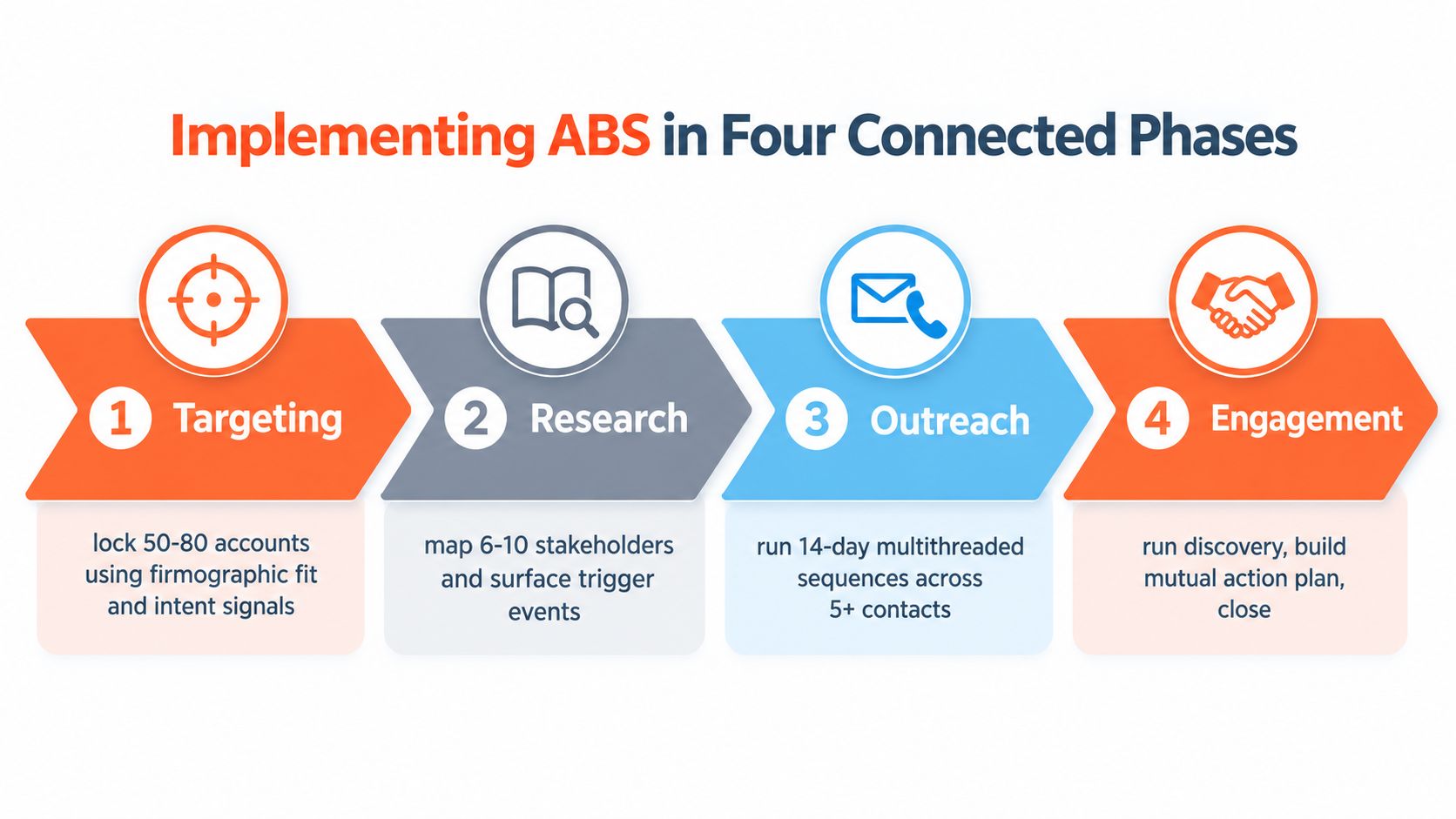
Northstar starts by defining the account fit: company type, operational complexity, relevant technology environment, and the business problem its product solves. The team then selects a focused group of 50 to 80 accounts using firmographic fit and available intent signals, ranking them by likely deal potential.
Meridian makes the first wave because it fits the commercial profile and has a visible operational change that could make the problem more urgent. The account receives a brief rationale, not just a score. That rationale becomes the filter for every later decision.
Phase two, research and outreach
The researcher maps Meridian's likely buying group, including an operational leader, a finance stakeholder, a technical evaluator, and an executive sponsor. The team records each person's role, likely concern, trigger context, and reason for contact. Practical market-mapping guidance can help teams structure that account view through resources such as what market mapping means.
The executor then builds a personalized sequence with a first message tied to Meridian's situation, followed by role-specific emails, calls, and LinkedIn touches. A sequence should have enough follow-up to create a fair test, but not so much repetition that the company experiences it as noise. The strategist can add a higher-context LinkedIn touch or direct introduction while the executor maintains operational consistency.
Phase three, engagement
A warm reply goes to the closer with the account brief, contact map, original message, and likely hypotheses. The closer doesn't restart discovery from zero. The conversation tests whether Meridian's stated priority is active, who else must be involved, what the current process costs, and what would make a next step worthwhile.
The meeting is successful when it creates shared movement, not when the buyer politely accepts a demo. A mutual action plan should name stakeholders, decision criteria, responsibilities, and the next commercial event.
Phase four, measurement
Northstar reviews the pilot weekly. The team checks positive replies, qualified meetings, opportunity creation, account coverage, and pipeline value. Segments that generate activity without meaningful conversations are removed or rewritten before the list expands.
Measurement closes the loop between targeting and execution. Skipping targeting wastes sends. Skipping research produces weak relevance. Skipping engagement wastes replies. Skipping measurement guarantees that the same mistakes return in the next wave.
KPIs That Actually Predict ABS Success
ABS dashboards often contain too much activity and too little account movement. The useful metrics connect a specific operational phase to a commercial outcome. A high send count doesn't prove that the right accounts noticed, replied, or entered a buying process.
The first metric to inspect is meetings booked per 100 targeted accounts. A healthy motion should land between 4 and 8 meetings per 100 targeted accounts, while the account-based sales benchmark provides broader evidence that account-based programs can improve engagement, conversion, deal size, and win rate when execution is disciplined.
The next filter is meeting quality. The opportunity creation rate from those meetings should clear 25%, according to the benchmark specified for this playbook. A meeting that doesn't fit the ICP, involve a real problem, or produce a credible next step is not a win for ABS.
Phase-level scorecard
| Phase | KPI | Healthy benchmark |
|---|---|---|
| Targeting | Meetings booked per 100 targeted accounts | 4 to 8 |
| Outreach | Positive reply rate | Above 3% |
| Outreach | Sequence completion rate | Above 70% |
| Engagement | Meeting-to-opportunity conversion | Above 25% |
| Engagement | Multi-thread penetration | 1.4 contacts per active account |
These benchmarks should be treated as operating signals, not universal guarantees. A low reply rate can indicate poor targeting, weak deliverability, an unclear offer, or an irrelevant trigger. A healthy reply rate paired with weak opportunity creation usually points to qualification or discovery rather than copy.
Review the leading indicators weekly. A positive reply rate above 3%, sequence completion above 70%, and multi-thread penetration of 1.4 contacts per active account show whether execution is reaching the account as intended. They don't replace pipeline analysis, but they help the team diagnose problems before the sales cycle hides them.
Ignore total emails sent, open rate in isolation, and aggregate reach that isn't tied to named-account movement. For deeper diagnosis, campaign performance analysis is useful when the team needs to connect activity data with actual campaign outcomes.
Common Pitfalls and How a Done-For-You Partner Helps
Account based selling doesn't require an SDR army, but it does require operational coverage. The most common failures aren't caused by a lack of ambition. They happen when a small team spreads attention too widely, researches without launching, or optimizes for easy dashboard numbers.
Targeting sprawl
A list with more than 800 accounts usually signals weak ICP discipline rather than healthy scale. Reps can't create meaningful account context for every company, so the message becomes broad and the account-first promise disappears.
A managed partner can narrow the list around the commercial brief, validate contacts, and separate a focused pilot from a later nurture pool. The internal leader should approve the selection logic, but shouldn't spend weeks cleaning every row manually.
Research paralysis
Research has value only when it improves the next action. Teams sometimes build detailed persona documents, collect every public signal, and delay the first send until the information feels complete. By launch day, the trigger may be stale and the team still has no response data.
The better approach is a minimum viable account brief. Capture the account rationale, one or two relevant triggers, the likely buying group, and a role-specific hypothesis. Researchers and copywriters can deepen the brief as replies reveal which assumptions were wrong.
Measurement drift
Open rates and total replies are easy to report, so teams often use them as the campaign's main scorecard. That choice rewards messages that attract curiosity, including from people who will never qualify, while hiding weak meeting quality and stalled opportunities.
A done-for-you partner can assign list building, personalization, sending operations, reply handling, and calendar coordination to dedicated operators. The internal sales lead then focuses on discovery, qualification, and late-stage conversations instead of trying to become a deliverability specialist, researcher, copywriter, and SDR manager simultaneously.
Hiring and ramping two SDRs requires recruiting, training, tooling, management time, and a period before the team can run a stable motion. An external launch can compress the operating setup to roughly 14 working days with a fixed monthly scope, according to the scenario specified for this playbook. The trade-off is control. An internal team develops deeper product judgment and account history, while a partner offers faster coverage and less management overhead.
In-house still wins for a small set of strategic accounts, highly regulated industries, or offers that require extensive technical and legal review before contact. A partner fits better when the bottleneck is outbound capacity and the message can be approved through a clear brief. Teams comparing delivery models can use what a turnkey solution involves as a useful frame for deciding which work should stay internal.
The operational benchmark is sobering. The 2025 State of ABM report says 59% of organizations are blocked by insufficient staff and poor data quality, while Demand Gen Report's 2025 benchmark survey identifies proving ROI, sales and marketing alignment, and scaling as leading challenges, as summarized in the 2025 SaaS sales trends analysis. The same source says 45% see promise in AI personalization, but nearly 70% say current effectiveness remains limited. Automation helps most when it simplifies execution and prioritizes signals, not when it generates more generic personalization.
Your First 30 Days With Account Based Selling
The first month should produce learning, not a complicated revenue operations project. The team needs a clear account definition, a credible offer, a controlled pilot, and a decision about which work belongs inside the company.
Week one
Lock the ICP and build a broader working list of 200 to 400 accounts. Rank that list, select a 50-account pilot, and decide whether the team will build internally, hire, or use a managed cold email service. The decision should follow the actual constraint. If the founder can handle meetings but nobody can maintain research, sending, and reply triage, execution is the bottleneck.
Week two
Finalize one offer, one sequence framework, and one primary proof asset. Launch the first wave only after the team can explain why each account fits and why each contact should care. Don't build a library of collateral before the market has reacted to the basic message.
Week three
Review positive replies and qualified meetings. Remove weak segments, rewrite the offer where the same objection appears repeatedly, and layer relevant LinkedIn touches only after email messaging has a clear direction.
Week four
Expand to the full approved list, establish the weekly operating rhythm, and align the team around four measures: qualified meetings booked, pipeline value created, account engagement score, and cost per meeting. Month one should skip complex intent scoring, elaborate multichannel orchestration, and tooling that requires a RevOps hire to maintain.
The decision aid is simple. Build the strategy internally, delegate repetitive execution when capacity is missing, and keep the closer accountable for conversation quality. That balance preserves commercial judgment without forcing a founder to operate every part of the outbound machine.
Eludic designs, launches, and manages done-for-you cold email programs, including targeted list research, personalized campaign copy, sending operations, reply handling, and meeting booking. Visit Eludic to assess whether a managed outbound motion can help turn a focused account list into qualified B2B conversations.