
Monday morning, the founder opens the CRM and sees 12 deals sitting in “Qualified”, no new names added last week, and a forecast that still claims the quarter is on track. Sales has sent plenty of emails, held a few demos, and updated opportunity notes, but nobody can explain which deals will move, which ones are already dead, or how many new conversations the team needs to create next.
That isn't a CRM problem. It's a pipeline math problem. Every outbound list, reply, booked meeting, discovery call, proposal, and negotiation creates a transition with a measurable chance of progressing. When one transition leaks, the damage travels through every stage after it.
What a B2B Sales Pipeline Actually Is
A B2B sales pipeline is the total value of opportunities moving through a defined sales process toward closed revenue. Each opportunity should have a clear stage, an owner, an expected next action, and an evidence-based probability of reaching the next stage.
A pipeline isn't the same as a forecast. The pipeline contains potential revenue. The forecast is the portion leadership believes will close within a specific period after considering stage quality, deal momentum, buyer commitment, timing, and historical conversion. A CRM full of opportunities can still produce an unreliable forecast if reps advance deals without proof.
The practical distinction matters most in outbound. A cold email isn't pipeline. A reply isn't pipeline either. A positive reply can become a booked meeting, then a qualified opportunity, then an evaluation, negotiation, and signed contract. Each step removes accounts that lack fit, urgency, authority, budget, or a credible buying process. The difference between leads and prospects becomes operationally important because the CRM should show where a contact has earned progression, not merely where marketing captured a name.
The six transition points
A useful operating model follows six stages:
- Prospect or stranger: The account matches the ICP and is ready for a relevant outbound touch.
- Engaged: The contact replies, clicks, submits a form, or otherwise shows identifiable interest.
- Qualified: Discovery confirms a real problem, business fit, buying context, and a plausible next step.
- Proposal or evaluation: The buyer is reviewing a solution built for their needs with relevant stakeholders involved.
- Negotiation: Commercial, legal, security, or procurement work is active.
- Closed-won or closed-lost: The contract is signed, or the loss reason is recorded accurately.
The exact labels can change by sales motion. The discipline can't. Pipeline health is the product of stage-to-stage conversion, not the number of logos displayed in the CRM. If outbound generates conversations but discovery doesn't produce qualified opportunities, more sending won't solve the problem. If proposals stall because no economic buyer is involved, polishing the proposal won't repair the leak.
Practical rule: Every stage should answer one question: what evidence proves this deal belongs here?
The Six Stages From Stranger to Closed Deal
Consider Acme Logistics, a potential customer evaluating routing software with an annual contract value of $24,000. The opportunity should not jump from “interested” to “proposal” because a contact attended a demo. It should progress only when the buyer completes a meaningful action.
1. Prospect or stranger
The sales rep identifies Acme as a suitable logistics account, finds an operations leader, verifies the contact, and records the trigger behind the outreach. Entry requires ICP fit and a usable contact. Exit requires a response or another meaningful engagement signal. The next action is a relevant cold email, not a generic sequence sent to every logistics company.
2. Engaged
Acme's operations leader replies that routing inefficiency is under review. The rep records the reply, answers the question, and proposes a discovery call. Entry is a reply, click, form fill, or direct request. Exit is a booked meeting or a clear disqualification. The rep owns the response and should handle it while the context is still fresh.
3. Qualified
During discovery, Acme confirms the operational problem, identifies the affected team, explains the buying timeline, and brings the relevant decision-maker into the process. Entry requires a completed discovery conversation. Exit requires documented fit, pain, authority or access to authority, and an agreed next step. The next action is a customized demonstration or evaluation plan.
4. Proposal or evaluation
The rep demonstrates how the routing product addresses Acme's workflow, maps stakeholders, and identifies procurement or security requirements. Entry requires a qualified opportunity with a defined use case. Exit requires buyer agreement to review commercial terms or proceed with a formal evaluation. The account executive owns the opportunity, with technical support added when needed.
5. Negotiation
Acme reviews pricing, contract terms, security materials, and legal language. Entry requires active commercial or contract work, not a proposal that has gone quiet. Exit is a signed agreement or a documented objection that prevents purchase. The next action should be a dated commercial or legal step, such as returning redlines or confirming an approval meeting.
6. Closed-won or closed-lost
Acme signs the $24,000 agreement, making the opportunity closed-won, or declines and provides a structured reason such as timing, budget, product fit, or a competitor. The owner records the final outcome and hands implementation details to customer success if the deal closes. A loss without a reason is missing data, not a neutral outcome.
| Stage | Owner | Entry Criteria | Exit Criteria |
|---|---|---|---|
| Prospect or stranger | SDR or founder | ICP fit and verified contact | Reply, engagement, or disqualification |
| Engaged | SDR or founder | Identifiable response or intent | Meeting booked or lead rejected |
| Qualified | Account executive | Discovery completed | Fit, pain, buying context, and next step confirmed |
| Proposal or evaluation | Account executive and specialist | Qualified use case | Commercial review or formal evaluation accepted |
| Negotiation | Account executive and leadership | Active terms, legal, or procurement work | Signed contract or structured loss |
| Closed-won or closed-lost | Account executive | Final decision reached | Handoff completed or loss reason logged |
Pipeline Metrics That Tell You Where It Is Leaking
A founder doesn't need a dashboard packed with every CRM field. The useful metrics connect directly to an outbound action and identify the next operational fix.
Start with stage-to-stage conversion. Pipeline benchmarks report lead to MQL conversion at 20% to 25%, MQL to SQL at 12% to 18%, SQL to opportunity at 10% to 12%, and opportunity to closed-won at 6% to 9% in the cited benchmark set (MarketJoy pipeline conversion data). These figures aren't universal targets, but they demonstrate the compounding effect of leakage. A weak qualification step leaves fewer credible opportunities for every later stage.
Top-of-funnel and mid-funnel benchmarks tell a similar story. Top-of-funnel B2B conversion is typically 1% to 3%, mid-funnel conversion is about 10% to 15%, and bottom-funnel conversion is about 20% to 30%. Small to mid-sized B2B SaaS firms average about 1.4% visitor-to-lead conversion, while enterprise companies are closer to 0.7%, according to the sales pipeline benchmark summary from Landbase. A falling demo-to-proposal rate usually points to weak discovery or poor fit, not a need for prettier demo slides.
The diagnostic metrics
- Reply rate: Measures whether the list, message, and offer create engagement from outbound prospects.
- Meeting-booked rate: Shows whether positive replies become calendar commitments.
- SQL-to-opportunity rate: Tests qualification quality and discovery execution.
- Opportunity win rate: Reveals deal fit, stakeholder access, competitive position, and commercial execution.
- Stage age: Flags stalled opportunities that look active only because nobody has closed them.
- Pipeline velocity: Uses the formula (number of opportunities × win rate × average deal size) ÷ sales cycle length, as defined in Avoma's pipeline metrics guide.
Suppose a team has 20 opportunities, a 20% win rate, an average deal size of $24,000, and a 60-day sales cycle. Its pipeline velocity is $1,600 per day, calculated as (20 × 0.20 × $24,000) ÷ 60. The team can increase that figure by creating better opportunities, improving win rate, raising deal size, or shortening the cycle. More cold emails are only relevant if volume is the actual constraint.
Two numbers deserve less attention. Raw lead count says nothing about ICP fit or buying intent. Email open rate without reply rate can distract from the only outbound outcome that reliably creates a conversation, a response that leads to a useful next step.
| Metric | Benchmark | What a Leak Signals | Stage It Acts On |
|---|---|---|---|
| Lead to MQL | 20% to 25% | Weak targeting or unclear intent | Prospecting |
| MQL to SQL | 12% to 18% | Poor handoff or weak qualification | Engagement and qualification |
| SQL to opportunity | 10% to 12% | Discovery fails to establish a real buying case | Qualification |
| Opportunity to closed-won | 6% to 9% | Fit, stakeholders, terms, or competition problem | Evaluation and negotiation |
| Pipeline velocity | Formula-based metric | Lower win rate, deal size, or speed | Entire pipeline |
How Much Pipeline Coverage You Really Need
Pipeline coverage is a forecasting calculation, not a badge that says “healthy.” The basic formula is:
Required pipeline value = quota ÷ weighted close rate
A raw coverage ratio treats every open opportunity as equally valuable. Weighted coverage gives early-stage opportunities less credit and later-stage opportunities more credit. A team might assign 20% to a qualified opportunity, 40% to a proposal, and 70% to a negotiation, then compare the weighted total with quota.
The familiar 3x quota coverage rule is a starting point, not a law. Recent benchmark coverage has shifted toward roughly 3.1x to 4x for many teams, while enterprise organizations often target 4x to 5x because win rates can fall to about 19% to 21% and sales cycles are longer, according to Kondo's B2B sales trends coverage. The right ratio depends on segment, deal size, sales motion, and the quality of opportunities entering the pipeline.
Calculate coverage from actual conversion
A sales lead should calculate the last quarter's conversion by stage rather than importing a generic ratio. The process is straightforward:
- Group opportunities by inbound and outbound source, then split them by segment such as SMB, mid-market, and enterprise.
- Measure how much value entered each stage and how much eventually closed.
- Record slipped deals separately from genuine losses.
- Apply those observed rates to the current pipeline.
- Remove the largest 20% of opportunities by value and recalculate coverage to expose dependence on a few optimistic deals.
A blended number can hide a serious problem. Inbound opportunities may move quickly while cold outbound deals require more qualification. Enterprise opportunities may carry larger values but also face more stakeholder and procurement risk. A founder who averages them together can report acceptable coverage while the segment responsible for next month's quota is empty.
Forecasting test: If coverage looks healthy but quota is repeatedly missed, inspect slippage and stage quality before adding more lead volume.
| Scenario | Recommended Coverage | Why |
|---|---|---|
| Established, shorter-cycle motion | Around 3x | Historical conversion is more stable |
| Mixed B2B team | Roughly 3.1x to 4x | Coverage must absorb varied win rates and cycle lengths |
| New outbound motion | 4x to 5x | Early opportunities carry greater qualification and timing risk |
| Enterprise sales | 4x to 5x | Longer cycles and lower win rates require more active value |
Filling the Top of the Pipeline With Cold Email
A founder can build an outbound campaign by treating every step as a pipeline input, not a marketing task.
The first step is a focused list. Apollo or Clay can help assemble an ICP list from firmographic filters and trigger signals, while NeverBounce can verify addresses before launch. The list should explain why each account belongs in the campaign. “Companies in software” is not a targeting strategy. A useful record connects industry, role, trigger, likely problem, and a credible reason to contact the person now.
Write for a reply, not a performance
Three copy angles work well as starting points:
- Pain point: Name a costly workflow problem and ask whether it is active.
- Observation: Mention a specific change at the account or in its market.
- Contrarian take: Challenge a common approach without pretending to know the buyer's situation.
Each version should stay concise, use one clear idea, and finish with a low-friction CTA such as “open to a 15-minute look?” The cold email lead generation guide is useful for keeping list quality, message relevance, and reply handling connected instead of treating copy as the whole campaign.
Deliverability is part of pipeline generation. A dedicated sending domain, aligned SPF, DKIM, and DMARC, a 14-day warm-up through tools such as Instantly or Lemwarm, and a cap of 30 sends per inbox per day are the operating constraints in this representative setup. The sequence uses four touches across 12 days, with branches for replies, out-of-office responses, and bounces.
The math and the failure points
A representative campaign sends 2,000 messages, receives a 35% open rate, and generates a 4% reply rate, producing about 28 replies. If 8 to 12 of those replies book meetings, the campaign has created a measurable input for the qualified pipeline. Those figures come from the campaign model specified for this execution example, not a universal performance promise.
The campaign usually fails in one of three places:
- Over-personalisation: Reps spend too long writing one-off messages and can't produce enough relevant volume.
- Slow reply handling: Positive intent cools while the inbox waits for an answer.
- Weak offer: The email asks for a meeting without giving the buyer a reason to accept.
Reply triage should happen within 30 minutes where the operating model allows it. Positive intent, objections, and unsubscribe requests need separate workflows. A team that wants outside capacity can review Hire SDR as one route to adding prospecting execution, but the internal owner still needs to define qualification and what makes a meeting worth accepting.
Build vs Buy the Outbound Engine
Outbound decisions become clearer when cost, speed, control, and management effort appear in the same view. There isn't one correct option for every B2B company. A founder with strong product-market fit and no sales capacity has a different constraint from a mid-market team that already has reps but lacks list operations.
The following matrix compares the options described in the operating plan.
| Option | Monthly Cost | Ramp Time | Best For |
|---|---|---|---|
| In-house SDR | $55,000 to $75,000 base, plus tools | 60 to 90 days before productive output | Teams with product-market fit and enough revenue capacity |
| Freelance SDR | $3,000 to $6,000 | Faster start, higher management need | Founders who can coach closely |
| Done-for-you agency | $8,000 to $20,000 plus tools | Fastest time to meetings | Teams prioritising speed over process ownership |
| Self-serve tools | $100 to $500 | Immediate access, operator-dependent | Founders or ops leads willing to run campaigns |
An in-house SDR offers control and learning, but hiring cost, onboarding, coaching, and ramp time arrive before reliable output. A freelance SDR lowers fixed overhead, yet the founder must supply direction, feedback, list quality, and quality control. Agencies can move faster, although margins compress and the company may not own the operating process.
Self-serve tools such as Apollo, Instantly, Smartlead, and Clay offer the lowest software cost. They don't remove the work. Someone still needs to research accounts, write variants, monitor deliverability, handle replies, and schedule meetings. Teams evaluating building a winning sales team should include that management load in the hiring decision, not compare salary with software fees alone.
The break-even question is expected pipeline value. A $12,000 agency month is rational only when each booked meeting is worth $3,000 or more in expected pipeline, based on the decision rule in this operating model. Below that threshold, self-serve or in-house execution may offer better economics if the team can maintain quality.
Diagnosing and Fixing Common Pipeline Problems
A pipeline should help a sales lead find the next bottleneck within one working session. Three problems appear repeatedly because teams measure activity instead of transitions.
Activity volume hides targeting failure
A campaign can send 2,000 emails per month and still produce only four demos when the list, offer, or sequence is wrong. The CRM view should show reply rate, positive-reply rate, and meetings per 100 sends by campaign, segment, and sender. If replies are weak, inspect targeting and message fit. If replies are positive but meetings are low, inspect booking friction and response handling.
The operational fix is a short campaign review that changes one variable at a time. Rebuild the list or offer before increasing send volume. More activity through a broken conversion step only creates more low-quality conversations.
Slow speed-to-lead wastes existing demand
Inbound forms often sit untouched for 18 hours, and the cited failure pattern shows meeting-to-opportunity conversion falling from 35% to under 10% when response speed collapses. The campaign performance analysis guide can support a more granular review of source, response time, reply outcome, and opportunity creation.
A CRM query should isolate every inbound lead by submission time, first response time, meeting status, and opportunity status. The sprint-level fix is a five-minute automated acknowledgement followed by a same-day call block, with ownership assigned before the form arrives.
Fuzzy qualification inflates the forecast
An opportunity shouldn't advance because a prospect was polite on a demo. If the record lacks confirmed pain, budget context, authority, timeline, and a mutually agreed next step, the opportunity belongs in nurture or disqualification. Weak qualification can push win rates down to 8% to 12% in the failure pattern specified for this operating model.
The dashboard should filter opportunities with missing qualification fields, no next meeting, and stage age above the team median. The fix is a stage gate. Reps can advance only after completing the required fields and documenting the buyer's commitment.
| Failure Mode | Diagnostic Signal | Prescribed Fix |
|---|---|---|
| Activity volume over quality | High sends, weak replies or demos | Segment campaign results and revise list or offer |
| Slow inbound response | Long gap between form and first contact | Auto-acknowledgement and same-day owner action |
| Fuzzy qualification | Many open opportunities, weak win rate | Enforce stage gates and structured discovery fields |
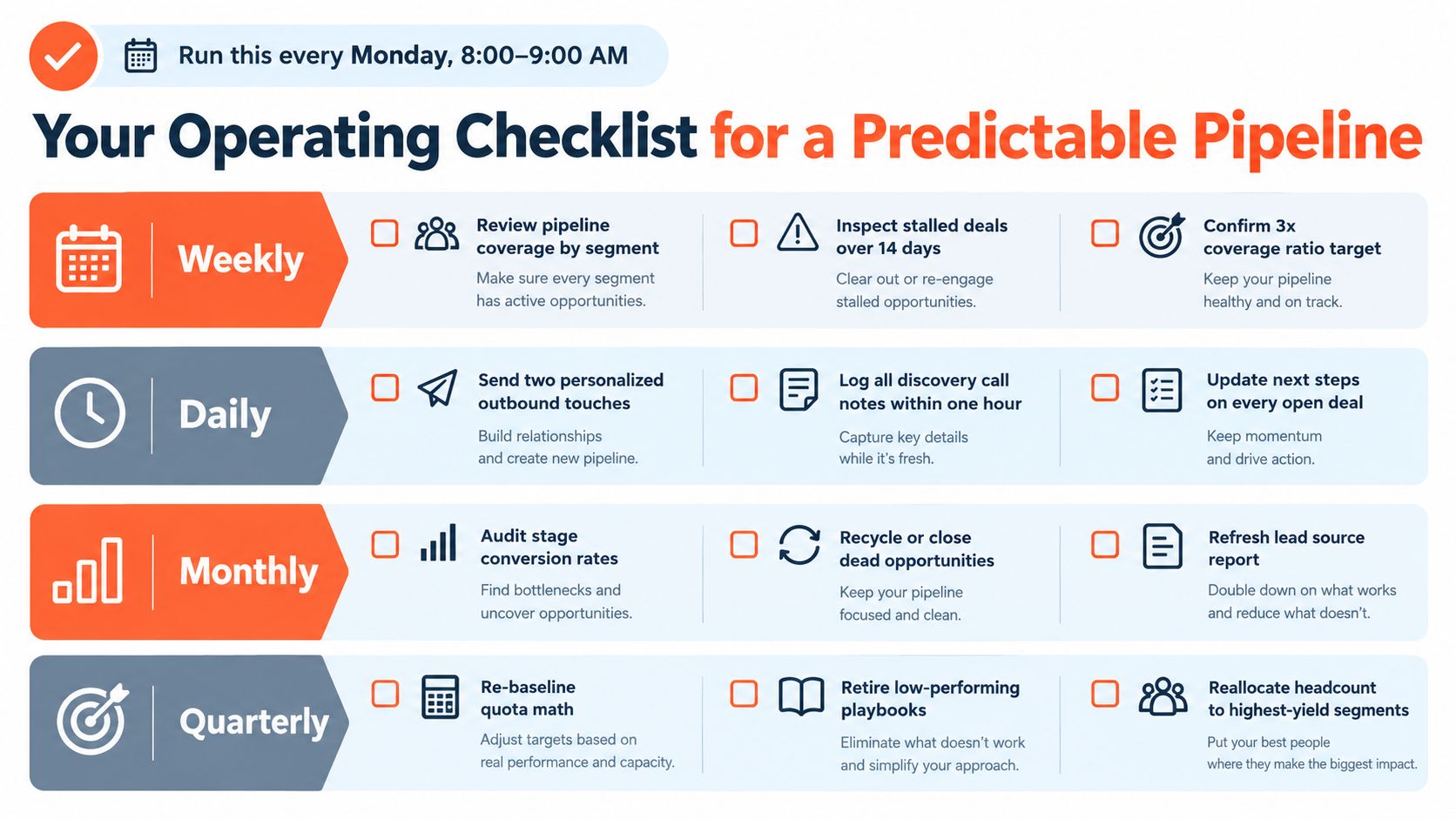
Your Operating Checklist for a Predictable Pipeline
A founder or sales lead can run the operating rhythm below every Monday.
- Weekly: Review coverage by segment, inspect stalled deals older than twice the normal stage age, and record outbound reply rates.
- Daily: Respond to inbound quickly, log discovery notes within one hour, and give every open deal a dated next step.
- Monthly: Compare stage conversion with the team's observed benchmarks, refresh the ICP using closed-won data, and close or recycle zombie opportunities older than 90 days.
- Quarterly: Recalculate coverage using the team's actual win rate, test whether outbound should be built or bought, and pressure-test deliverability and campaign economics.
- Per deal: Confirm qualification before advancing the stage, involve the right stakeholders before proposal, and record a structured loss reason.
The point isn't to create more CRM administration. It's to make every cold email, reply, meeting, and deal change the forecast in a traceable way.
Eludic builds and manages done-for-you cold email programs for B2B teams, including audience research, campaign copy, deliverability operations, reply handling, and meeting coordination. Visit Eludic to see how its outbound service can help turn targeted prospecting into a more measurable sales pipeline.