
Sunrise is often presented as the obvious answer. Early runs supposedly build discipline, protect the schedule, and make every later workout easier. Yet controlled exercise research often points toward the late afternoon or early evening for stronger running performance. Both ideas can be true, because “best time to run” hides three different questions: When can a runner perform at their peak? When can they train consistently? And when do weather and daily responsibilities make running safest and most realistic?
The right answer changes with the goal. A runner preparing for a fast race-pace session may benefit from an evening slot, while a runner in a hot climate may perform better before the day heats up. Someone building a new habit may gain more from a repeatable lunchtime route than from an ideal biological window that keeps getting skipped.
Why Everyone Disagrees About the Best Time to Run
The disagreement starts with a mismatch between laboratory performance and real-world behavior. Sports scientists can control sleep, meals, temperature, route, pacing instructions, and the exact time of a test. A working runner has meetings, school drop-offs, commuting, darkness, family commitments, and weather to manage.
That difference explains why sunrise advice remains popular even when research often finds better acute performance later in the day. Morning running can fit neatly before work, protect the session from calendar interruptions, and help a runner establish a dependable routine. Evening running can offer a warmer, more prepared body, but the session may compete with dinner, fatigue, social plans, or bedtime.
Three meanings of “best”
Performance timing asks when the body is most ready to produce speed, power, or sustained effort. The answer often leans toward late afternoon or early evening, when body temperature and neuromuscular readiness have risen.
Adherence timing asks when a runner is most likely to complete the session repeatedly. The answer depends on the person, not a universal clock. A technically inferior time that happens every week can produce more training than a theoretically superior time that rarely happens.
Environmental timing asks when conditions make the run comfortable and safe. In a hot, humid summer, an early morning run may beat an evening run even if evening normally supports stronger performance. Heat can become the limiting factor before circadian readiness does.
Practical rule: The best time to run is the time that matches the session's purpose and can be repeated without creating problems elsewhere in the day.
A useful decision starts by naming the priority. A runner testing peak capability should think differently from a runner protecting a daily habit. A marathon trainee in a cool climate has a different problem from a recreational runner training through a hot summer. Once those questions are separated, the apparent contradiction becomes much easier to resolve.
The Science Behind Your Running Clock
There is no single biological “best time” that wins every run. Your body works more like a car engine than a light switch: it can start in the morning, but it may need time before it responds at its sharpest. Core temperature, muscle readiness, reaction time, breathing function, sleep quality, and recent food intake all influence how a session feels.
For many runners, body temperature climbs through the afternoon. Warmer muscles may contract more efficiently, joints can feel less stiff, and the nervous system has had hours to become alert. That built-in advantage is only one part of the result. Poor sleep, a stressful workday, dehydration, or an uncomfortable meal can matter more than the clock.
A 2023 review and meta-analysis of 31 studies found that time to exhaustion was longer in afternoon and evening workouts than in morning workouts. The finding supports the idea that many runners can sustain effort better later in the day (Runner's World's review of morning versus evening running). The review also described performance as often peaking between about 4 p.m. and 8 p.m., although your own peak may fall elsewhere.
Why the effect changes between runs
The time-of-day effect is usually easier to see in sprint and strength tasks than in endurance running. Short, powerful efforts rely heavily on muscle temperature, nervous-system activation, and rapid force production. A longer run adds pacing, hydration, fueling, heat, sleep, and accumulated fatigue to the equation.
That means an evening runner may feel more explosive during intervals without gaining the same advantage on a long, easy outing. A morning runner who starts gently, eats appropriately, and trains regularly at that hour may also narrow the difference through adaptation. The hour you practise can become the hour your routine handles best.
Lung function may shift across the day too. Older exercise physiology reporting cited in a 2023 running report described lung function as more than 6% better in the afternoon than at other times (the 2024 Running Report from SportsShoes). That may help explain why breathing feels easier later, but it does not predict every runner's experience.
Use readiness as the practical model. Morning asks the body to move from rest toward full output. Afternoon often begins after movement, food, and warming have already happened. Your goal, climate, schedule, and training history determine whether that difference matters more than just getting the run done.
Morning Runs Versus Evening Runs
Morning and evening running each solve a different practical problem. Morning protects exercise from later disruptions. Evening often gives the body more time to warm up and may support stronger high-intensity work. The comparison below focuses on the criteria that matter outside a laboratory.
| Criterion | Morning Run | Evening Run |
|---|---|---|
| Raw speed and power | May feel slower until the body warms | Often favors sharper speed and power |
| Endurance comfort | Can feel calm and manageable when temperatures are low | May feel smoother after a full day of movement |
| Habit consistency | Protects the session before work and family demands | Works well for runners with reliable evening control |
| Schedule realism | Strong fit for early risers and structured routines | Strong fit for later chronotypes and flexible workdays |
| Sleep interference | Usually leaves more time before bedtime | Can interfere with sleep if intensity ends too late |
| Heat and weather | Often preferable in hot climates | Can be comfortable after temperatures fall |
| Fueling | May require planning around breakfast | Usually allows more time for meals and hydration |
| Safety | Darkness can be an issue in winter mornings | Darkness and traffic can be issues after work |
What mornings do well
Morning running creates a clear boundary around training. A runner can complete an easy run before emails, appointments, or unexpected overtime appear. The cooler air can also make summer sessions more tolerable, although darkness, poor visibility, and cold muscles require sensible preparation.
The main challenge is readiness. Stiffness, low energy, and limited time for food can make a demanding workout feel unnecessarily hard. Runners who train before breakfast should pay attention to how the session feels rather than forcing race pace immediately after waking.
Breakfast still matters across a training plan, especially when morning sessions are long or demanding. Runners who want a broader explanation of how the first meal fits into daily nutrition can consult this practical resource on breakfast as the key meal, then adapt the idea to personal tolerance and workout demands.
What evenings do well
Evening sessions often benefit from warmer muscles, more time to eat and drink, and a body that has already moved through the day. That combination can make intervals, hills, tempo work, and race-pace running feel more natural.
The trade-off is reliability. Evening plans can disappear when work runs late or family responsibilities change. Hard exercise close to bedtime may also leave some runners alert when they want to sleep. Evening runners need a route with adequate visibility and a shutdown routine that gives the nervous system time to settle.
Neither slot wins every category. Morning usually wins when the priority is protecting time and escaping heat. Evening often wins when the priority is expressing speed and the schedule supports it.
What a Controlled 10K Time Trial Reveals
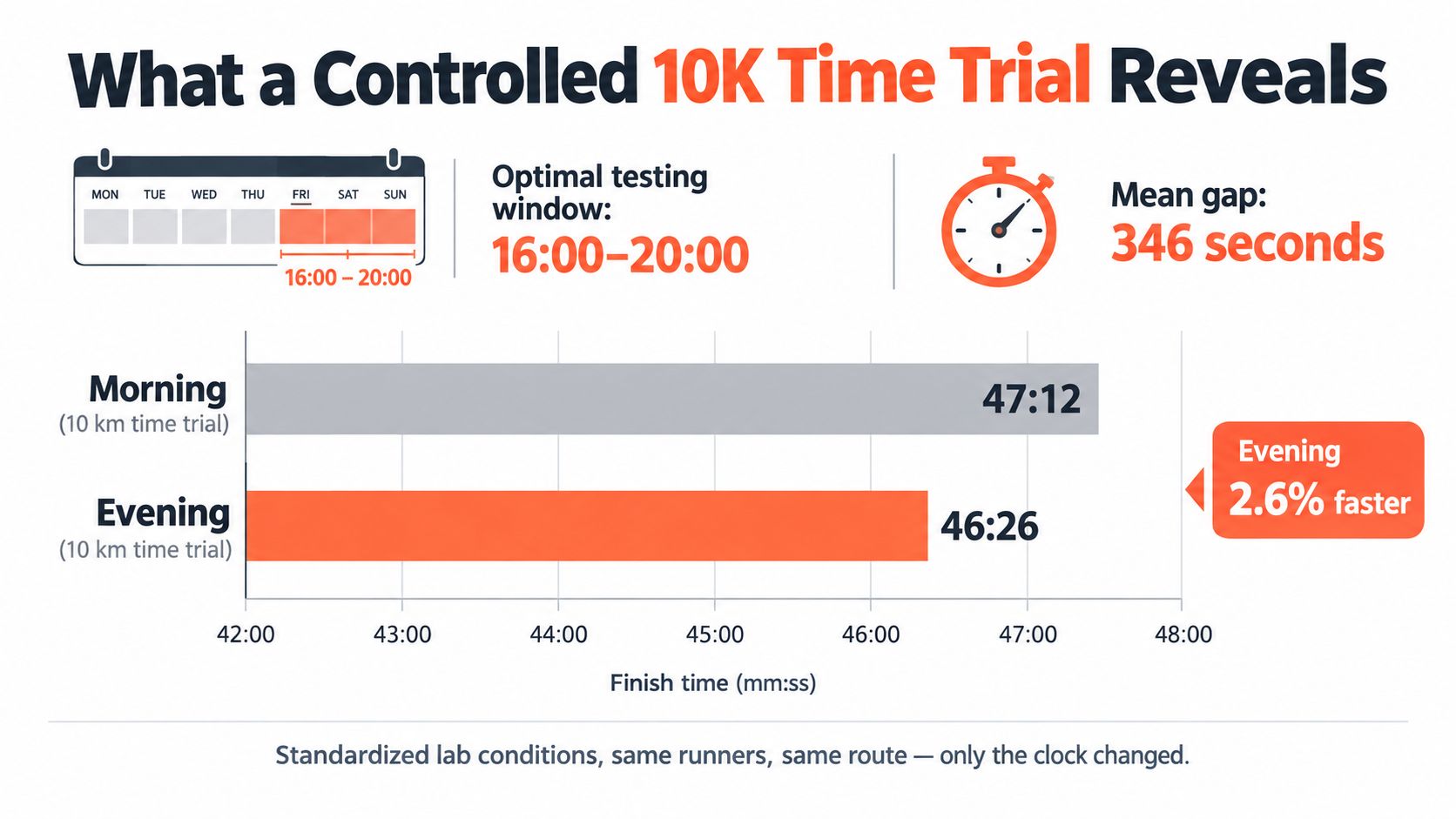
A controlled laboratory test offers a cleaner answer than a collection of personal anecdotes. In the standardized 10-kilometer time trial, the same runners completed the same type of test under controlled conditions, with the clock changing rather than the basic testing setup. Evening performance was 2.6% faster than morning performance, with a mean finishing-time difference of 346 seconds, and the researchers identified roughly 17:00 to 19:00 as the optimal testing window (the published 10-kilometer time-trial study).
That result matters because standardization reduces noise. If one runner tests on a cool morning and another tests after a hot workday, the result may reflect weather, food, sleep, or stress rather than the clock. A controlled protocol tries to hold those influences steady so researchers can isolate time of day more effectively.
The finding doesn't mean every runner should move every workout to the evening. A laboratory time trial measures peak capability, not whether a person can sustain a training plan. It also doesn't prove that a runner will gain the same advantage in every climate, race, route, or level of fatigue.
Translating the result into training
For a runner preparing for a fast 10K, the practical lesson is straightforward. Key speed sessions and race-pace efforts may belong in the late afternoon or early evening when the goal is to assess what the body can produce at its best.
That timing can also make a workout feel more representative if the target race starts later in the day. If the target race begins early, however, occasional morning sessions still matter. Training only at a comfortable evening hour may leave the runner unfamiliar with the stiffness, fueling routine, and warm-up demands of an early start.
Performance timing is a testing choice, not a command to abandon a workable routine.
The controlled result also teaches a broader evidence lesson. A precise study can show that the clock influences performance under specific conditions. It cannot decide whether an evening schedule fits a particular runner's sleep, safety, family life, or climate. The strongest conclusion is narrow but useful: when measuring peak 10K capability, evening testing deserves serious consideration.
When Heat Changes the Answer
A warm body can help performance, but a hot environment can overwhelm that benefit. Running in heat forces the cardiovascular system to manage both movement and cooling. As temperature and humidity rise, the body sends more blood toward the skin, sweat losses increase, and the same pace can demand more effort.
That is why the biologically favorable hour isn't always the environmentally favorable hour. A late-afternoon runner may have warmer muscles and better neuromuscular readiness, yet still struggle if the route holds heat and humidity. An early runner may give up some theoretical performance potential but gain cooler air and lower physiological strain.
A study of 10-kilometer time trials in hot, humid conditions found no significant performance difference between 09:00 and 18:00. The morning trials nevertheless averaged 19 seconds faster and produced less physiological strain, leading the authors to suggest that morning training or racing may be preferable when heat stress is high (the study of 10-kilometer running in hot and humid conditions).
A summer decision process
Runners can make the choice by asking what limits the session:
- If heat is the main limiter, choose the coolest safe window, often early morning.
- If speed expression is the main limiter, choose a later window when conditions remain manageable.
- If acclimation is the goal, include some carefully controlled training in the conditions that resemble the target event.
- If the route is dark or unsafe, move the session indoors or select a better-lit time rather than chasing an ideal temperature.
The distinction between training for peak performance and training for environmental tolerance matters. A runner preparing for a hot race may need some exposure to heat, but that doesn't make every difficult, overheated run productive. Pacing, hydration, route shade, and recovery still determine whether the session supports the plan.
Heat also changes the value of consistency. A runner who can safely repeat short morning runs may build more useful training than someone who schedules ambitious evening workouts that get abandoned during the hottest weeks. The best time to run in summer is therefore a negotiation between body clock, weather, and the routine that survives real life.
How to Find Your Personal Best Time to Run
The best time to run is not always the hour that produces your fastest split. It is the hour that matches your goal, your conditions, and the routine your body has learned. A simple self-experiment can show whether morning or evening gives you the better combination of performance and follow-through.
Treat the comparison like a fair test. Keep the route, distance, effort, warm-up, and conditions as similar as practical. Real life will add noise, but reducing obvious differences makes the pattern easier to read.
A practical testing protocol
-
Choose one repeatable run. Use a steady route at a controlled effort. Comparing an easy morning run with an all-out evening race tests two different workouts, not two time slots.
-
Alternate the time slot. Run some trials in the morning and others later in the day. Continue long enough for both schedules to feel familiar, rather than judging the first memorable session.
-
Record useful signals. Note pace, perceived effort, heart rate, sleep quality, temperature, meal timing, and how your legs felt. A slower run after poor sleep does not prove that mornings suit you less.
-
Keep the effort honest. Set similar effort targets for both time slots. Chasing speed in one session and jogging comfortably in the other makes the comparison unreliable. Your pace may differ while the effort remains comparable.
-
Review the pattern. Look across repeated observations over several weeks. One unusually good workout can reflect sleep, weather, fueling, or simple luck.
Allow time for adaptation
Your body learns a running schedule much like it learns a familiar route. Research summarized in the review of morning and evening running indicates that training consistently at one time can improve performance at that time, often after roughly 3 to 6 weeks of regular scheduling (the same Runner's World research review). Sluggish early runs may show unfamiliarity, not a permanent morning limitation.
The adjustment works in both directions. Morning runners can become better at warming up and producing useful work early. Evening runners can improve their handling of meals, work-to-run transitions, and post-run sleep. The clock is partly a biological signal and partly a practiced routine.
Recovery can blur the result. If you are adding mileage, changing strength work, or sleeping poorly, first address those factors with support from this guide to recovery for athletes. The aim is not to declare one hour universally best. It is to find the time that gives you acceptable performance, fits your goal, and can be repeated reliably.
Consistency Beats the Perfect Clock
A perfect time that gets skipped has no training value. A good-enough time that appears on the calendar repeatedly gives a runner warm-up practice, aerobic work, stronger movement habits, and a clearer sense of progress.
That doesn't make performance timing irrelevant. Race-pace sessions can benefit from a later slot when the goal is to test peak speed. Easy base miles don't need the same precision. They can fit wherever the runner can complete them without compromising sleep, safety, or the rest of the training week.
A simple choice for common goals
- Fast intervals or race-pace work: Late afternoon or early evening often makes sense when weather and schedule allow.
- Easy aerobic running: Choose the time that protects completion and leaves enough energy for recovery.
- Hot-weather training: Favor the coolest safe window, often early morning, while adjusting effort to conditions.
- An early-start race: Include some early sessions so the warm-up and fueling routine feel familiar.
- A new running habit: Use the hour the runner controls most reliably, even if it isn't the body's theoretical peak.
- Sleep-sensitive evening training: Finish hard sessions early enough to allow the body to settle before bed.
A runner can also separate the weekly schedule by purpose. Easy runs may happen before work, while one quality session lands later in the day. That approach respects both adherence timing and performance timing without forcing every run into one rigid window.
Fueling deserves the same practical treatment as timing. Runners preparing for longer sessions or races can use a resource on how to plan race day fueling, then test the chosen routine during training rather than improvising on event day.
The strongest personal answer may sound less dramatic than a universal rule. A runner may discover that evening produces the best pace, morning protects the habit, and hot-weather mornings keep the effort controlled. Those answers can coexist. The best time to run isn't a single point on the clock. It's the intersection of performance, repeatability, climate, and the demands of the target event.
Eludic helps B2B companies build and manage done-for-you cold email programs, from campaign copy and deliverability to reply handling and qualified meeting booking. Teams looking for a more consistent outbound routine can visit Eludic to see how the service turns a clear brief into an operating campaign.