
Most cold-email advice starts with the wrong question: “How can this campaign get a higher reply rate?” That metric is useful, but it can reward curiosity, confusion, auto-replies, and polite compliments from people who will never buy. Cold emails that get responses create qualified conversations, not just inbox activity.
The distinction matters because published benchmarks use different denominators and campaign types. A 2026 benchmark covering 7.53 million high-volume B2B cold emails reported an average reply rate of 0.45% across 2025 campaigns, while a separate platform-level report recorded 3.43% and found that the top 10% of senders exceeded 10.7%. Those figures aren't contradictory. They describe different operating environments, list qualities, and measurement methods. Belkins' cold email response-rate benchmark and Instantly's 2026 benchmark report are useful precisely because they show why a universal “good rate” is a weak operating target.
The practical target is simpler: reach the right people, earn a relevant reply, handle it quickly, and turn genuine interest into a meeting without adding friction. That requires better subjects, sharper hooks, meaningful personalization, disciplined sequencing, controlled testing, and reliable deliverability.
What "Getting Responses" Actually Means in 2026
A reply rate can rise while pipeline quality falls. A vague offer may attract “interesting” responses from people who don't understand the product, while a tightly targeted message produces fewer replies but more serious conversations. The operator's job isn't to maximize every response. It's to identify which responses deserve time.
A useful inbox taxonomy separates four categories:
| Reply Type | Operator Action | Weight in Pipeline Tracking |
|---|---|---|
| Positive, meeting-ready | Respond quickly and offer a low-friction next step | Highest, because it can create pipeline |
| Neutral question | Answer directly and nurture toward fit | Medium, depending on intent |
| Negative or unsubscribe | Confirm removal and stop outreach | No pipeline value, but important for list hygiene |
| Out of office | Record the return date and schedule carefully | Informational, not a conversion |
The first category should drive the main dashboard. A message such as “How does this work?” isn't equivalent to “Yes, let's discuss this.” Both count as replies, but they move different metrics. Track positive reply rate, positive-reply-to-meeting rate, and meeting show rate separately from total replies.
That distinction also changes how campaigns are judged against benchmarks. The strict Belkins dataset reported reply rates below 1% as typical for large-scale, net-new B2B outreach, while the platform-level Instantly report showed a much higher average. Operators should record the denominator, campaign type, delivered volume, and reply definition before comparing performance. A benchmark can orient a decision, but it can't replace an audience-specific baseline.
The levers that actually change outcomes
The strongest campaigns usually improve several connected conditions rather than relying on one clever line.
- Subject and opening: Earn attention without pretending the message is something it isn't.
- Personalization: Use a current business signal and connect it to a plausible problem.
- Sequence design: Give follow-ups a new reason to exist instead of repeating the same bump.
- Angle testing: Change one meaningful variable and keep a clean record of what happened.
- Reply handling: Treat interest as time-sensitive and make the next step easy.
- Booking friction: Offer a clear path to a conversation, not an elaborate scheduling exercise.
Timing belongs in that system too. The BAMF cold email guide is a useful practical reference for thinking about send windows, but timing won't rescue a poor list or weak offer. The Eludic cold email response-rate guide also reinforces the more important operating principle: qualified replies matter more than a dashboard number.
Practical rule: If a reply doesn't have a credible path to a qualified conversation, don't let it inflate the campaign's success story.
Deliverability is the silent prerequisite. A perfectly written email can't earn a response if authentication is incomplete, the list contains bad addresses, or the sender's reputation has deteriorated. Copy gets attention, but infrastructure determines whether the copy gets a chance.
Subject Lines and First Lines That Earn the Open
The subject line has one job: create enough relevant curiosity to earn the open. It shouldn't carry the entire pitch, and it shouldn't sound like a trick. The first sentence then has to confirm that opening the email was a sensible decision.
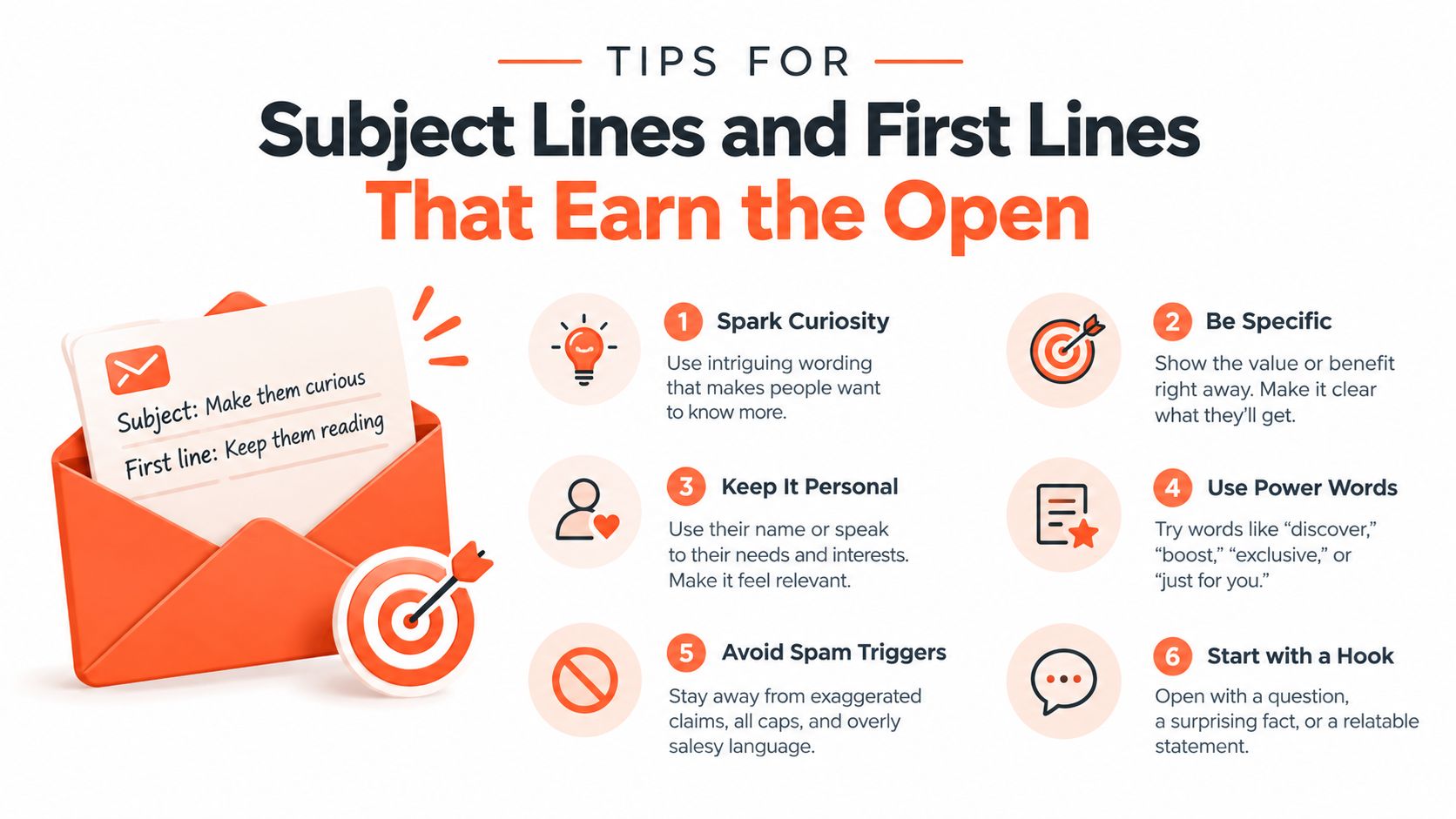
Four subject patterns work well as starting points for B2B tests:
- Observation-led: “Saw your team is hiring sales engineers”
- Pattern-interrupt question: “Is expansion slowing your outbound?”
- Lowercase brevity: “pipeline coverage”
- Specificity over cleverness: “Hiring across DACH”
The structural rule is straightforward: keep the subject short, aim for fewer than six words, and include one personal token when a real token exists. “Quick idea” is generic. “RevOps hiring” is more concrete. Wordplay often asks the recipient to decode the message before they understand why it matters.
Guidance on crafting effective sales subject lines is useful for building a test bank, but the sender still needs to judge each line against the actual audience. A subject that sounds natural for a founder may feel careless to a senior procurement leader.
Build the opening from evidence
A dependable first-line structure is:
Specific observation, plausible problem, relevant outcome.
The observation should be public and recent enough to matter. The problem is a hypothesis, not a claim that the sender knows the recipient's internal situation. The outcome should explain why the conversation could be worthwhile.
For a SaaS VP of Sales:
Saw your team is expanding into enterprise accounts. That usually creates pressure on pipeline coverage before the new reps are fully productive. Eludic helps B2B teams test outbound angles and route qualified replies into meetings.
For a marketing leader at a Series A startup:
Your recent product positioning puts a lot of weight on category education. If paid acquisition is doing most of the early lifting, outbound can test which pain points resonate with specific buyer roles before the message gets locked in.
For an operations manager at a mid-market company:
Your hiring posts mention several systems across sales and customer operations. That kind of growth often creates gaps in lead routing and response ownership, so a short review of the handoffs may uncover meetings being lost after the first reply.
The examples stay deliberately cautious. They don't claim inside knowledge, invent proof, or bury the ask under a company biography.
Before sending, remove the recipient's name and company from the draft. If the message still sounds specific, it may be ready. If the opening becomes interchangeable with any account in the list, the personalization is cosmetic. Use the guide to writing email subject lines for additional structure, but judge success by qualified replies rather than opens alone.
Personalization Beyond First Name Mail-Merge
Adding {FirstName} isn't personalization. It's formatting. Real personalization gives the recipient a reason to believe the sender understands something about the company's current context.
A practical research stack can stay lightweight:
- LinkedIn activity: Look for a post published within the last month that reveals a priority, launch, hire, or operational concern.
- Company media: Check a blog, podcast appearance, or webinar for language the team uses about its market.
- Public changes: Review a recent funding announcement or hiring pattern, but only use it when it connects to the offer.
- Customer feedback: Scan G2 or TrustRadius for recurring complaints that match the problem being addressed.
- Tool signals: Examine job posts or BuiltWith data for a public technology pattern that makes the message relevant.
The research isn't the deliverable. The line in the email is. A useful conversion formula is:
Signal + relevance + outcome.
For example, a raw signal might be “the company is hiring sales operations.” A weak version says, “Congrats on the growth.” A stronger version says:
Saw the sales operations hiring. Teams usually make that hire when routing and reporting have become too manual, so a focused outbound test may help expose where qualified replies are getting delayed.
A second example starts with a podcast appearance about entering a new market:
Your comments on entering the UK market suggest the team is still learning which buyer language travels. A small, role-specific outbound test could surface that language before the next campaign is scaled.
Both examples use the signal to establish relevance. Neither turns the research into flattery or implies surveillance.
Keep the research human
Personalization crosses into creepy territory when the detail is private, overly intimate, unrelated to the business, or presented with unnatural precision. Public doesn't automatically mean appropriate. A prospect's family information, personal location history, or obscure activity shouldn't appear in a sales email.
When nothing useful surfaces, switch to a company-level signal, role-level problem, or segment hypothesis. A clean, relevant message beats a forced reference to a stale post. The personalization at scale guide can help teams design repeatable research workflows, but no workflow can compensate for a signal that has no connection to the offer.
The best operators also store the source and date of each signal. That makes stale personalization easier to remove and gives the writer a fast fallback when a prospect's situation changes.
Sequencing and Follow-Ups That Compound Replies
Email one sets the direction, but follow-ups create the campaign's working surface. Treat each touch as a separate opportunity to test relevance, timing, and the amount of effort you ask from the reader.
A practical starting cadence is day 1, day 3 or 4, day 7 to 9, day 14, and day 28. These intervals are operating hypotheses, not universal rules. Keep the first follow-up close enough to preserve context. Widen the gaps later, and give each new interruption a clear reason.
| Touch # | Day Sent | Format | Role in the Sequence | Recommended Angle |
|---|---|---|---|---|
| 1 | 1 | Initial message | Establish relevance | Primary problem hypothesis and one CTA |
| 2 | 3 to 4 | Pure bump | Recover attention | Short reminder with no new demand |
| 3 | 7 to 9 | New hook | Test a different reason to care | Different pain or trigger |
| 4 | 14 | Value asset | Earn attention without a meeting ask | Useful observation, checklist, or example |
| 5 | 28 | Soft breakup | Close the loop respectfully | Leave the door open |
The sequence should rotate angles, not repeat the same pitch with new timestamps. A pure bump can be one sentence. A new hook changes the business problem or introduces a relevant trigger. A value asset offers something useful without making the reader accept a call. A soft breakup gives them an easy way to decline and protects the relationship.
Keep the CTA disciplined. Ask for one action in each email, and make the request match the touch. Early messages can ask whether the problem is relevant. A later value-led email can offer the asset first. The breakup can ask whether the topic belongs with someone else or should be closed.
The data-driven ways to improve cold email response rates reports that its cited analysis found a first follow-up increased B2B response rates by 50%, while advanced personalization produced a 142% reply-rate lift. Those figures depend on the source methodology, so use them as directional evidence rather than promises. The practical takeaway is to give follow-ups a distinct job instead of treating them as automatic reminders.
Follow-ups should add context, not pressure.
Set stopping rules before launch. Remove non-openers from the active path after touch three when the available engagement signal supports that choice. Stop immediately after an unsubscribe or clear negative reply. Review bounces, spam complaints, and delivery problems before increasing volume. Persistence without relevance damages list quality and makes later campaigns harder to deliver.
Testing Angles Without a Research Team
A small team doesn't need a research department to test messaging. It needs a clear hypothesis, one clean variable, and enough structure to avoid drawing conclusions from noise.
The test design should start with the commercial question:
- Pain angle: Does the prospect care about the operational problem?
- Trigger angle: Does a recent company change make the offer timely?
- Social-proof angle: Does evidence from a comparable context reduce uncertainty?
Choose one angle, then write two versions that differ only in the opening hook and CTA. Split the cold list evenly. The plan notes recommend 200 prospects per cell, but that number is an experimental design requirement, not a verified market statistic. The verified data does not establish a universal sample size, so teams should use it as a practical starting point and avoid claiming certainty from a tiny send.
Subject tests produce faster signals because more recipients see the subject, while body and CTA tests are slower and commercially more meaningful. Don't change the subject, opening, offer, and CTA in the same run. If the result improves, nobody will know which decision caused it.
A two-hour test workflow
- Write the hypothesis: “A trigger-led opening will earn more positive replies from recently funded SaaS companies than a generic efficiency hook.”
- Hold the audience steady: Use one segment, one sender setup, and the same schedule.
- Change one variable: Keep the body stable except for the opening and CTA under test.
- Log the outcome: Record sample, open rate, reply rate, positive reply rate, and meeting rate.
- Choose a next action: Keep the stronger angle, rerun it with a new segment, or discard both if quality is poor.
The sheet should also include the campaign name, send window, bounce rate, unsubscribe count, and a short note about reply quality. A winning reply rate with irrelevant responses isn't a win.
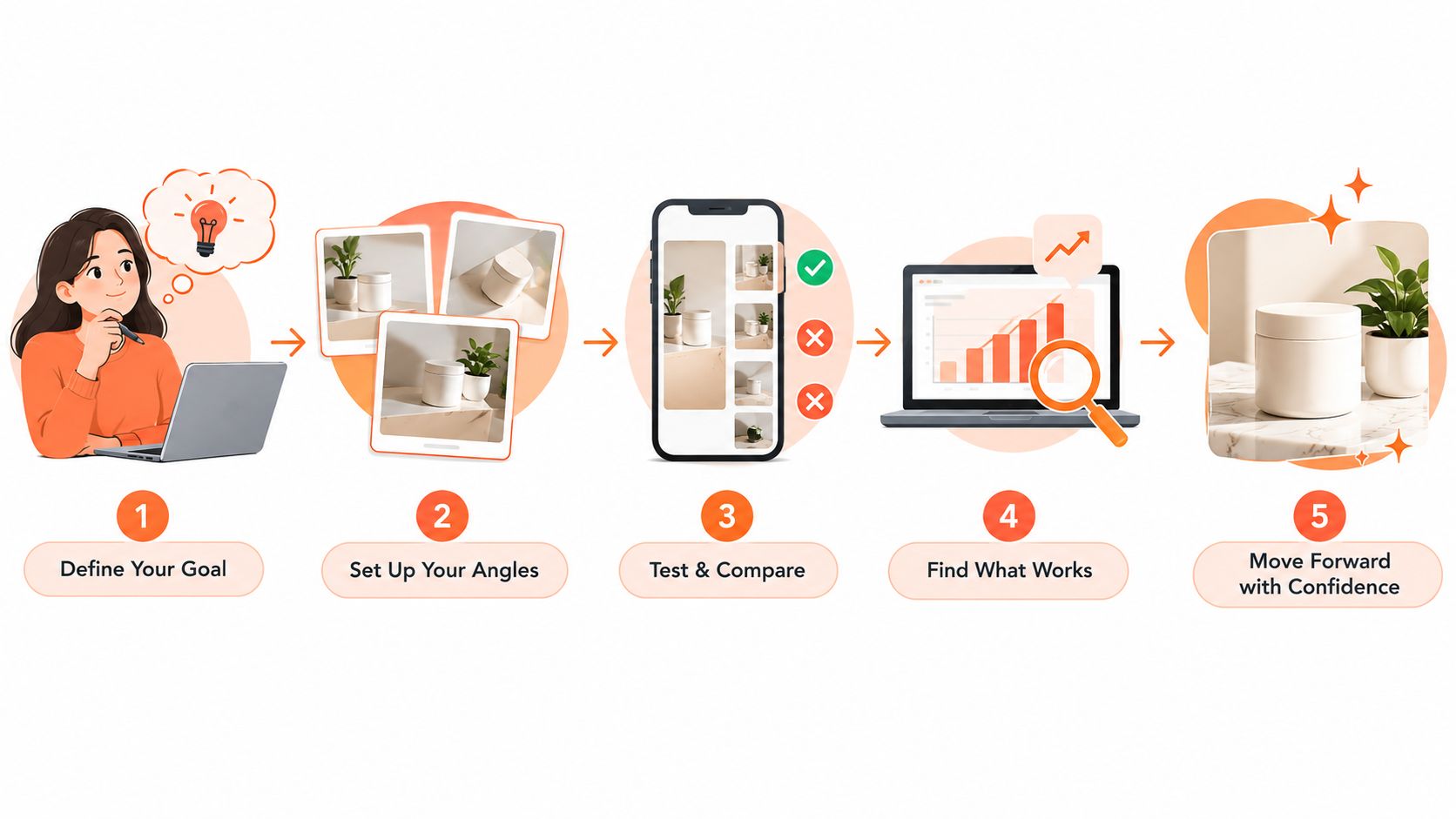
The operating rhythm matters more than a complicated testing framework. A founder can run a clean angle test, review the replies, and use the wording from serious prospects in the next draft. Six to eight tests per quarter is a planning cadence from the brief, not a verified performance fact. Its value is consistency, not the promise of a specific lift.
Reply Handling and Booking the Meeting
A reply isn't a meeting. It's a fragile signal that can disappear if the sender responds slowly, answers the wrong question, or makes scheduling harder than necessary.
The first task is triage. Within the first hour, separate positive intent, an objection, a referral, and an unsubscribe. Each category needs a different response. A positive reply deserves a direct next step. An objection needs a useful answer. A referral should move to the correct contact without restarting the entire pitch. An unsubscribe needs confirmation and a permanent stop.
Positive replies should receive a short answer that reflects the prospect's words. Then offer two concrete slots, along with a calendar link as a fallback. A calendar page with too many empty choices creates another decision. Two proposed times reduce the negotiation loop.
Booking rule: Make the next action easier than writing a second explanatory email.
Common stalls need simple handling:
- “Send me more info.” “Happy to. The relevant part is how the program targets your buyer roles and handles replies. Would Tuesday or Wednesday suit a short discussion after you've reviewed that?”
- “Talk to my boss.” “That makes sense. Would it help to include them in a short conversation, or should the message go directly to the person responsible for outbound pipeline?”
- “Not now.” “Understood. Is there a month or business trigger that would make this more relevant, so the follow-up can stop until then?”
When the fit is wrong, disqualify politely in one sentence: “Thanks for clarifying. This isn't a fit for the current use case, so the contact will be removed from the sequence.” That protects sender reputation, respects the recipient, and prevents a weak lead from consuming sales time.
Measure time to reply, positive-reply-to-meeting rate, and meeting show rate. Opens and total replies diagnose attention, but attended qualified meetings are closer to the pipeline outcome.
Your 30-Day Cold Email Action Plan
A cold email program becomes manageable when each week has one deliverable and one decision rule. The first month shouldn't aim to prove a grand theory. It should establish a clean baseline, expose the weakest link, and create a repeatable operating loop.
Week one builds the foundation
Define the ICP in terms of company situation, buyer role, trigger, and exclusion criteria. Pull a focused list of 200 prospects, authenticate the sending domains, and write three angle drafts. The list size is an execution target from the brief, not a verified benchmark.
The deliverable is a launch-ready campaign brief. Track list completeness, role fit, bounce risk, and whether every prospect has a usable signal. Pivot before sending if the list relies on vague job titles or stale research.
Week two establishes the baseline
Launch the first sequence with one clear CTA and record open rate, total reply rate, positive reply rate, and reply category. Log every response manually or through a workflow, including out-of-office messages and opt-outs.
The deliverable is a baseline report by segment and sequence step. Pivot if replies are irrelevant, negative feedback rises, or deliverability signals deteriorate. Don't rewrite the entire campaign because of one quiet day.
Week three improves one variable
Retire the weakest subject line only after comparing it within the same audience and send setup. Change one body variable, such as the opening hook, problem framing, or CTA, while preserving the rest of the sequence.
Review cumulative data rather than reacting to the first few sends. The pivot threshold is qualitative: if one angle consistently attracts the wrong role or fails to create positive intent, replace the angle. If the subject earns attention but the body earns no useful replies, leave the subject alone and fix the offer or hook.
Week four converts interest
Tighten reply routing, assign ownership, and add the calendar link to the third touch if earlier messages created interest but scheduling stalled. Set a target for booked meetings per 100 prospects, then compare that target with the actual positive-reply-to-meeting rate and show rate instead of treating booked calls as equally valuable.
The deliverable is a meeting-conversion report. Pivot when qualified replies aren't becoming attended conversations because the problem may be response speed, scheduling friction, or poor qualification rather than copy.
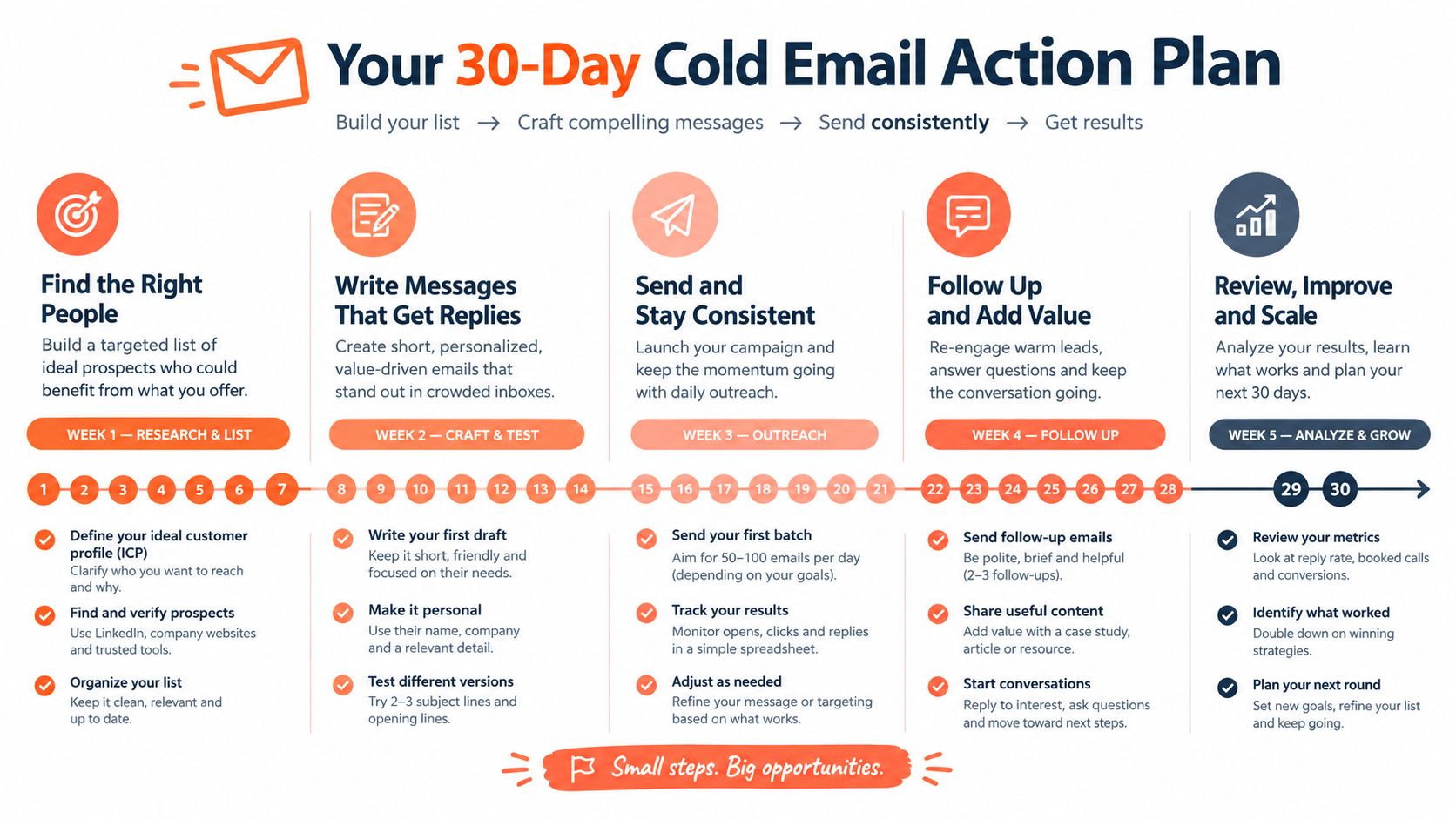
Before scaling in month two, refresh the list, test a new hook, review bounce and unsubscribe rates, and confirm that authentication and reply handling are still working. The next volume increase should follow evidence of list quality and positive conversation quality, not excitement about a headline reply rate.
Eludic designs, launches, and optimises done-for-you B2B cold email programs, including infrastructure, deliverability monitoring, personalised copy, angle testing, reply handling, and meeting booking. Visit Eludic to see how a managed outbound program can turn the playbook into qualified conversations without adding an SDR workflow to the team.