

A new sales rep can spend a Monday morning doing everything right and still never reach the buyer. The rep finds the company's main number, calls with a clear reason, and gets routed through an auto-attendant that asks for an extension, a department, or a name the caller doesn't know. After several transfers, the conversation has become a queue-management exercise instead of a sales conversation.
That frustration explains the demand for direct phone numbers. A direct line can route a call toward one person or one endpoint without forcing the caller through the company's front door. But a number that exists in a database isn't automatically reachable, trusted, current, or lawful to use. The useful question isn't only, “Where can the team find a number?” It's, “What makes that number a reliable path to the right person?”
Why Everyone in Sales Is Chasing a Direct Line
The rep's first call reaches the receptionist. The second call reaches an automated menu. The third call ends with a voicemail box that gives no clue whether the prospect still works there. Each attempt consumes time, but the larger cost is momentum. The rep begins the eventual conversation feeling as though the company has already created a barrier.
A direct line changes the starting point. Instead of calling the building's front desk, the rep calls a route associated with a person, desk, mobile device, or softphone user. That doesn't guarantee an answer, but it removes one avoidable layer between the sales team and the intended contact.
Practical rule: A direct number should reduce routing friction, not eliminate judgment about whether the call is appropriate.
Sales operations teams often treat this as a contact-data issue. It's also a workflow issue. A rep who spends less time searching for departments and extensions can spend more time preparing a relevant reason for the call. The same logic applies to territory design and account research. A market map that identifies the right company and decision-maker still needs a dependable communication path, which is why market mapping and phone-data governance belong in the same operating conversation.
The main line still has a legitimate role. It may be the best route for a new supplier, a support request, or a call where the correct department is unknown. A direct number becomes valuable when the sales team already knows the intended person and wants to avoid unnecessary routing.
The catch is that directness is only the first layer. The number must be structured correctly, assigned to the intended endpoint, recognized by carriers, and handled in a way that gives the recipient a reason to trust the call. Without those safeguards, a direct number may readily create a faster route to voicemail, blocking, or a complaint.
What a Direct Phone Number Actually Is
A direct phone number is a number that routes toward a specific endpoint instead of a shared company switchboard. That endpoint might be a desk phone, a mobile handset, or a softphone account inside a business communications system.
The simplest analogy is a building. The company's main number is the front desk. A toll-free number is a convenient public entrance that may still lead to a menu or queue. An auto-attendant is the receptionist's directory. A direct number is a labeled mailbox or room connection associated with one person or function.
The routing technology underneath can vary. A PBX may use a Direct Inward Dialing, or DID, number that sends an incoming call to a particular extension without requiring the caller to move through the main menu. A mobile number may connect directly to an employee's handset. A cloud phone system may route the number to an application, a browser, several devices, or a backup destination. In each case, “direct” describes the call's behavior, not the hardware carrying it.
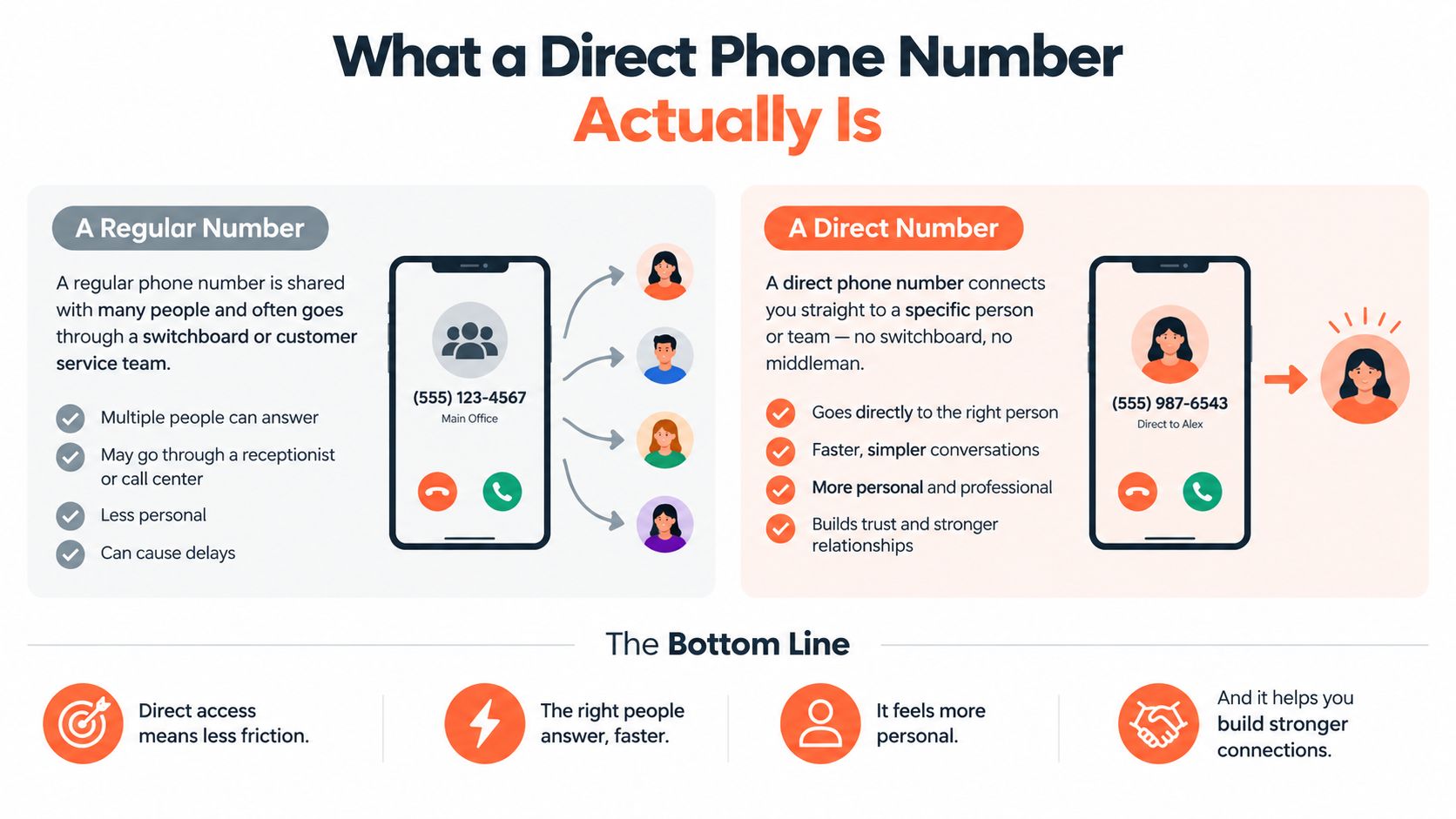
The routing distinction
A number can be direct even when it isn't a private mobile line. Conversely, a mobile number can stop being a useful direct route if it has been reassigned, disconnected, screened, or attached to the wrong person.
| Number type | Typical route | Best understood as |
|---|---|---|
| Main business number | Switchboard, receptionist, or menu | The company's front door |
| Toll-free number | Public service or sales route | A broad access channel |
| DID number | A specific extension or user | A direct route inside a phone system |
| Mobile number | A handset or mobile service | A personal or work endpoint |
| Softphone number | Cloud application or browser | A software-based endpoint |
Direct numbers can be local, national, or international. Their usefulness depends less on the label and more on whether the route still belongs to the intended person or team. A direct route can remain reachable while the main line is busy, but it can also fail for reasons that a basic contact database won't show.
That distinction matters for sales reps. “The record has a phone number” describes the presence of a value. “The rep has a direct, current, trusted route to the right person” describes an operating outcome.
The Global Numbering System Behind Every Direct Line
A phone number isn't an arbitrary string created by a sales database. It sits inside a coordinated international numbering framework. The International Telecommunication Union's E.164 numbering recommendation defines the structure and functionality of numbers used for international public telecommunications.
E.164 numbers can contain a maximum of 15 digits, excluding the international dialing prefix. A geographic number generally combines a country code, a national destination or area code, and a subscriber number. This hierarchy allows carriers to identify the country and routing region before directing the call toward the assigned endpoint.
An example can make the layers easier to follow:
| Component | Purpose | Example (+1-415-555-0142) |
|---|---|---|
| Country code | Identifies the national numbering plan | +1 |
| National destination or area code | Identifies a geographic or routing region | 415 |
| Subscriber number | Identifies the assigned endpoint within that region | 555-0142 |
The example is useful as a structural illustration, not as proof that a particular person or company owns the number. Teams handling international calls to the US can use the same hierarchy to understand why an international format differs from the way a local number appears on a screen.
Why the hierarchy matters
The structure supports more than dialing. Systems use it when they normalize records, validate formats, display caller ID, store call records, connect carriers, and manage portability between providers. A CRM that strips away the country code may create ambiguity. A dialer that stores too many or too few digits may fail to route the call correctly.
Numbering also involves several layers of allocation. Regulators and numbering authorities coordinate national plans, carriers receive number blocks, and communications providers assign individual numbers or routing destinations to customers. The exact commercial arrangement differs by market, but the result is the same. A direct number is an addressable endpoint inside a shared telecommunications space.
That framing prevents a common mistake. A data vendor can return a syntactically valid number, but validity only means the digits fit a recognizable pattern. It doesn't establish current ownership, consent, answer behavior, or caller trust. The numbering layer explains where a call can go. Operational governance determines whether the call should be made and whether anyone is likely to accept it.
Trust Is the Barrier That Decides Whether a Direct Line Answers
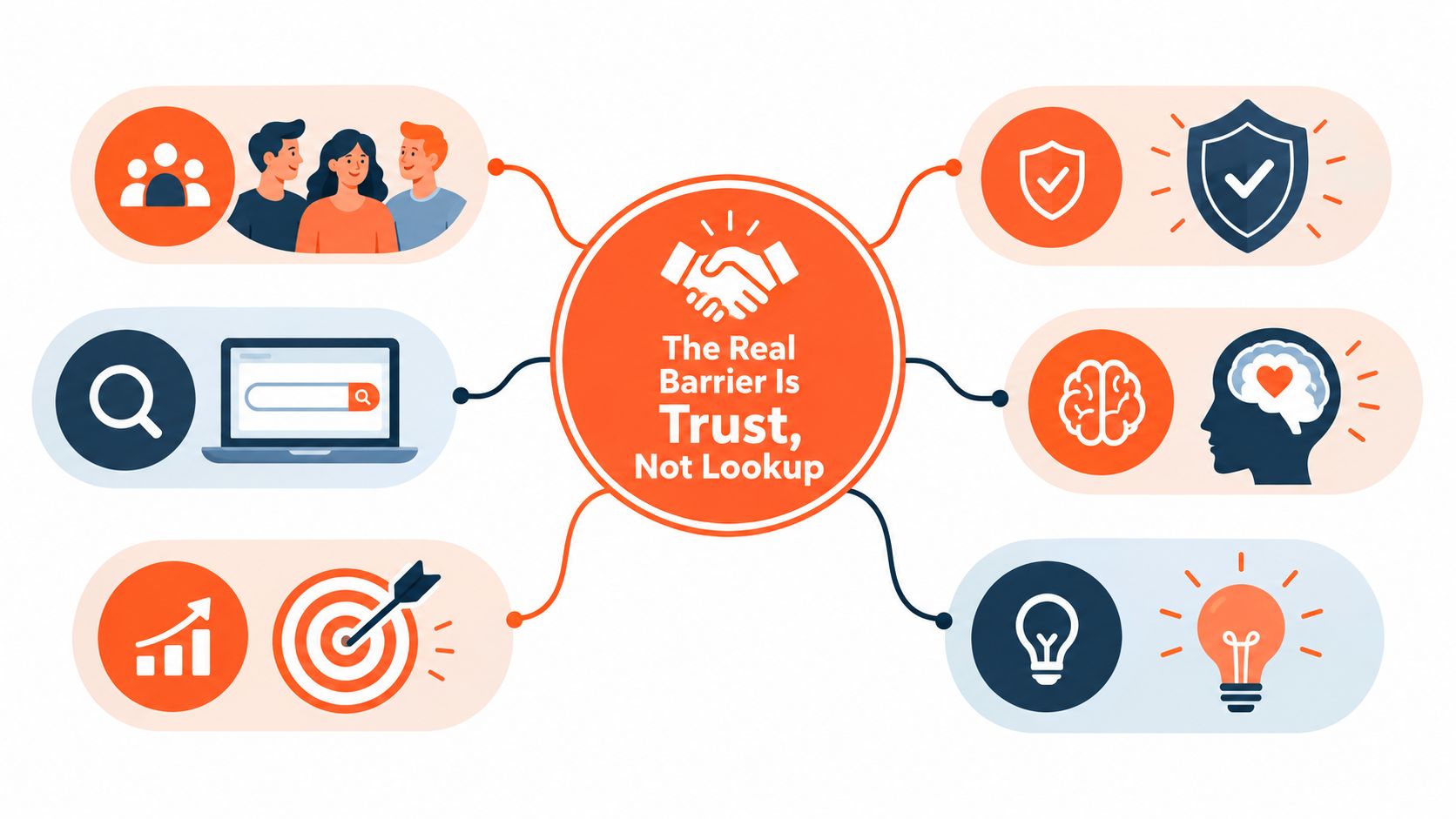
A rep receives a number marked direct and verified. The call goes to voicemail, triggers a spam warning, or never reaches the recipient because the carrier blocks it. The lookup produced a valid result, yet the sales conversation never began. That outcome reflects the number's full lifecycle, including how it was assigned, authenticated, used, and governed.
Recipients have strong reasons to screen unfamiliar calls. Google's 2025 Phone Scam Report found that 40% of Americans receive multiple calls from unknown numbers daily, 83% expect an unknown-number call to be unwanted, and 53% report receiving at least one scam call per day. The report also estimates 2.56 billion robocalls per month in the United States from January through September 2025, compared with 2.14 billion per month in 2024.
A direct number therefore needs to do more than route a call to a handset. It must support a recognizable, credible business identity at the moment the recipient decides whether to answer.
Three trust signals
Caller ID reputation is the first signal. In the United States, the FCC's explanation of STIR/SHAKEN caller-ID authentication describes a cryptographic framework that lets participating providers verify caller-ID information as calls move across IP networks. Providers can assign A, B, or C attestation based on how strongly they can validate the caller's relationship to the number. The FCC reports that the framework can authenticate caller-ID information at nearly 100% rates within participating networks when deployed as designed.
Authentication confirms the relationship between a caller and its displayed number. It does not confirm that the conversation is legitimate or guarantee delivery. Carriers also assess traffic patterns, complaints, and other analytics. A properly authorized number gives the organization a stronger technical foundation than a number merely asserted by an unverified service.
Usage history shapes the next signal. A newly provisioned VoIP number, a recently ported number, or a number previously used by another organization may have little useful reputation. The digits can be valid while recipient systems associate them with unwanted traffic or an inconsistent identity.
Consent context completes the picture. A number published for customer support does not automatically indicate permission for unrelated sales outreach. A number shared directly by a prospect, listed for business development, or supplied through a consent-based process gives the team a clearer reason to call. Trust starts before the dialer runs.
Lawful Ways to Find and Verify Direct Phone Numbers
A careful sales operations team starts with the source closest to the person. First-party information usually gives the clearest business context because the company or employee chose to publish it.
Useful starting points include:
- Company pages: A leadership page, department directory, or contact page may publish a business route for a defined purpose.
- Employee-provided details: An email signature, business card, conference introduction, or verified professional profile can indicate that the person expects business communication.
- Reciprocal networks: A partner, customer, association, or event organizer may provide a contact route under stated participation terms.
- Consent-based providers: A vendor may supply phone data under contractual terms that describe collection, permission, suppression, and update processes.
A provider's words need careful interpretation. “Opt-in” should identify what the person agreed to receive, through which channel, and for what kind of sender. “DNC scrubbed” should identify the relevant geography, the update process, and what happens when a person later opts out. Those labels aren't substitutes for a documented compliance process.
Teams that need to enrich leads with phone data should evaluate the provider's provenance and controls alongside the field-level output. The same discipline applies to data enrichment generally. More fields don't necessarily create better outreach if the team can't explain why a record is current and appropriate to use.
Source comparison
| Source | Consent basis | Compliance risk | Typical yield |
|---|---|---|---|
| Company website | Public business context | Lower, if used for the stated purpose | Selective |
| Employee signature or shared contact | Direct business context | Lower, subject to local rules and purpose | Targeted |
| Conference or partner list | Participation-based context | Moderate, depends on terms | Targeted |
| Contracted consent-based provider | Vendor-documented process | Depends on contract and controls | Broad |
| Scraped directory | Often unclear | High | Unpredictable |
| Purchased bulk list | Frequently unclear or stale | High | Broad but uneven |
| Unverified lookup API | Often unclear | High | Variable |
A line check can add operational confidence. An LRN lookup can help identify the routing carrier, while an HLR-style check can indicate whether a mobile line is active and associated with an expected country or network. Neither check proves that the intended person owns the line or consents to a call. They verify technical conditions, not human identity.
Scraping and bulk purchasing create a tempting shortcut because the output arrives quickly. They can also introduce inaccurate ownership, stale consent, and restrictions that the sales team never sees. A responsible team treats those records as review items, not automatic dialing permission.
Keeping a Direct Number Usable Over Time
A direct number behaves like a living business asset. Its quality can change after a provider switch, employee departure, reassignment, complaint, or change in calling pattern. Verification at the moment of collection is useful, but it doesn't freeze the record in time.
Two technical checks often appear in a maintenance workflow. An LRN check helps identify the carrier responsible for routing. An HLR-style check can help confirm whether a mobile line appears active in the expected network context. Those signals help remove obvious failures, but they don't answer the more important question: does the number still belong to the intended contact?
Portability complicates the record. U.S. customers can retain numbers when changing providers, so the carrier associated with a number may change while the digits stay the same. A CRM that treats the original carrier as permanent can misclassify a valid line. A recently ported number can also create temporary confusion in caller-ID and routing systems.
The authentication and answer layer
In the United States, STIR/SHAKEN gives carriers a way to authenticate caller-ID information, but authentication isn't a complete reputation system. Calling teams should keep ownership records accurate, use a provider that signs calls, monitor spam labels, and retire numbers that consistently produce poor engagement or complaint signals.
Answer behavior provides another feedback loop. Twilio's Voice Insights documentation defines answer-seizure rate, or ASR, as the share of calls answered by a person or voicemail and identifies 70% or higher as a good benchmark. The documentation also treats a high share of calls lasting fewer than six seconds as a warning signal, because those calls may have been rejected, abandoned, or misclassified.
Teams should separate human answers from voicemail answers rather than treating both as conversations. A falling ASR alongside rising blocking or short-call activity suggests that the number's reputation or calling pattern needs investigation.
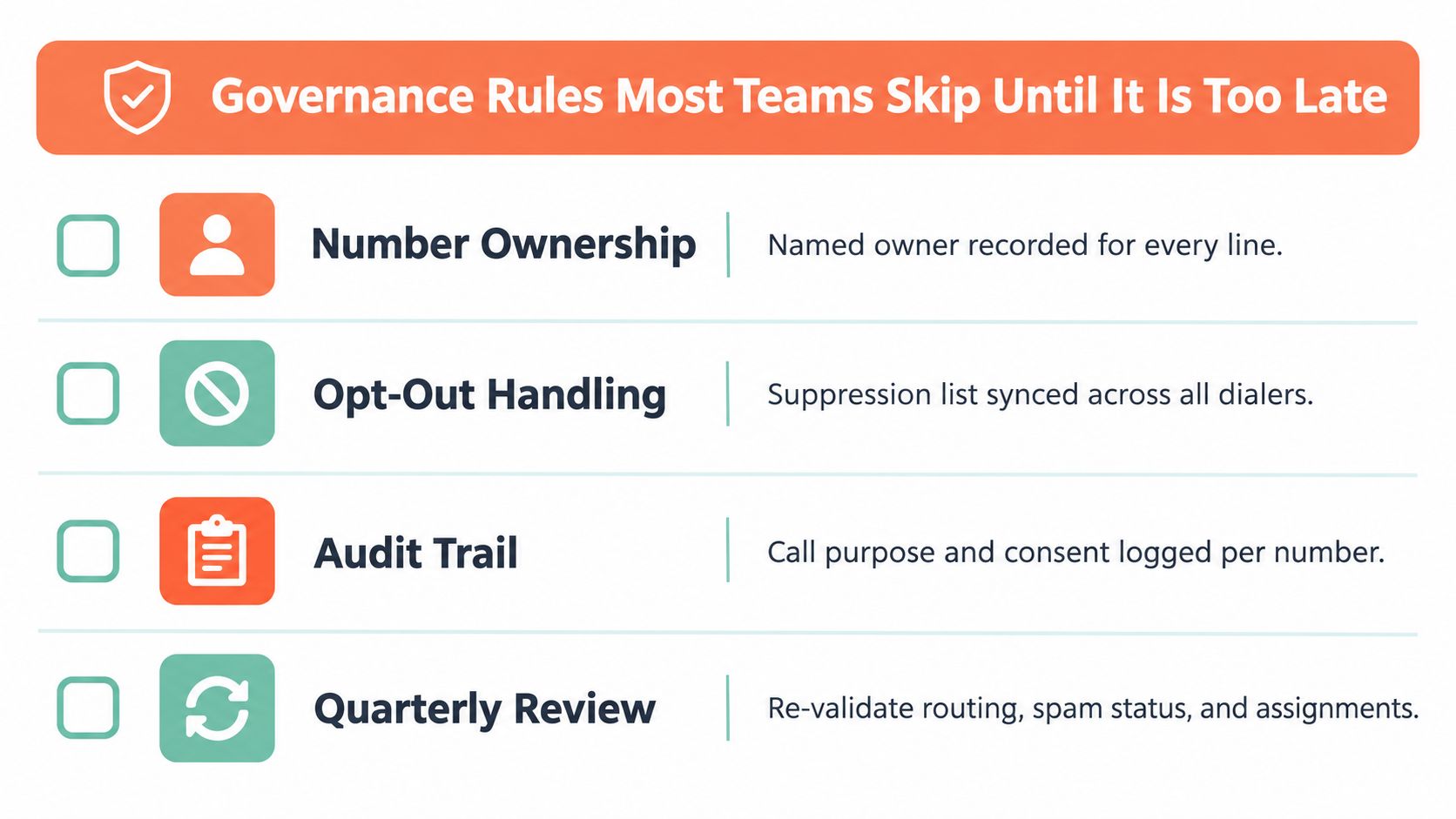
A useful operating record includes the number owner, source, verification date, carrier or routing changes, consent status, opt-outs, campaign assignment, and retirement reason. That record turns a number from a static spreadsheet value into something the team can monitor and govern.
Governance Rules Most Teams Skip Until It Is Too Late
Governance sounds administrative until a former employee's number reaches a new owner, a prospect opts out in one tool but not another, or a caller ID begins displaying a spam label. At that point, the absence of a simple process becomes a deliverability and compliance problem.
A practical governance loop assigns responsibility at the record level.
- Name the owner. Every direct number should have an accountable person or team, along with the department and business purpose.
- Record the source. The CRM should preserve where the number came from and when the team last verified it.
- Log status changes. Provider changes, employee departures, porting events, and suspected reassignment should trigger review.
- Synchronize suppression. An opt-out should reach the CRM, dialer, messaging platform, and any connected automation.
- Review call signals. Human answers, voicemail, short calls, blocks, complaints, and spam labels should influence whether the number remains active.
- Define retirement. A number with uncertain ownership or persistent negative treatment should be suppressed until revalidated or removed.
The FTC's fiscal year 2025 report records more than 2.6 million Do Not Call complaints and over 258 million active registrations in the National Do Not Call Registry. Those figures demonstrate the scale of consumer preference and complaint handling, but they don't replace market-specific legal review.
A suppression list is not a spreadsheet. It is a control that must travel with the contact record.
Reassignment checks deserve special attention. A number can be accurate when collected and unsafe later because another person now controls it. U.S. processes distinguish ported numbers from abandoned numbers, and teams should investigate the applicable reassignment resources and carrier guidance before reactivating stale records.
Governance should also cover caller-ID presentation. Rotating numbers merely to evade reputation signals is not a substitute for responsible calling. A better approach is to use authorized numbers consistently, identify the business truthfully, leave a clear voicemail, respect quiet hours and local restrictions, and stop calling when the recipient requests it. Consent management belongs in the operating workflow, which is why consent management should connect directly to dialing and suppression systems rather than sit in a separate policy folder.
Putting It All Together
A direct phone number has three identities at once. At the telecom layer, it is an addressable endpoint within the E.164 numbering system. At the human layer, it is a caller-ID signal that can invite confidence or trigger screening. At the operational layer, it is a record with an owner, source, consent context, verification history, and retirement path.
That combination changes how sales teams should evaluate phone data. A technically valid number may not belong to the intended person. A current number may not carry enough caller trust to earn an answer. An authenticated call may still be inappropriate if the recipient never agreed to that kind of outreach.
The strongest workflow treats each number as a living asset:
- confirm the route and format,
- document the source and ownership,
- verify the intended business context,
- use carrier-supported caller-ID authentication,
- monitor answer and blocking signals,
- synchronize opt-outs,
- revalidate after role or provider changes,
- retire the record when ownership or permission becomes uncertain.
A team that can run this loop for one direct number can apply the same discipline across a larger account list. The advantage doesn't come from collecting the most phone numbers. It comes from maintaining the smallest set of numbers that the team can explain, authenticate, and use responsibly.
Eludic helps B2B teams build and operate outbound programs with researched audiences, personalised copy, deliverability monitoring, reply handling, and qualified meeting booking managed end to end. Teams that want a compliant outbound system without adding SDR headcount can visit Eludic to review the service and start with an initial brief.