

Even authenticated mail still lands in spam more than 30% of the time, according to the latest benchmark data, which is why email deliverability optimization can't be treated like a DNS checklist. A 2026 benchmark report found that global inbox placement averaged 87.2% in 2025, while Microsoft sat at 75.6% and Gmail at 89.8%. Those gaps make the point clearly, deliverability is an operating discipline built on reputation, engagement, list quality, and measurement, not just SPF, DKIM, and DMARC. Eludic's deliverability overview is a useful starting point for the broader concept, and a solid subject line resource like AI subject line prompts can help with testing when the copy itself needs a stronger opening.
Why Inbox Placement Is Harder Than It Looks
At 87.2%, the 2025 global inbox placement rate still left a meaningful share of legitimate email outside the inbox, according to Validity's 2026 benchmark report. Authentication establishes sender identity, yet mailbox providers also judge whether recipients engage with the messages. Inbox placement depends on the full sending operation.
Behavioral filters
Mailbox providers evaluate recipient behavior over time. Opens, replies, deletions, complaints, bounces, and sending consistency all influence whether a domain appears wanted or ignored. A sender can have correct DNS records and still develop a poor reputation if recipients repeatedly dismiss or report its mail.
Practical rule: an authenticated domain that recipients ignore can still be classified as a low-value sender.
Operators need several working levers rather than a single fix. Authentication protects identity. Warm-up builds a history of consistent sending. List hygiene limits reputation damage. Relevant content supports engagement. Monitoring shows when performance starts to deteriorate.
| Sender Setup | Avg Inbox Placement | Avg Spam Folder | Avg Missing |
|---|---|---|---|
| Baseline benchmark view | 87.2% | not stated | about 12.8% |
| Gmail in 2025 | 89.8% | not stated | not stated |
| Microsoft in 2025 | 75.6% | not stated | not stated |
Provider differences make aggregate delivery counts unreliable. Gmail and Microsoft can produce materially different outcomes for the same program, so cold email operators should test placement by provider instead of treating accepted messages as inboxed messages. A placement tool exposes that distinction more clearly than a dashboard showing only sent and delivered totals.
What a practical operating model looks like
A workable program follows a sequence: authenticate the sending infrastructure, ramp volume gradually, remove risky or inactive contacts, write for a specific audience, and review placement continuously. Server acceptance confirms transfer, not inbox visibility. Teams that stop at acceptance miss the signal that governs future reputation.
For outbound teams, Eludic's email deliverability overview provides useful context for the broader discipline. Copy testing can also support controlled experiments, and AI subject line prompts can help generate opening-line variations for testing. Neither resource repairs weak list quality or poor engagement. The send pattern, audience response, and reputation must support the promise made by the message.
Authentication answers one question: is this domain authorized to send? It does not show that recipients are engaged, the cadence is controlled, or the content is wanted. An authenticated domain can still earn poor placement when recipients ignore messages, mark them as spam, or receive volume that exceeds the sender's established reputation.
Where authentication fits in the stack
Treat authentication as a trust floor. An outbound program should not scale until these records are configured and aligned, yet DNS work alone cannot carry inbox placement. Reputation and engagement begin shaping results after authentication passes. Operators need placement checks, complaint monitoring, bounce analysis, and response trends to see whether authenticated mail is reaching useful inboxes.
For protocol details, Eludic's email authentication guide offers a focused reference. Use it to verify the setup, then measure what recipients do with the messages. Authentication gets the sender recognized. Ongoing operating discipline determines whether providers keep trusting the traffic.
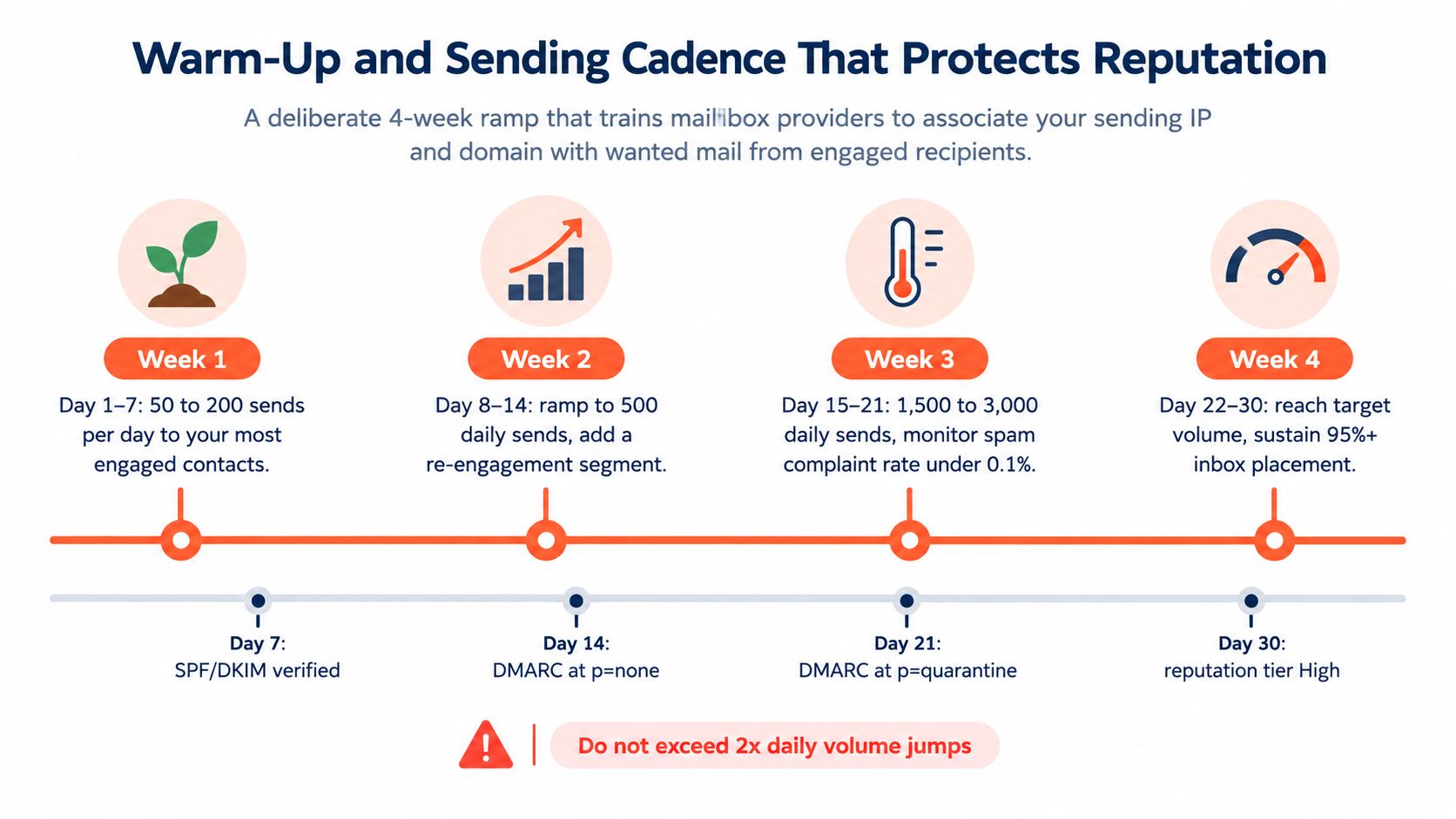
Warm-Up and Sending Cadence That Protect Reputation
Warm-up is how a sender teaches mailbox providers that new volume is still wanted volume. The mistake many teams make is treating warm-up like a short technical chore instead of a reputation-building phase. That's how a domain gets burned before the program ever stabilizes.
A ramp that doesn't trip filters
A new sending domain needs gradual volume, not a dramatic launch. A practical ramp starts with low daily sends to engaged contacts, then increases as complaint and bounce behavior stay clean. The exact pace varies by list quality and provider mix, but the principle stays fixed, don't spike volume faster than the reputation can absorb.
A workable sequence looks like this:
- Week 1: send only to the most engaged recipients.
- Weeks 2 and 3: increase volume gradually and include a light re-engagement segment.
- Week 4: reach target volume only if placement and complaints are stable.
- Every day: spread sends across business hours in the recipient's timezone.
Warm-up tools such as Mailreach, Instantly, and Lemwarm can help simulate early engagement, but human-to-human replies matter more than bot-only patterns. A real reply, a natural back-and-forth, and normal inbox behavior all create stronger positive signals than a scripted exchange.
Keep the ramp boring. Boring sends are usually healthy sends.
Cadence rules that keep a domain alive
Bursts are the enemy. One campaign should never dump a huge volume of new contacts onto a young domain in a single push, and multiple sending inboxes should split risk rather than concentrate it. That matters even more for cold outbound, where reply quality and complaint sensitivity are both high.
For a warm domain, maintenance shouldn't be a fixed number, it should follow the size of the active, recently engaged list. If that list shrinks, volume should shrink with it. If engagement weakens, the send strategy should slow down before reputation drops into recovery mode.
Eludic's warm-up guide fits naturally here for teams that want a practical domain ramp framework. The main thing to remember is simple, volume should follow trust, not force it.
List Hygiene and Audience Quality Controls
Bad lists destroy good infrastructure. A campaign can have clean authentication, decent copy, and a sensible cadence, then still hit a wall because the audience itself is stale, role-based, or full of dead addresses. Deliverability operators don't wait for post-send cleanup, they suppress problems before the send goes out.
What should get suppressed immediately
Hard bounces should come off the active list right away. Role-based addresses like info@ and support@ are weak targets for cold outreach and often behave like shared inboxes, which makes engagement hard to interpret. Disposable domains and known risky addresses should be filtered before they ever enter the send queue.
Engagement tiers help separate live prospects from dead weight. Contacts that haven't interacted for a long stretch should move into a sunset flow, and older records should get purged unless they've converted through another channel. That keeps the main list responsive instead of inflated.
| Engagement Signal | Threshold | Action |
|---|---|---|
| Hard bounce | Any instance | Suppress immediately |
| Role account | Any instance | Exclude from cold sends |
| Spam complaint | Any instance | Suppress immediately |
| Inactive contact | 180+ days | Move to sunset flow |
| Stale contact | 365+ days | Purge unless converted elsewhere |
Re-engagement should be short and deliberate. A three-email arc over roughly 10 to 14 days is enough to test whether the subscriber is still alive. If there's no response, the address should exit the active pool instead of lingering as dead weight.
Why purchased lists wreck the math
Purchased lists fail for two reasons. They carry low-quality or obsolete data, and they come with no meaningful engagement history. That combination tends to create a fast rise in bounces, complaints, and spam-trap exposure, which is usually enough to poison the sender's reputation within a short cycle.
For teams building B2B programs, the rule is simple. If the address hasn't earned its way onto the list, it shouldn't be on the list. Clean suppression is cheaper than reputation recovery every time.
Content and Personalization That Earn Engagement
Mailbox providers don't care whether the copy is clever. They care whether recipients act like the mail was expected. Opens, replies, moves, and clicks matter because they signal that the message was wanted, while deletions and spam complaints tell the opposite story.
What the filters respond to
The strongest cold email usually looks ordinary. Subject lines stay short, body copy stays tight, and the message gives the recipient one clear reason to respond. Personalization should point to a real trigger, such as a funding event, a new hire, or a role change, not just a first name merge tag pasted into a template.
A few content patterns tend to hold up better than flashy templates:
- Short subject lines: under 8 words keeps the opening clean.
- Tight bodies: under 120 words avoids the feeling of a mass blast.
- One CTA: one response path is easier to process than several.
- Plain text variants: often outperform design-heavy templates in B2B sends.
Image-heavy layouts, URL shorteners, and packed trigger words in the opening lines can all create unnecessary friction. They don't guarantee spam placement on their own, but they raise the odds that the message gets treated like low-quality bulk.
A better personalization standard
Real personalization is about relevance, not decoration. A first line that references a concrete event or context will usually outperform a line that only inserts a name. That's because the mailbox provider sees the engagement pattern later, and the recipient sees the relevance immediately.
For teams refining outbound sequences, a guide to converting leads can be useful if the copy needs to connect personalization to funnel movement. The central rule still holds, engagement is engineered through relevance, not emojis.
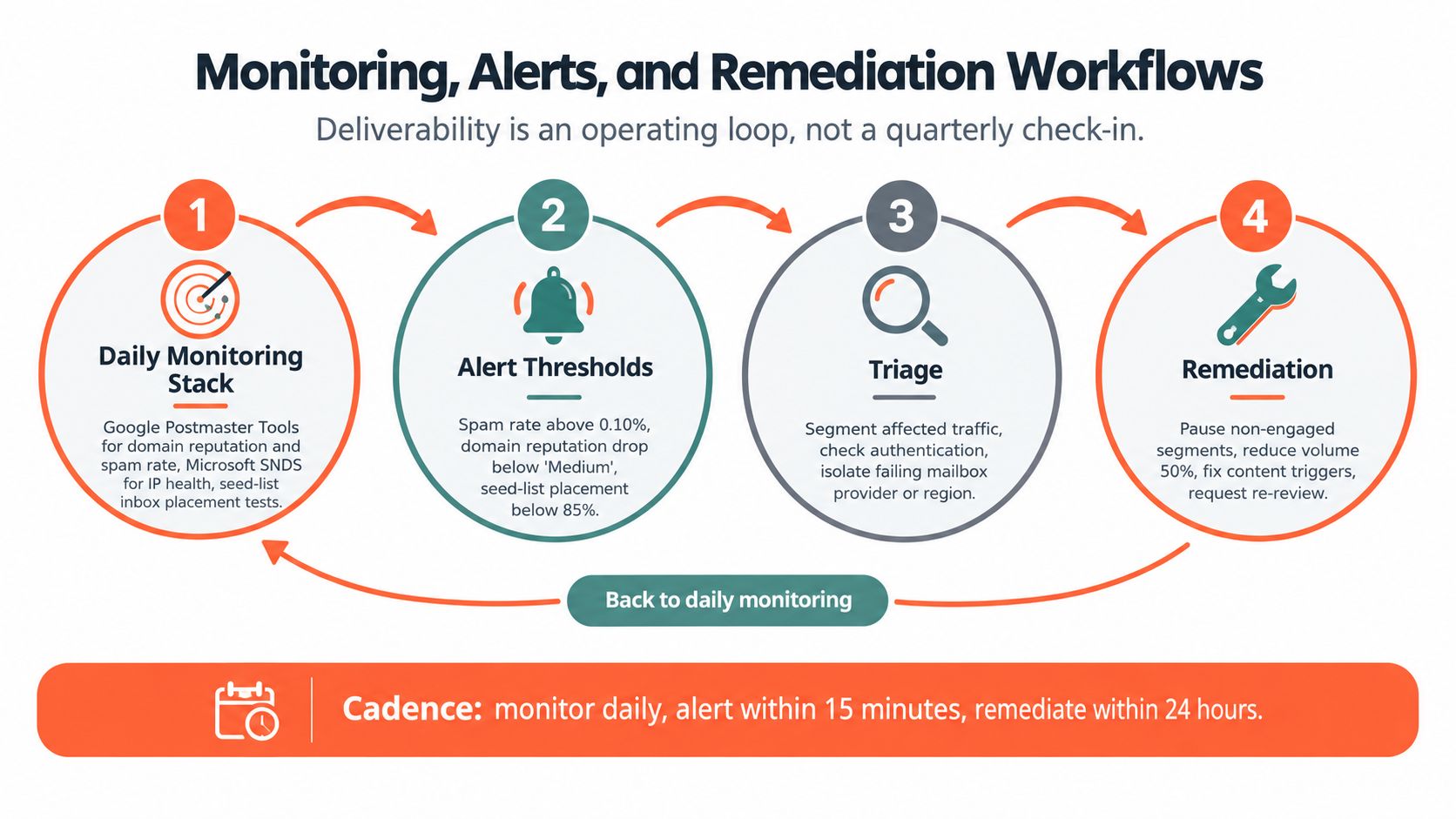
Monitoring, Alerts, and Remediation Workflows
Deliverability breaks slowly, then suddenly. That's why monitoring can't be a weekly vanity check, it has to be part of the send operation itself. The best teams watch reputation daily and react before a bad segment drags the entire domain down.
The daily stack that actually matters
Google Postmaster Tools should be checked for domain reputation and spam rate, while Microsoft SNDS helps surface IP health issues. Seed testing tools such as GlockApps or Mail Tester give a sender-side view of where the message lands before a campaign scales. That combination catches more problems than raw open rate reporting ever will.
Alerting should be aggressive. A spam rate above 0.1% in Postmaster is a real warning sign, and a bounce rate above 3% should trigger a list segment review. If domain reputation falls to Low, the domain needs a cool-down period before volume resumes.
The remediation sequence
Once a problem appears, the response should be controlled, not emotional. Pause the affected sends, inspect recent campaigns for copy or link triggers, scrub the damaged segment, and then resume at reduced volume. A restart at 25% of normal volume is safer than trying to recover by pushing harder.
Inbox placement testing should happen weekly for cold outbound and biweekly for newsletters. Gmail, Outlook, and Yahoo need separate interpretation because one provider can look healthy while another suppresses the same domain. That provider-level view is where most programs finally see the true cause.
Documentation matters: every incident, cause, and fix should be logged, because reputation problems tend to repeat when nobody records the pattern.
For teams already managing the full funnel, the monitoring loop belongs next to copy review and list cleanup, not after them. Eludic's managed outbound service includes authentication setup, inbox warm-up, and bounce and complaint monitoring, which makes sense for teams that want the sending system operated rather than assembled in pieces.
Your Deliverability Action Plan
The smartest rollout follows a simple order. First, fix authentication and make sure all active sending streams align. Next, warm the domain with controlled volume and a clean audience, then tighten list hygiene and start measuring inbox placement by provider. Only after those pieces are stable should the team scale cadence or add new campaigns.
A practical 30 60 90 day sequence
In the first 30 days, the priority is setup and visibility. In days 31 to 60, the priority is warming, suppression, and content testing. By days 61 to 90, the focus should shift to stable volume, incident logging, and provider-level optimization.
The decision to outsource is mostly about operating load. When volume stays under 50k per month, one sending domain is in play, and the team is running through a single ESP, a freelancer or agency can be more efficient than hiring a dedicated deliverability specialist. Once the footprint gets more complex, the internal process becomes the product.
A quarterly audit should always include these eight checks:
- Authentication alignment: SPF, DKIM, and DMARC all still pass.
- Sender reputation: domain health hasn't slipped across providers.
- Bounce suppression: hard bounces are being removed fast.
- Complaint tracking: complaint spikes are investigated immediately.
- List freshness: stale contacts are being sunset or purged.
- Content review: new campaigns don't rely on risky formatting.
- Provider testing: Gmail, Microsoft, and Yahoo are checked separately.
- Incident logs: every deliverability issue has a root cause and fix recorded.
A pause-and-investigate protocol should kick in when open rate drops below 15%, bounce rate rises above 3%, or spam complaint rate climbs above 0.08%. The right move in those moments is not more volume, it's less volume and better diagnosis.
Eludic builds and runs cold email programs with authentication, warm-up, monitoring, copy, and reply handling under one roof, so the deliverability side doesn't get patched together by accident. If this playbook matches the way the work needs to run, visit Eludic and see how a managed outbound setup fits the program.