

Most advice on email deliverability services treats them like interchangeable insurance policies. That's the wrong frame. A managed outbound operator, a deliverability consultant attached to an ESP, a seed-testing platform, a warmup tool, and a reputation-repair specialist solve different problems, require different levels of internal skill, and hand over very different levels of control.
That distinction matters because poor inbox placement rarely comes from one cause. Infrastructure, authentication, sender reputation, list quality, message content, and sending behavior all interact. Even legitimate email programs still miss the inbox often enough to matter. One benchmark put global inbox placement in 2022 at just below 85%, which means about 1 in 6 legitimate permission-based marketing emails never made it to the inbox, according to MailReach's summary of deliverability statistics. More recent benchmarks still show meaningful friction rather than a solved problem.
The market also overestimates how much a tool alone can fix. As of February 2026, DMARC had been adopted by 30.4% of 5.5 million domains, SPF by 56.0%, and DKIM by 22.7%, while only 12.8% of scanned domains enforced DMARC policies, according to Digital Applied's 2026 deliverability benchmarks. That gap is why strong services keep coming back to authentication and reputation basics.
The useful way to compare providers is by operational job: managed outbound execution, deliverability consulting, testing, monitoring, warmup, or remediation. Pricing transparency matters. So do implementation effort, managed support, control, scalability, and fit for the team's stage. The comparison below sticks to publicly supplied provider information, and pricing is described only where it's publicly stated.
1. Eludic
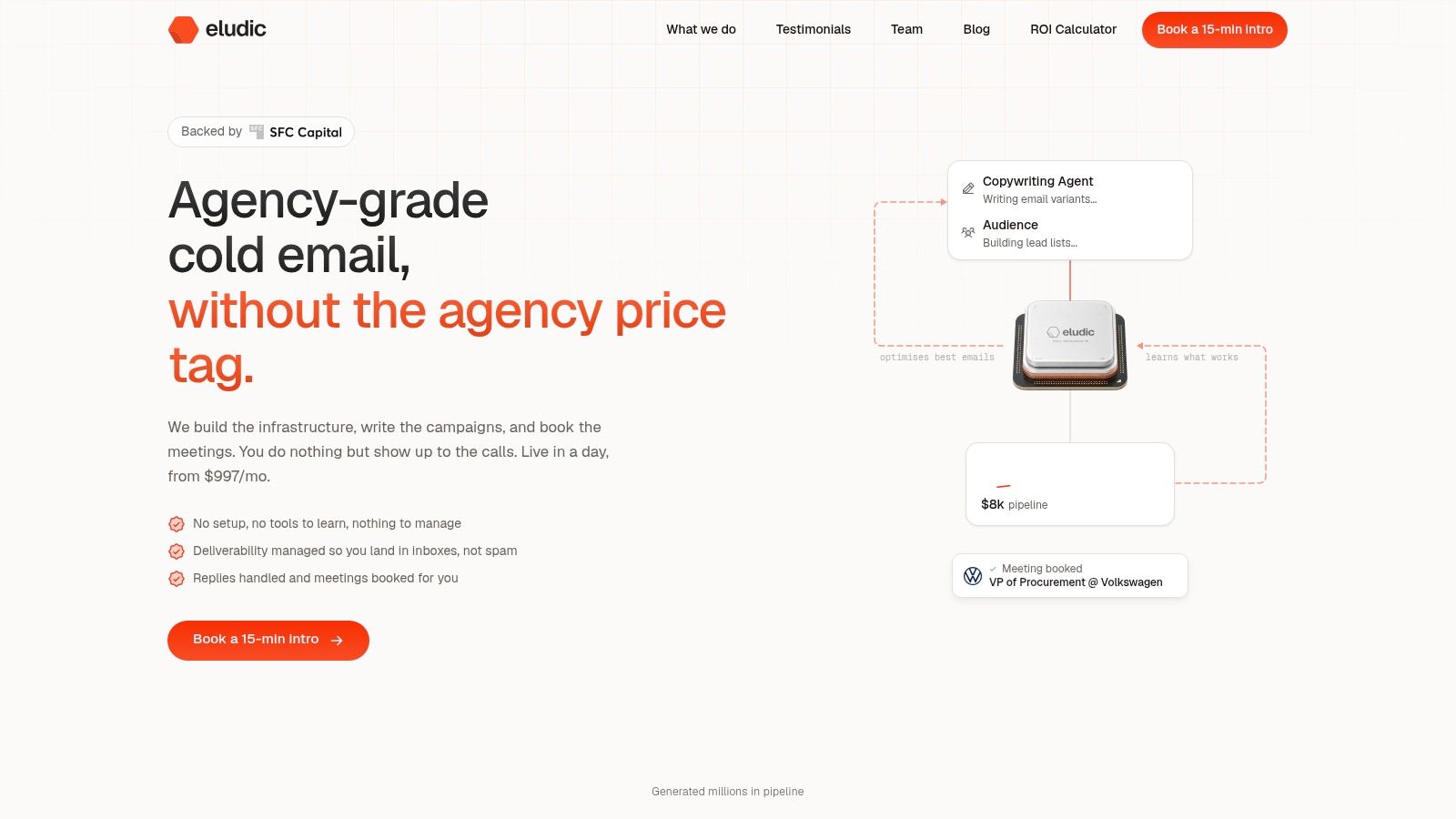
The first mistake buyers make is treating every deliverability provider as a tool for the same job. Eludic solves a different problem. It is a managed outbound execution service for teams that need meetings from cold email without building the operating layer in-house.
That distinction matters. A monitoring platform helps an existing email team inspect inbox placement, authentication, and reputation signals. Eludic takes responsibility for the workflow itself, including domain setup, DNS authentication, warm-up, list research, copy, campaign testing, sending, and reply handling. For a founder-led sales motion or a lean B2B team, the bottleneck is often not diagnosis. It is operational capacity.
Publicly stated pricing starts at $997 per month with no setup fee. The company says campaigns can launch quickly, with first sends possible the same day and full setup often completed within about a week. That speed changes the economics for small teams deciding between hiring, managing freelancers, or stitching together multiple point tools.
Best for teams buying execution capacity
Eludic fits companies that want outbound run for them, not companies that want to build a deliverability function internally. That usually means founders, SMB sales leaders, agencies, and smaller SaaS teams where one person may own prospecting, messaging, and pipeline generation at the same time.
The practical advantage is concentration of responsibility. One provider owns infrastructure, warm-up, copy testing, sending behavior, and reply management. That reduces a common failure mode in DIY stacks, where the ESP, warm-up tool, data vendor, and internal operator each control part of the outcome but none own the result.
A managed model also changes how to evaluate performance. The right question is less about dashboard depth and more about whether the service can produce stable sending, qualified replies, and booked meetings within the limits of your market, offer, and targeting.
Where the trade-off shows up
The trade-off is control. Teams that want to run their own experiments, keep messaging operations fully internal, or build repeatable deliverability knowledge across a larger organization may find the service model too closed. Consulting-led providers and self-serve platforms usually offer more visibility into process and more freedom to configure the stack.
Eludic is also tied closely to outbound cold email use cases. That makes it less comparable to enterprise deliverability suites designed for high-volume lifecycle or promotional email programs. If your sending architecture spans multiple ESPs, business units, and internal stakeholders, software and advisory services may fit better than outsourced execution.
Where Eludic fits in this list
Viewed by operational job, Eludic belongs in the managed outbound execution category. It is strongest when a business wants a vendor to handle setup and day-to-day sending rather than supply monitoring data for an internal team to act on.
- Best fit: Founder-led companies, SMB sales teams, agencies, and lean SaaS firms running cold outbound.
- Primary job solved: End-to-end outbound execution, including deliverability setup and ongoing campaign operations.
- Strength: Consolidates infrastructure, messaging, testing, sending, and reply workflows under one operator.
- Trade-off: Less direct control than self-serve monitoring or consulting-first options.
- Buying signal: Choose Eludic if lack of time, headcount, or internal expertise is the main constraint.
The company publishes named clients, testimonials, and case studies on Eludic, which is more useful here than a long feature checklist. For this type of service, proof of managed execution matters more than a broad software surface area.
2. Validity Everest

Validity Everest is for teams that need broad visibility more than turnkey execution. It combines inbox placement insights, reputation monitoring, content and rendering checks, and integrations into a mature enterprise platform. That matters most when multiple teams touch the same sending program and leadership wants one place to inspect signal quality.
This is not the right shape of product for a founder who just needs replies from cold outreach. It's a better match for enterprise email teams that already have operators, processes, and enough sending complexity to justify a wider monitoring surface.
Where Everest makes sense
Everest is strongest when email deliverability is already an ongoing internal function. Teams can use seed testing, complaint monitoring, reputation dashboards, rendering checks, and data integrations to spot issues before they spread across a large program. Optional professional services also make it more than a pure software subscription.
A lot of the value here comes from signal consolidation. Smaller senders may see that as overkill. Larger teams often see it as governance.
- Best fit: Enterprise brands with multiple stakeholders, established ESP workflows, and a need for detailed monitoring.
- Operational strength: Broad coverage across inbox placement, reputation, and pre-send checks.
- Main limitation: Pricing isn't publicly listed, so budget planning starts with a sales conversation rather than a self-serve trial path.
For teams that already think in terms of audits, dashboards, and remediation workflows, Validity is easier to justify than for teams still trying to get a basic outbound motion running.
3. Sinch Mailgun Deliverability Services and Optimize
Mailgun's model is practical for engineering-led senders. It combines a sending platform, a managed deliverability layer, and the Optimize toolkit for testing and monitoring. That bundling is most useful when a team already sends through Mailgun or plans to consolidate around it.
The human layer matters here. Technical Account Managers, warmup guidance, strategy help, and onboarding support are all more useful when the same vendor also has direct visibility into the infrastructure the team is using.
Strongest fit for platform-aligned senders
Mailgun isn't trying to be a neutral specialist across every possible stack. That's the trade-off and the appeal. Existing Mailgun customers can keep sending, testing, monitoring, and consulting within one vendor relationship instead of stitching together separate providers.
That setup is especially attractive for app teams, transactional senders, and technical organizations that already treat email as infrastructure. Authentication work is a core part of that. Teams comparing providers should understand why email authentication services keep showing up in deliverability conversations, because infrastructure trust is often the first thing that breaks.
Teams that already trust Mailgun for sending usually get more value from Mailgun's deliverability layer than from adding an unrelated monitoring product first.
The buying caveat
The limits are straightforward. Deliverability consulting pricing isn't public, and Optimize is separate from the core email API. Smaller senders may end up paying for capabilities they won't use well. But for a technical team that wants tooling plus access to people who understand the underlying send stack, Sinch Mailgun is one of the cleaner integrated options.
4. Twilio SendGrid Expert Services
Twilio SendGrid's deliverability consulting works best when the team already runs on SendGrid, or is moving onto it and wants expert help during the risky parts. Migration, authentication setup, IP or domain configuration, and remediation work are all easier when the consultant knows the sending platform and can tie advice directly to the account environment.
That makes SendGrid less of a neutral deliverability specialist and more of a platform-linked expert service.
Better for remediation and setup than broad comparison shopping
The practical appeal is familiarity. Existing SendGrid customers don't need to introduce another vendor just to troubleshoot reputation issues or tighten implementation. A documented consulting process and a specialized deliverability team can matter a lot when operations need escalation paths rather than just software alerts.
This option also suits teams that want one-time onboarding audits or ongoing managed support tied to their actual sender configuration. That's different from buying a dashboard and figuring out interpretation internally.
- Best fit: Existing SendGrid customers, teams migrating to SendGrid, and organizations that want vendor-native consulting.
- Strength: Clear alignment between infrastructure and consulting.
- Constraint: Expert Services are paid add-ons with quote-based pricing, so access depends on sales or account management channels.
For teams that want platform expertise more than independent tooling, Twilio SendGrid is easier to justify than a standalone service.
5. SendForensics
SendForensics is one of the clearest examples of a pre-send validation platform. It's built for teams that want to score messages, run spam checks, test inbox placement with seeds, review previews, and monitor reputation without committing to an enterprise services engagement.
That makes it attractive for SMBs and agencies that need repeatable checks before launch day. It doesn't replace campaign data, but it does reduce obvious avoidable mistakes.
Best when the team can act on the findings
The product is stronger as an operating aid than as a complete solution. Teams still need someone who can interpret results, adjust copy, inspect DNS, or change sending behavior. But accessible pricing and shareable reports lower the barrier to building a process around deliverability.
This is the kind of platform that helps a team move from guessing to inspecting. For agencies, that's useful because clients often want evidence that a sequence was checked before launch. For in-house marketers, it creates a routine for pre-send QA.
What to expect from the trade-off
Seed-based testing can't fully replicate live audience behavior. If a campaign underperforms despite clean pre-send checks, the problem may sit with targeting, engagement, or sender history rather than spam-copy triggers. That doesn't make the tool less useful. It just means SendForensics works best as part of a broader operating discipline, not as a substitute for one.
6. GlockApps

GlockApps is a monitoring-first choice. Teams use it for inbox placement tests, spam filter checks, DMARC analytics, reputation monitoring, and uptime tracking across multiple domains and IPs. It's a practical fit when the problem isn't “who will run outbound?” but “how will the team keep watch across a messy footprint?”
That distinction matters for agencies, consultants, and multi-brand senders. These buyers often already have sending systems in place. They need visibility and early warnings.
Useful for ongoing oversight
GlockApps is easier to justify than heavier enterprise suites when the team wants straightforward pricing and operational coverage without a large consulting contract. It also gives organizations a cleaner way to centralize checks across multiple assets.
Teams that are still learning the mechanics of seed testing should pair product use with a more grounded process for validating real campaign outcomes. A simple starting point is understanding how to test email deliverability before treating any single inbox test as final truth.
Watch for this: Monitoring software tells a team where to investigate. It usually doesn't fix the underlying process that caused the issue.
Best buyer profile
GlockApps fits operators who want continuous monitoring more than strategic hand-holding. Optional consulting is there, but remediation and infrastructure changes still require internal action or outside help. For many SMBs and agencies, that's fine. They don't need a managed service. They need a dependable instrument panel.
7. InboxAlly
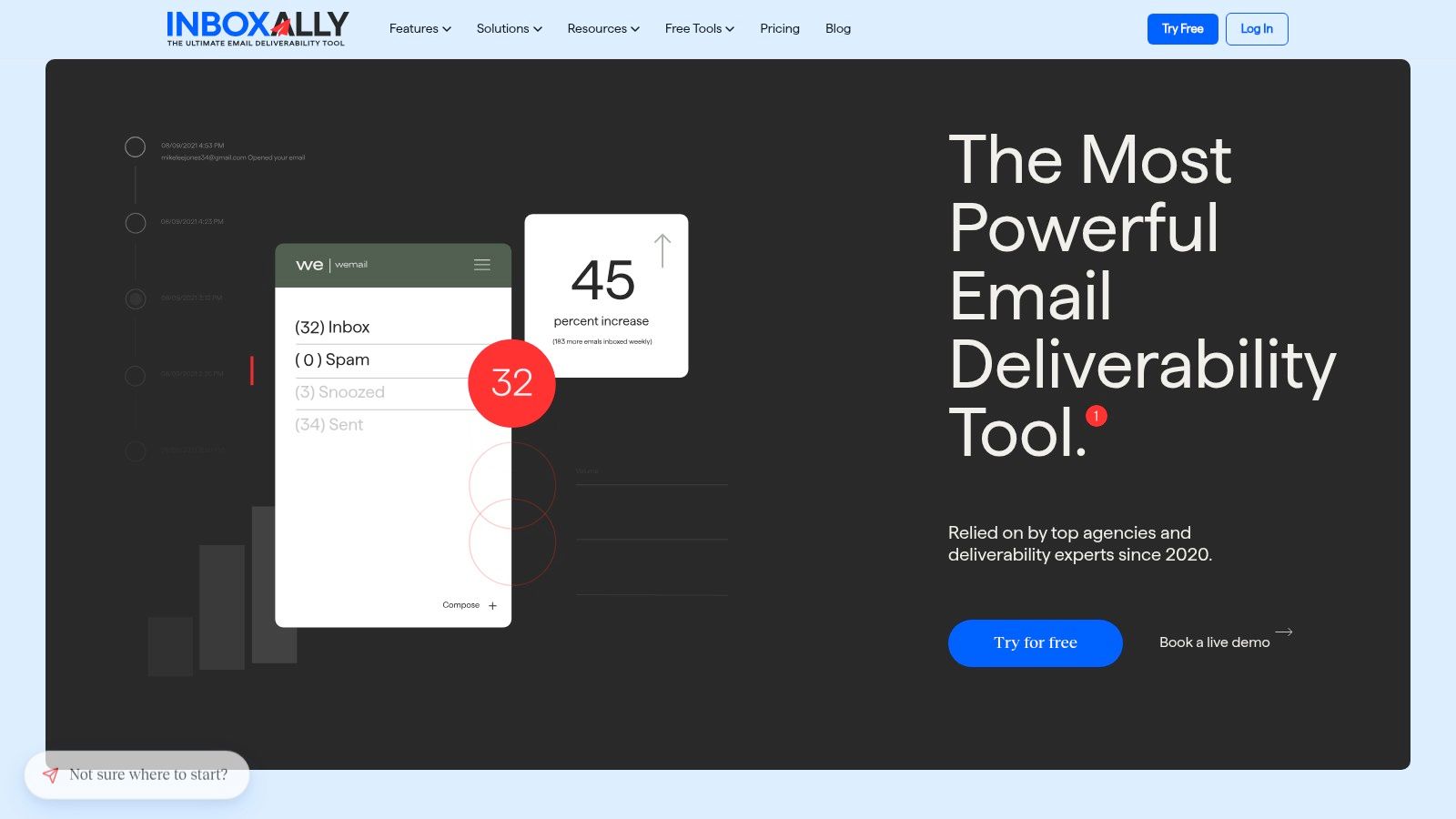
InboxAlly is one of the few products in this list that is explicitly shaped around reputation repair, not just monitoring or initial warmup. It uses engagement-style actions through a seed network of real mailboxes, combined with placement testing, blacklist checks, and DMARC monitoring.
That positioning matters because the operational problem is different. A team trying to launch a fresh outbound program needs clean setup and measured warmup. A team already landing in spam needs rehabilitation.
Best when damage already exists
InboxAlly earns attention when sender reputation is already weak and basic warmup routines aren't enough. Dedicated customer success on all plans reinforces that this is not a lightweight self-serve utility. It's a guided product aimed at reversing poor placement patterns.
The multi-domain and agency angle also makes sense. Reputation trouble often isn't isolated to one mailbox. It tends to spread through bad habits across a cluster of domains, users, or sequences.
Why it isn't for everyone
The obvious trade-off is cost. InboxAlly is positioned above simpler warmup products, and small teams may struggle to justify it unless inbox problems are already affecting revenue. But when the issue is repair rather than setup, InboxAlly is more aligned than a basic warmup subscription.
8. MailReach
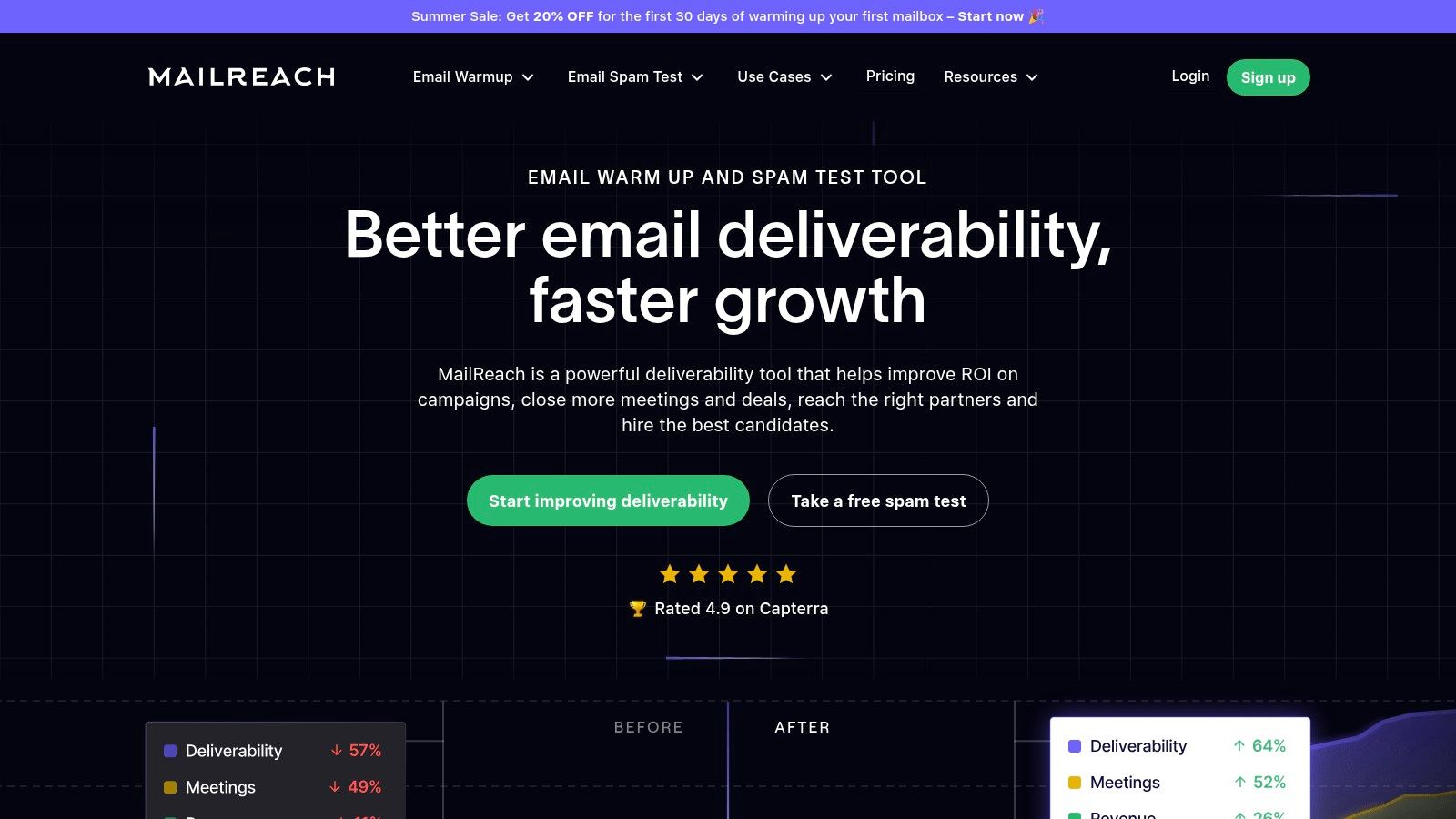
MailReach is a focused warmup option for teams managing many inboxes. It combines automated warmup with spam tests, reputation checks, and basic health monitoring around SPF, DKIM, DMARC, and blacklists. The product shape is simple, and that's part of the appeal.
Cold-email operators often don't need a large consulting engagement first. They need mailbox-level warmup at scale, basic alerts, and enough visibility to catch obvious health issues before launch.
The strongest case for MailReach
Public deliverability benchmarks help explain why warmup and health checks still matter. One benchmark report cited a global deliverability health score of 88 out of 100, and another large-scale benchmark put global inbox placement at 87%, meaning roughly 1 in 8 legitimate marketing emails still misses the inbox, according to Unspam's deliverability report. The same source says a well-managed program should target 90 to 95% or better inbox placement, keep hard bounces below 1%, and hold spam complaints below 0.1%.
That framing fits MailReach well. It gives teams a way to operationalize warmup and health monitoring without turning deliverability into a full enterprise program.
Where the limits appear
MailReach is still a warmup-first product. It offers lighter remediation guidance than a consultancy, and it won't replace deeper infrastructure audits or strategic troubleshooting. For teams with lots of inboxes and a need for predictable mailbox-level scaling, MailReach is usually easier to adopt than a more complex suite.
9. Folderly
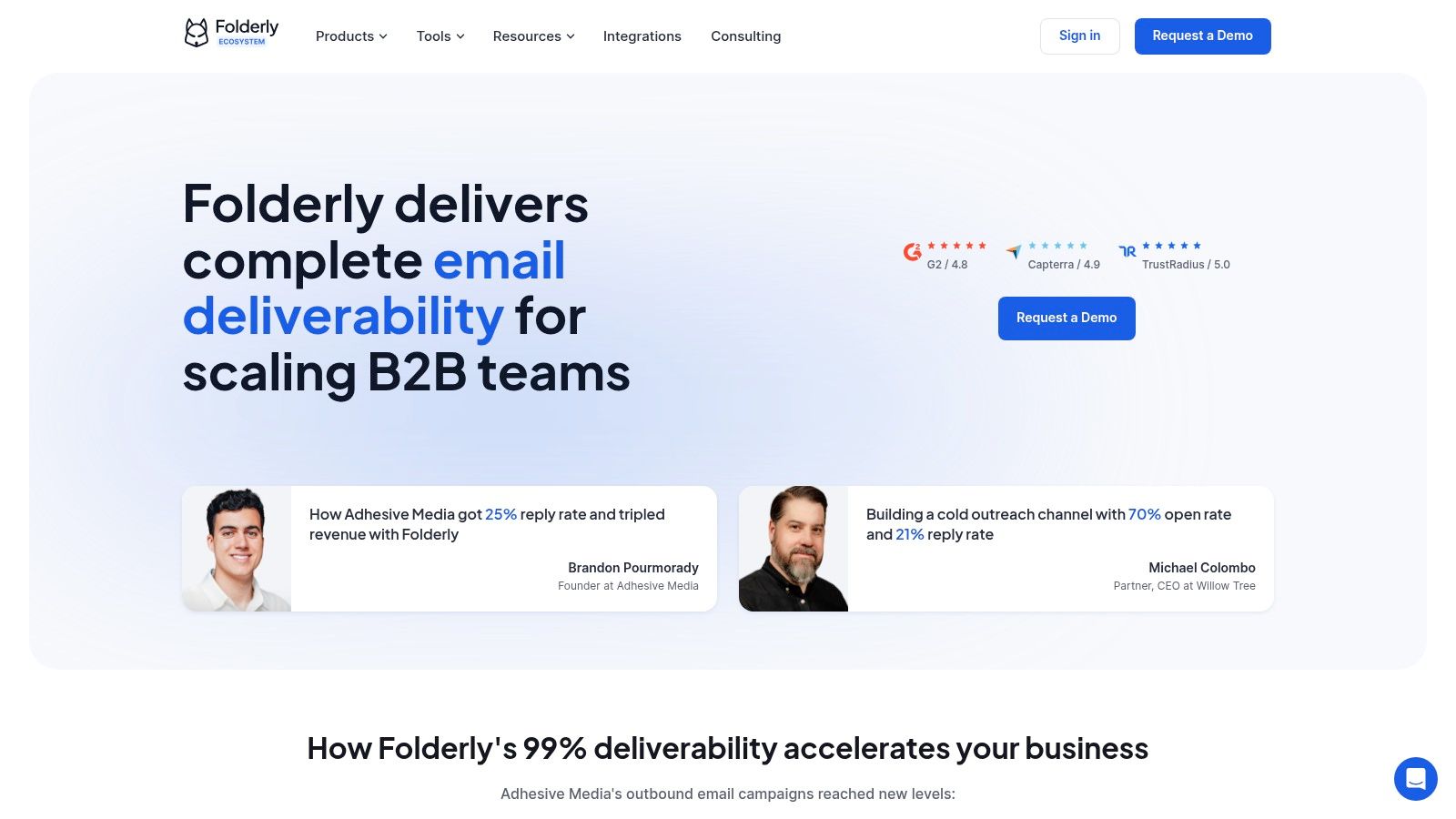
Folderly sits between software and service. It offers automated warmup and maintenance, inbox placement testing through Inbox Insights, real-time alerts through Pulse, AI-assisted sequence generation, and optional consulting. That blend is useful for teams that want some automation guardrails but don't want to operate entirely alone.
This middle position is often underrated. Plenty of teams aren't ready for a full done-for-you service, but they also don't have enough internal depth to interpret every deliverability issue from scratch.
Good hybrid for active operators
Folderly's real-time alerting is one of its strongest operational ideas. Spam placement alerts by Slack, SMS, or email can help teams respond faster when a domain starts slipping. That's more actionable than discovering the problem during a weekly review.
Authentication context matters here too. In a 2026 scan of 5.5 million domains, only 30.4% published DMARC and just 12.8% enforced it, while SPF adoption was 56.0% and DKIM adoption 22.7%. Among Fortune Global 500 companies, adoption was stronger but still incomplete, with 91.6% on SPF, 79.4% on DMARC, 58.2% on DKIM, and only 48% at full DMARC p=reject enforcement, according to DMARC Guard's authentication research. That's why teams using Folderly still need to care about basics such as how to warm up an email domain and maintain authentication over time, not just respond to alerts.
Main limitation
Per-mailbox pricing can get expensive for large fleets, and consulting is quoted separately. Still, for teams that want software first with access to experts when needed, Folderly is one of the more balanced hybrid options.
10. Postmastery
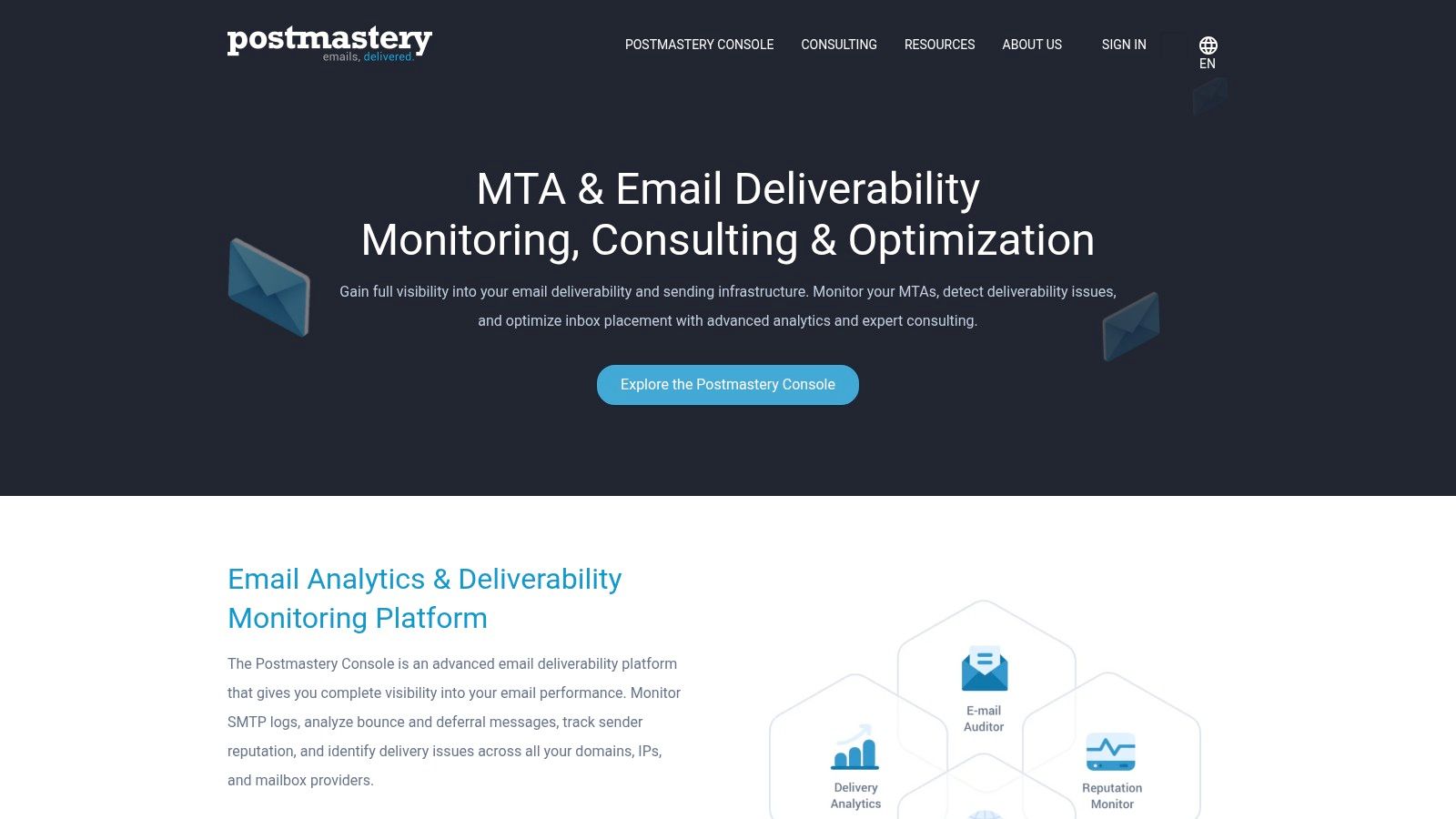
Postmastery is the specialist choice for complex email environments. It offers audits, remediation, reputation management, DMARC services, MTA and ESP configuration work, and its own monitoring layer through the Postmastery Console. This is the sort of vendor that becomes more relevant as the sending stack becomes less standard.
Organizations running their own MTA, juggling multiple ESPs, or treating email as a high-stakes infrastructure function usually need deeper engineering support than mainstream warmup or testing products provide.
Best for self-managed complexity
The key difference with Postmastery is operational depth. A business with a self-managed MTA has problems that many SaaS deliverability tools can only describe, not solve. Configuration, flow analysis, licensing decisions, reputation management, and SMTP observability all require a more technical partner.
That also makes Postmastery less compelling for smaller senders. If a team sends simple campaigns through a standard platform, this is probably more consultancy than they need.
Complex stacks create complex failure modes. The value of a specialist shows up when the team can't afford to guess which part of the stack caused the drop.
Budget and fit
Pricing is custom, and the engagement starts with a conversation rather than a checkout flow. That's normal for this category. For organizations where email is business-critical infrastructure, Postmastery is one of the more credible specialist options.
Top 10 Email Deliverability Services Comparison
| Offering | Core scope & features | Deliverability & outcomes ★ | Price / Value 💰 | Target audience 👥 | Unique advantage ✨ |
|---|---|---|---|---|---|
| Eludic 🏆 | End-to-end done-for-you: domain auth, warm‑up, lists, multi-variant copy, sends, reply handling & meetings | ★★★★★, specialist ops, case studies ($4M/$2.7M/$873k), same‑day sends | 💰 From $997/mo, no setup fee, agency-grade value | 👥 Founders, SMBs, bootstrapped SaaS, agencies | ✨ Automated angle testing + full reply-to-meeting service; fast 1‑week launch |
| Validity, Everest | Enterprise inbox placement, seed tests, rendering & reputation dashboards | ★★★★★, deep signal coverage for enterprises | 💰 Enterprise pricing (quote) | 👥 Large enterprises, ESP-heavy senders | ✨ Consolidated ReturnPath + 250ok signals for broad visibility |
| Sinch Mailgun, Deliverability + Optimize | Managed deliverability (TAMs, IP warmup) + Optimize testing toolkit | ★★★★, strong for scale & engineering teams | 💰 Quote-based; Optimize billed separately | 👥 Dev-led teams, high-volume Mailgun users | ✨ Combines API sending + technical TAM support |
| Twilio SendGrid, Expert Services | Audits, remediation, ongoing managed deliverability with SendGrid infra | ★★★★, specialist team + SendGrid signal guidance | 💰 Add-on consulting (quote) | 👥 SendGrid customers, migrating senders | ✨ Direct path to SendGrid infra & support |
| SendForensics | Pre-send scoring, unlimited spam tests, seed inbox placement & DMARC analytics | ★★★★, quick pre-send confidence checks | 💰 Transparent, SMB-friendly plans | 👥 SMBs, agencies needing repeatable checks | ✨ Unlimited testing + shareable reports |
| GlockApps | Seed inbox tests, spam/filter checks, DMARC & reputation monitoring | ★★★★, ongoing multi-domain monitoring | 💰 Clear pricing; useful quotas | 👥 Multi-domain senders, SMBs | ✨ Low-friction monitoring with straightforward quotas |
| InboxAlly | Engagement-driven warmup & reputation repair using real mailboxes + CSM | ★★★★★, built to reverse poor placement at scale | 💰 Premium pricing | 👥 Senders with damaged reputation, agencies | ✨ Real‑mailbox engagement + dedicated CSM |
| MailReach | Automated warmup with AI sequences, per-mailbox pricing, health checks | ★★★★, cost-effective warmup at scale | 💰 Per-mailbox pricing (scales) | 👥 Cold-email teams needing many warmed inboxes | ✨ AI-driven sequences + bundled health checks |
| Folderly | Automated warmup/maintenance, Inbox Insights, Pulse real-time alerts, AI sequences | ★★★★, proactive alerting & maintenance | 💰 Per-mailbox (can scale costly) | 👥 Teams wanting alerts + optional experts | ✨ Real-time spam placement alerts (Slack/SMS) |
| Postmastery | High-touch audits, MTA tuning, DMARC, Postmastery Console for SMTP observability | ★★★★★, deep engineering remediation for complex stacks | 💰 Custom enterprise engagements | 👥 Organizations running own MTA or complex architectures | ✨ Engineering-first consultancy + console for SMTP flows |
Choose by Your Operating Model, Not by Feature Count
The easiest way to buy the wrong deliverability product is to compare feature lists without naming the actual operational problem. Teams don't need every category at once. They need the right category first.
Eludic is the strongest fit for companies that want a hands-off B2B cold-email program rather than another tool to operate. It's for teams that want domains configured, mailboxes warmed, messaging written, campaigns launched, replies handled, and meetings booked with minimal internal effort. That's very different from buying monitoring software and assigning someone to run it.
Platform-linked options make more sense when the sender already lives inside a particular stack. Validity Everest fits enterprises that need broad monitoring and governance across an established program. Mailgun's deliverability services and Optimize suit technical teams that already send through Mailgun and want consulting plus tooling in one relationship. SendGrid Expert Services is the practical choice for organizations already using or moving onto SendGrid and wanting vendor-native setup or remediation help.
Testing and monitoring products belong in a different bucket. SendForensics and GlockApps are good fits when the team already owns campaign execution and mainly needs pre-send checks, inbox testing, reputation visibility, or ongoing oversight. They help disciplined teams move faster and make fewer blind guesses, but they don't remove the need for internal operational ownership.
Warmup and repair should also be separated, because they aren't the same purchase. MailReach works well for teams that need scalable warmup and health checks across many mailboxes. InboxAlly is more compelling when sender reputation is already damaged and the team needs a product designed to support rehabilitation, not just initial preparation. Folderly works for teams that want a blend of automation, alerts, and optional expert help without jumping straight to a fully managed model.
Postmastery belongs in the specialist tier. It's the option for high-stakes, technically complex, or self-managed sending environments where MTA tuning, multi-ESP coordination, and deep remediation work matter more than convenience.
Before buying any email deliverability service, teams should check five things. Who owns implementation. What data and diagnostics the buyer can access. How escalation support works when placement drops. Whether pricing scales by mailbox, domain, volume, or contract scope. And how success will be measured once the service is live.
The best provider usually isn't the one with the longest feature page. It's the one that matches the team's desired level of control, internal expertise, and operational capacity.
Eludic offers a different answer than most email deliverability services because it runs the outbound program instead of just handing over tools and reports. For B2B teams that want authenticated infrastructure, warmup, copy, sending, reply handling, and booked meetings under one roof, it's worth a closer look at Eludic.