
A B2B founder has a European prospect list, a polished sequence, and a sending tool ready. Just before launch, one question changes the plan: can the team email these people, or is the campaign resting on an untested assumption?
Email GDPR compliance is not a CRM dropdown between “consent” and “legitimate interest.” It is an evidence-management problem. The team must show where each address came from, why the outreach fits that person, which country's rules apply, and what happened after an objection. Suppression logic matters too. An unsubscribe or objection must stop future contact across campaigns, tools, and sending domains.
The financial stakes are significant. Under Article 83 of the GDPR, the most serious infringements can attract administrative fines of up to €20 million or 4% of worldwide annual turnover, while less severe infringements can reach €10 million or 2%. A 2026 industry summary reported more than 3,200 enforcement actions and over €6.3 billion in fines since the GDPR began applying, according to Adaptive Security's email compliance penalties overview.
The practical response is to build outbound like an auditable system. Separate the legal basis from permission to use email, route contacts by jurisdiction, attach evidence to every record, and treat suppression requests as immediate system events. A lawful basis explains why data may be processed. It does not, by itself, prove that a message may be sent.
The guide follows that operating model, from legal-basis choices to record keeping, daily controls, and the shortcuts that create exposure.
How GDPR Applies to Commercial Email
A sales team can hold a named work address in its CRM and still be unable to email that person lawfully. Email GDPR compliance depends on two connected questions: may the business process the address, and may it use email for direct marketing? GDPR covers personal-data processing, including collection, storage, enrichment, and use. The ePrivacy rules add requirements for the marketing channel itself.
The distinction works like two checkpoints on the same route. A lawful basis may justify keeping an address, but it does not automatically authorize a promotional email. The campaign also needs a jurisdiction-aware sending decision, clear transparency, and controls that honour objections.
Practical rule: A valid reason to hold an address is not automatically permission to send a marketing email.
Why B2B addresses can still be personal data
A work email can identify a person. A named employee's business inbox, especially when paired with a job title, company, or CRM profile, usually relates to an identifiable individual. Calling an outreach campaign “B2B” does not remove that record from the data-protection framework.
Start with the record, not the company label. A generic role inbox may raise different questions from a named address, yet both require careful handling because national ePrivacy rules and the surrounding circumstances can change the result. The same contact may therefore need a different route depending on the recipient's country and the campaign's channel.
GDPR consent must be freely given, specific, informed, and unambiguous. Opt-in is the normal compliance baseline for marketing email across major European markets. Keep the exact consent language, purpose, collection method, and time of action so the record can support that conclusion later.
The two-layer decision
For every campaign, document four separate decisions:
- Processing decision: Why may the business collect, store, and use the address?
- Sending decision: Does the applicable ePrivacy rule permit direct marketing by email in that situation?
- Transparency decision: Can the recipient understand who is contacting them, why the message is relevant, and how the address was obtained?
- Control decision: Can the recipient object or unsubscribe easily, and will suppression apply across every relevant tool and sending domain?
This makes compliance an evidence-management task. The CRM record, source details, jurisdiction route, assessment, and suppression status should align. If one element is missing, the team may have a defensible explanation in one system and an incomplete history in another.
A plain-language overview is available in Eludic's guide to what GDPR compliance means. Teams operating across borders can also review GDPR vs Israeli privacy law to see why a local process may not answer European outreach questions.
Consent vs Legitimate Interest for B2B Email
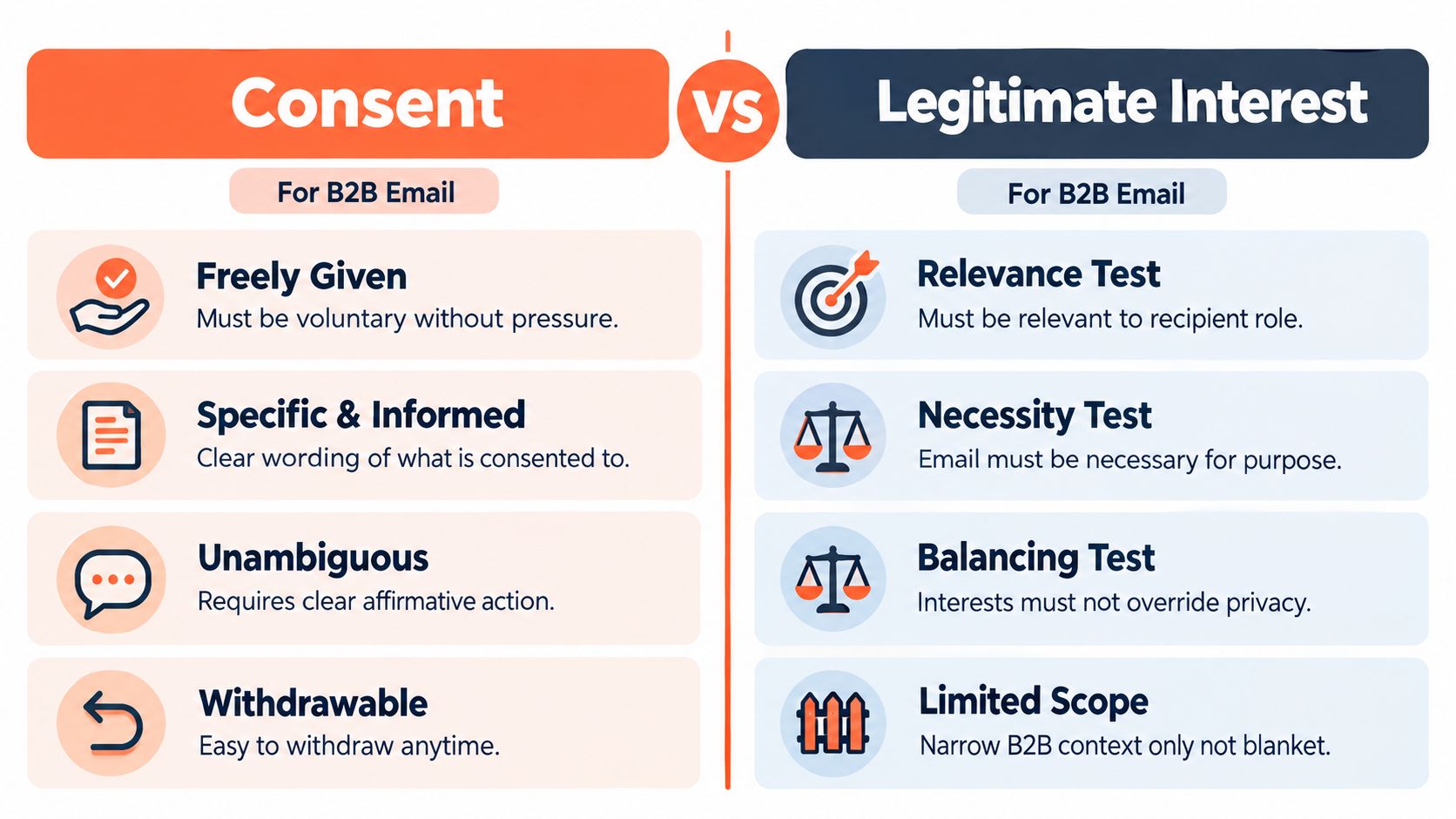
Consent is the easier basis to explain because the recipient has taken a clear affirmative action. A strong record preserves the exact wording shown, the purpose described, the time of the action, and the mechanism used to collect it. Consent must also be easy to withdraw, with an unsubscribe process that doesn't create friction.
Legitimate interest requires more judgment. The European Data Protection Board says unsolicited direct marketing by email can only take place with the recipient's prior consent, and that this processing may not be based on Article 6(1)(f) GDPR, as set out in its legitimate interest guidelines. In other words, legitimate interest isn't a universal answer for cold email in the EU and EEA.
That distinction creates a common design error. A team may complete a legitimate-interest assessment for storing a lead, then assume that assessment authorizes the email send. The processing basis and the direct-marketing rule need separate checks.
A decision matrix for campaign design
| Factor | Consent | Legitimate Interest |
|---|---|---|
| Recipient action | Requires a clear affirmative action | Doesn't rely on prior consent as the GDPR processing basis |
| Evidence | Exact wording, timestamp, source, and purpose | Written assessment, necessity analysis, balancing test, and source provenance |
| Scope | Must match the purpose communicated | Must be relevant, necessary, limited, and proportionate |
| Withdrawal or objection | Withdrawal must be easy | Objection must stop the relevant processing and outreach |
| Cold email suitability | Usually the clearer route where consent is required | Not a blanket authorization for unsolicited marketing email |
| Operational burden | Consent capture and consent history | Continuous assessment, transparency, objection handling, and routing |
For a deeper treatment of permission capture and lifecycle controls, teams can review consent management practices. The key choice should be made before list upload, not after a complaint.
When each route makes sense
Consent generally fits subscription forms, event registrations, product updates, and other situations where a recipient actively asks for communications. The record needs to prove what the person agreed to, not merely that an address appeared in a database.
Legitimate interest may be relevant to certain processing activities when the interest is lawful, clear, real, present, and necessary, and when the individual's rights don't override it. The EDPB's standard still requires a balancing exercise. Even then, the separate ePrivacy rule for the actual email must be satisfied.
The safest basis is the one the records can explain without interpretation.
Record Keeping and Proof You Need to Maintain
A compliance program becomes credible when another person can reconstruct the decision for a single contact. The question isn't only, “What policy does the company have?” It's also, “What happened to this address, and why was this message sent?”
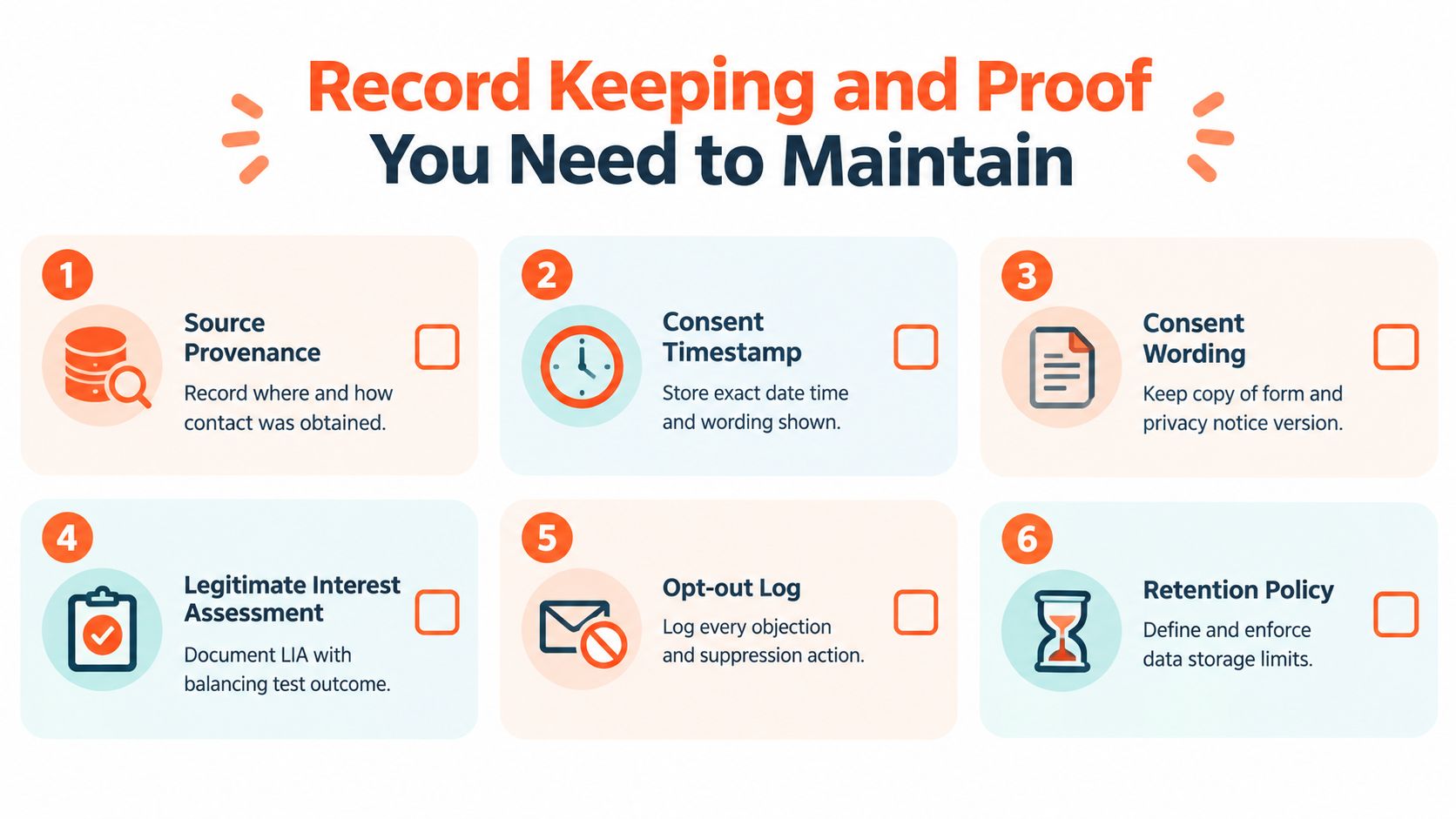
That reconstruction starts with source provenance. The record should identify how the address was obtained, when it entered the system, what fields were collected, and whether a third party supplied the information. “Found online” is too vague to support a reliable audit trail because it doesn't explain the source, context, or permitted use.
The European Commission notes that third-party sourced marketing data may be processed on legitimate-interest grounds only when individuals retain a right to object. The EDPB also requires the interest to be lawful, clear, real and present, necessary for the purpose, and not overridden by the individual's rights after a balancing test, as described in its legitimate interest statement.
What the evidence file should contain
A useful record isn't a single checkbox. It's a connected set of evidence:
- Source history: The vendor, form, event, directory, or other origin of the address, plus the collection context.
- Consent evidence: The exact date and time, wording, purpose, and version of the notice shown to the recipient.
- Assessment evidence: The legitimate-interest assessment, including purpose, necessity, balancing outcome, and the reasons the outreach is relevant.
- Transparency evidence: The privacy notice presented or linked, the sender identity, the reason for contact, and the explanation of where the address came from.
- Control evidence: Every unsubscribe, objection, deletion request, suppression action, and system propagation event.
- Retention evidence: The rule governing how long the record remains available and when unnecessary data is removed.
A practical privacy policy for developers can help teams think through the information that forms and data-collection workflows should disclose. It shouldn't replace a legal review, but it can expose missing details in a basic capture flow.
Why scale changes the problem
One contact can be checked manually. A large outbound operation needs controls that apply consistently across CRMs, enrichment tools, sequencing platforms, and sending domains. If an objection reaches the CRM but not the sequencing tool, the organization may still contact the person after they opted out.
The suppression list therefore needs to function as shared infrastructure. Every sending system should consult it before launch and before each send, while new objections should propagate quickly enough to prevent another message from leaving.
Teams managing this kind of workflow benefit from treating compliance monitoring systems as operational controls rather than reporting dashboards. The audit trail should show not only that a rule existed, but that the rule acted on the relevant record.
Practical Compliance Checklist for B2B Outbound
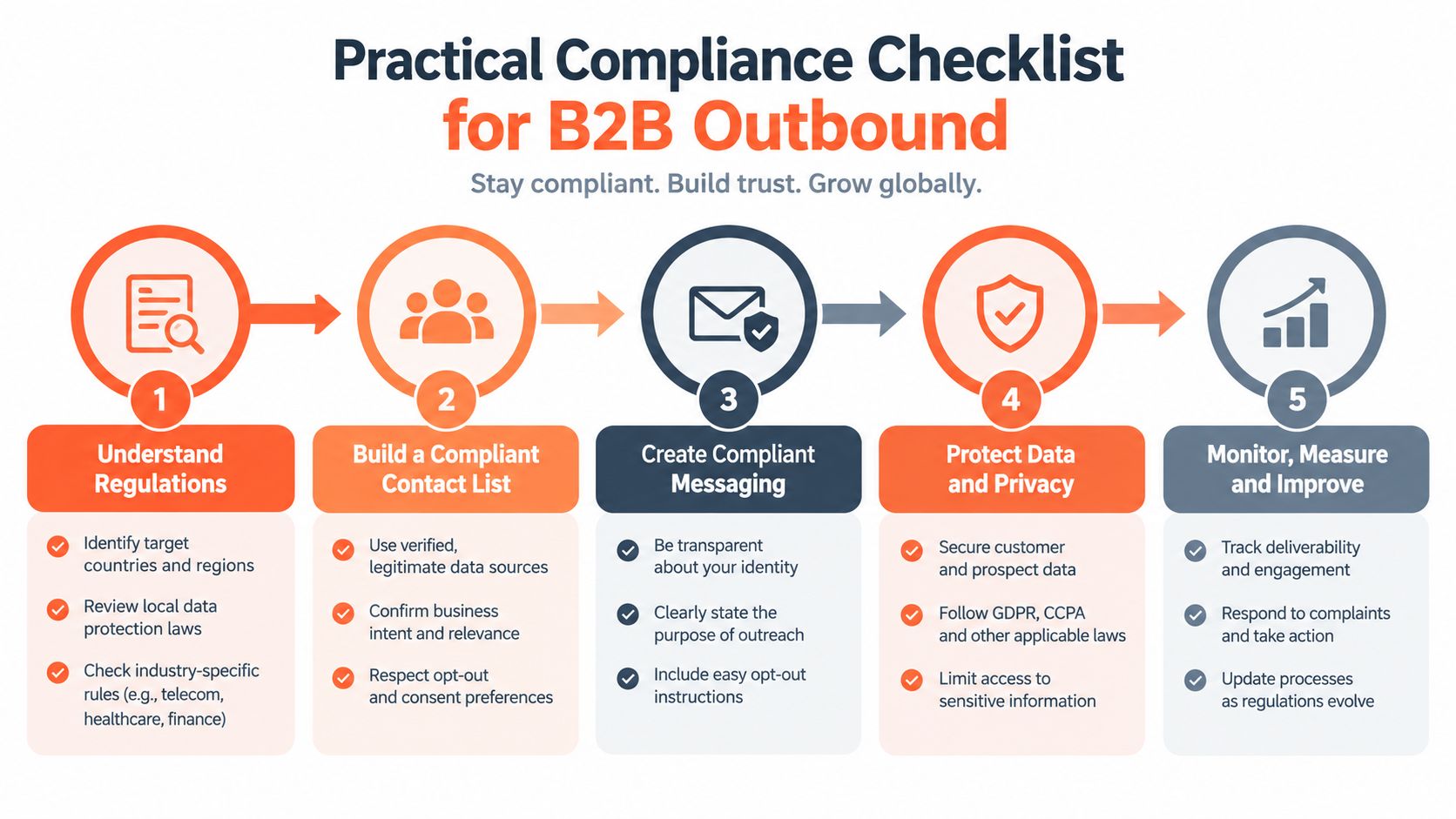
A compliant outbound workflow starts before copywriting. The campaign owner first defines the audience, target countries, data fields, outreach purpose, and acceptable sources. That preparation prevents a mixed list from forcing one legal assumption onto recipients who live under different national rules.
Build the list around necessity
Collect only the information the campaign needs. A typical B2B prospecting record may need a business email, name, company, role, country, source, lawful-basis status, and suppression status. Extra personal details increase the amount of data the business must explain, protect, update, and eventually delete.
The list-building process should also distinguish named contacts from role-based inboxes. That distinction doesn't settle compliance by itself, but it helps the team apply more precise review and messaging controls.
Route by jurisdiction before sending
Country routing should happen before contacts enter a sequence. GDPR provides the data-protection layer, while ePrivacy rules and national implementing laws can change whether a marketing email is permitted in the target country. A legitimate-interest assessment in one jurisdiction doesn't create a universal cross-border permission.
Campaign infrastructure should preserve the routing decision. If a contact's country is unknown, the system should send the record to review rather than place it in a general EU campaign.
Make suppression automatic
An unsubscribe link belongs in every marketing message. The mechanism should be easy to find, simple to use, and connected to every relevant campaign, CRM segment, and sending identity.
Replies need the same treatment. A recipient may write “remove me” instead of clicking a link, so the workflow should detect that request, record the time and channel, update the suppression list, and stop future marketing processing.
Make the sender transparent
The message should identify the organization, explain why the recipient is being contacted, and provide a clear path to object. If the address came from a third-party source, the business should be able to explain that provenance in its privacy information or response to the recipient.
Use a pre-send gate
Before activation, the campaign owner should confirm:
- Audience: Each contact has a documented country and business context.
- Data: The record contains only necessary fields and a traceable source.
- Basis: Consent or the relevant assessment is attached to the campaign decision.
- Permission: The applicable ePrivacy and national rules allow the planned send.
- Message: Sender identity, relevance, transparency, and unsubscribe controls are present.
- Suppression: The current list has been checked against all objections and opt-outs.
- Monitoring: Someone owns complaint review, reply handling, and evidence retention.
Tools can support the mechanics, but ownership still matters. A platform may automate suppression, yet the business remains responsible for deciding whether the campaign is lawful.
Common Pitfalls and Costly Mistakes to Avoid
A sales manager imports a list of work addresses and starts a sequence without checking where each contact lives, how the address was obtained, or what happens after an objection. The campaign may look efficient, yet its evidence trail is incomplete. A work address can still identify a person, and the B2B label does not remove requirements for transparency, lawful processing, recipient control, or country-specific marketing rules.
A second mistake is treating legitimate interest as a universal cold-email pass. The EDPB position is narrower: unsolicited direct marketing by email requires prior consent and cannot rely on Article 6(1)(f) GDPR for that processing. A policy that labels every prospecting campaign “B2B legitimate interest” leaves the sender unable to explain the decision.
Where teams usually lose control
- Mixed-country lists: Contacts from several European jurisdictions enter one sequence without country-level review.
- Public-data assumptions: A visible address is treated as permission to receive marketing.
- Missing provenance: No record shows who supplied the address or when it was collected.
- Disconnected suppression: An unsubscribe changes one platform but not other campaigns or domains.
- Vague consent: The record contains a date but not the wording, purpose, or version presented.
- Invisible sender identity: The recipient cannot quickly identify the sender or understand the reason for contact.
These are evidence failures as much as legal failures. If a regulator or recipient asks why a message was sent, the business needs a clear chain from source to basis, campaign, jurisdiction, and suppression status. As noted earlier, serious infringements can attract substantial administrative fines, and authorities have penalized unauthorized email marketing involving publicly available data. The lesson is practical: a public address is not a permission slip.
Deliverability is part of the risk picture
A weak opt-out process creates operational damage too. Recipients may report unwanted messages, send objections that never reach the suppression system, or associate several campaigns with one sender identity. Those signals can reduce inbox placement and make later permission-based communication harder.
The remedy is not to hide a campaign behind extra domains or unclear sender details. Assign an owner, maintain one reliable suppression source, and synchronize it across sending tools. Keep provenance, basis, consent wording, objections, and routing decisions available as working records, not paperwork reconstructed after delivery. When an objection arrives, suppression should function like a circuit breaker: one signal stops every relevant marketing path.
Conclusion Building Compliant Outbound With Confidence
Effective email GDPR compliance rests on four connected decisions. The business identifies the data and its source, determines the processing basis, checks the separate ePrivacy and national marketing rules, and builds recipient control into the sending system.
That model changes how founders evaluate outbound. The key question isn't, “Can the team find a legal basis?” It's, “Can the team prove the decision for every contact, apply the correct country rules, and stop processing immediately when someone objects?”
A practical program keeps the answer visible. Contact records carry provenance and status. Campaigns use jurisdiction-aware routing. Consent and assessment documents remain versioned. Suppression lists sync across tools and sending domains. Messages identify the sender and offer a clear unsubscribe path.
This approach doesn't require a perfect legal theory for every possible scenario. It requires disciplined evidence management, careful segmentation, and escalation when the facts are unclear. Teams that build those controls before launch can move faster because fewer decisions need to be reconstructed under pressure.
The next step is a focused audit. Select a representative set of contacts, trace each address back to its source, inspect the basis and transparency record, test the unsubscribe flow, and confirm that one objection blocks every future marketing send. Any missing evidence becomes a workflow issue to fix before the next campaign.
Eludic designs and operates managed B2B cold email programs with documented data handling, GDPR and CAN-SPAM processes, built-in unsubscribe handling, deliverability monitoring, reply management, and meeting coordination. Visit Eludic to see how a compliance-aware outbound system can be built and run without adding an internal SDR operation.