
Most B2B cold email programs don't fail because the body is weak. They fail before the body gets read. A 2025 analysis of 5.5 million B2B cold emails found that personalized subject lines reached a 46% open rate, compared with 35% for generic lines (Belkins' analysis of B2B cold email subject lines). The same dataset found that 2–4-word subject lines performed best at 46%, while longer lines declined to 34% at 10 words.
That doesn't mean every short subject line creates pipeline. A separate synthesis covering more than 130 million B2B emails found strong open rates for questions, calls to action, and number-based lines, but it also reported that around 43% of recipients decide whether to open or delete based on the subject line alone (Autobound's B2B subject-line analysis). Opens are the first gate, not the final business outcome.
The practical answer is to match one of eight subject-line angles to a specific buyer situation. Each category below includes the audience it suits, the variant worth testing, the trade-off to watch, and the operational method for separating a genuine winner from a curious but unqualified opener.
1. The Question-Based Subject Line
A strong question-based subject line gives the recipient an easy mental answer while pointing toward a real business issue. It might ask, “Are outbound handoffs slowing the sales team?” or “Is deliverability limiting campaign volume?” Both lines create relevance without pretending that a sales conversation already exists.
Question-based subject lines work best when the question reflects a problem the recipient already recognizes. A revenue leader may care about inconsistent meeting flow, while a marketing leader may care about attribution or lead quality. The question should sound like a business question, not a disguised product pitch.
A 2025–2026 synthesis of more than 130 million B2B emails reported a 46% open rate for question-based subject lines, making this one of the strongest angles for initial testing (Autobound's research on subject-line structure). That result describes opens, not qualified replies, so the body must answer the question quickly and credibly.

What to test
A useful test compares the same audience and offer across different questions:
- Operational question: “Still handling outbound manually?”
- Outcome question: “Is meeting volume predictable this quarter?”
- Risk question: “Are cold emails reaching the inbox?”
The operational version suits founders and sales operators who feel process friction. The outcome version suits leaders accountable for pipeline. The risk version fits teams already worried about sender reputation or inconsistent delivery.
The question needs to be answerable almost instantly. Complex wording creates work before the recipient has even opened the message. A question that depends on several assumptions also makes the sender appear unfamiliar with the account.
Practical rule: A question should expose a relevant tension, not force the recipient to solve the sender's research problem.
Eludic's guide to cold emails that get responses follows the same operating principle. The subject line earns the open, while the first sentence should make the reason for the question obvious. For Eludic campaigns, real account research can be paired with several question variants, then compared by replies and meeting quality rather than opens alone.
2. The Social Proof and Credibility Subject Line
Social proof reduces uncertainty, but it can also make a cold email look like an advertisement. The useful version gives the recipient a reason to believe the sender understands a comparable business situation. The weak version stacks famous company names or vague claims into a subject line that sounds borrowed.
A safer structure is to reference a relevant peer category rather than imply that a prospect's direct competitor endorsed the sender. For example, “How a SaaS team rebuilt outbound” creates a credible context without making an unsupported performance promise. “A pipeline lesson from a similar sales team” is another option when the body contains a specific, verifiable lesson.
Match proof to the buyer
Proof only helps when the recipient can see the connection. A founder may respond to a story about a lean team creating outbound capacity. A sales leader may care more about meeting quality, reply handling, or the operating burden removed from an internal team. An enterprise buyer may need evidence that the process can work within compliance and deliverability requirements.
Useful variants include:
- Peer-category proof: “A similar RevOps team asked about this”
- Named proof: “[Client] raised the same outbound issue”
- Method proof: “A better way to test outbound angles”
- Evidence-led proof: “What the campaign data changed”
The named version should only appear when the relationship and claim are genuine. A sender shouldn't imply that a company is a customer, reference, or endorser without permission. Social proof that cannot survive a basic verification check is worse than no social proof.
The subject line also shouldn't carry the entire case study. It should establish relevance, then let the body explain the situation, action, and outcome. The recipient needs enough context to trust the message, not an overloaded headline.
A useful A/B test compares a company name with an anonymized peer description. If the anonymized version earns fewer opens but stronger replies, it may be attracting more suitable buyers. That distinction matters because an impressive logo can create curiosity without creating buying intent.
3. The Time-Sensitive and Scarcity Subject Line
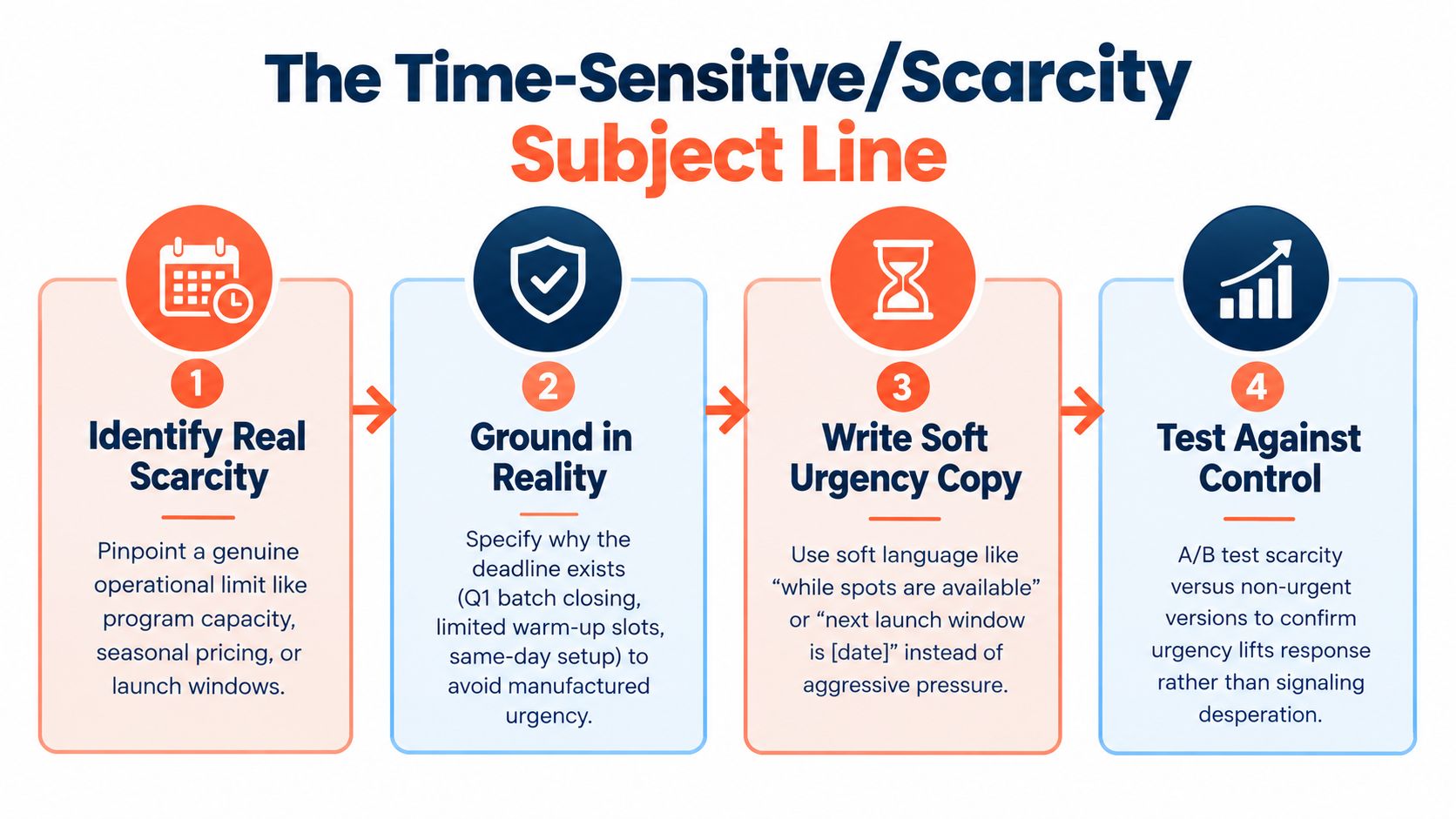
Urgency has a narrow use in B2B cold email. It works when a real operating constraint exists, such as a campaign launch window, a scheduled program intake, a seasonal planning cycle, or limited implementation capacity. It fails when the sender invents a deadline only to pressure an unfamiliar recipient.
A credible line might read, “Next outbound launch window,” “Planning around the new quarter,” or “Campaign setup before the hiring push.” Each example points to timing without claiming that a recipient will lose an imaginary discount by ignoring the email.
When urgency earns attention
A time-sensitive subject line suits prospects with a visible planning event. A company expanding into a new market may be reviewing pipeline coverage. A team preparing for a product launch may need prospecting support before the launch date. A consultancy may be filling a defined delivery window.
The test should compare genuine urgency with a neutral version:
- Time-bound: “Before the next launch window”
- Neutral: “Outbound support for the launch”
- Planning-led: “Planning pipeline for the next quarter”
The comparison reveals whether the timing matters or merely creates pressure. If the urgent version gets opens but no useful replies, the deadline may be attracting attention without creating a credible reason to act.
Avoid manufactured pressure
Scarcity language becomes risky when it hides the reason for the limit. “Only a few spots left” tells the recipient almost nothing. “The next setup window opens after the current intake” gives the constraint a business explanation.
Eludic campaigns can use legitimate timing such as same-day campaign setup or a stated next launch window when those conditions are real. The subject line should never suggest a deadline that the delivery team won't honor. Trust is difficult to recover after a recipient discovers that an artificial countdown was only a copywriting device.
The right operator mindset is simple. Urgency should clarify timing, not manufacture fear. If the prospect's business situation has no meaningful time element, a research-driven or pain-focused angle is usually safer.
4. The Personalization and Research-Driven Subject Line
Personalization works when it shows real account awareness. A first-name token usually does not. A reference to a recent leadership hire, product launch, market expansion, or hiring pattern does.
“New VP Sales hire,” “Expansion into enterprise accounts,” and “Thought on the product launch” are practical examples. Each line points to something observable. The body then has to connect that event to a plausible operational issue without turning research into a creepy inventory of personal details.
Research before wording
Start with the business trigger, then write the line. Public company news, executive posts, product pages, hiring activity, press coverage, and earnings material can all surface useful context. The goal is not to mention every fact. It is to find one fact that gives the outreach a legitimate reason to exist.
The clean test is event-led personalization against lighter company-level wording:
- Event-led: “Saw the move into enterprise”
- Company-led: “[Company] and enterprise outbound”
- Generic control: “Outbound pipeline question”
Use the event-led version only when the trigger is recent and accurate enough to survive scrutiny. A stale funding mention or a wrong assumption about a hiring plan makes the sender look careless.
Event-led lines that reference a recent hire or launch usually beat first-name tokens because they prove account-level attention, not mail-merge effort. That is the kind of difference worth testing in a live campaign, not guessing at in a spreadsheet. Eludic's email personalization guide covers the workflow here, including lead research, audience building, multiple copy variants, and personalization that can be tested against the same segment.
Restraint still matters. A subject line that mentions an executive's personal activity when the outreach is really about a company process can feel intrusive. Company-level signals usually give you a cleaner and more professional starting point.
5. The Benefit-Focused and Outcome-Driven Subject Line
A benefit-focused subject line earns the open by naming the result the buyer wants. “More qualified meetings from outbound” is sharper than “A new approach to email automation.” The first line gives the recipient a clear outcome to judge. The second asks them to translate a category into value.
This angle works best with buyers who already know the problem and are choosing between solutions. Sales leaders care about predictable meetings. Founders want pipeline without adding headcount. RevOps teams want less manual campaign work and fewer gaps in the process.
The promise still has to hold up. A subject line that hints at revenue, meetings, savings, or delivery performance needs to match what the sender can support for that audience. If the claim feels inflated, the message reads like a pitch before it ever gets opened.
Match the outcome to the role
Different roles react to different benefits:
- Founders: “Building pipeline without another hire”
- Sales leaders: “More qualified meetings from outbound”
- RevOps leaders: “Less manual campaign management”
- Finance stakeholders: “A clearer cost per opportunity”
The clean test is outcome against outcome. Keep the audience, offer, and body constant, then vary the promised result. That shows whether the recipient cares more about capacity, efficiency, or commercial impact.
Outcome-led framing tends to beat category labels because the reader can judge relevance fast. A line about qualified meetings is easier to evaluate than a line about email automation. That is why result-first wording often gets a stronger open, especially when the benefit fits the account.
Eludic's subject-line writing guide matches the way strong campaigns are run. Put the result in the subject line, then use the body to explain how it works and whether the fit is real. That split matters. A clear outcome can win the open, but only an honest body earns the reply.
6. The Reference and Mutual Connection Subject Line
A real mutual connection changes the reading of a cold email. “Sam suggested reaching out” feels more grounded than “A thought on outbound,” because the recipient can place the sender inside a known network. That can raise opens, but only if the reference is legitimate and the context is clear.
The trade-off is simple. Weak references create suspicion fast. If the named person did not expect outreach, or never agreed to be mentioned, the subject line can backfire before the email is opened.
Make the reference specific enough to verify
Specificity gives the line credibility. “Met Priya at the revenue leadership event” lands cleaner than “We both know Priya.” “Worked with Alex on a previous outbound project” tells the recipient why the connection matters.
The best way to test this category is by reference type, not by vague wording. Try direct referral against shared context, then compare a topic-led version that ties the name to the business problem.
- Direct referral: “Alex suggested reaching out”
- Shared context: “After the revenue leadership event”
- Shared network: “Priya mentioned the sales expansion”
- Referral plus topic: “Alex and the outbound hiring plan”
Direct referral is usually the strongest opener for open rate, especially in consulting, professional services, partnerships, and niche B2B markets where trust affects access. Shared context can be safer when the referral is softer and you want to avoid implying an endorsement the referrer never gave. Referral plus topic works well when the buyer already knows the person and the subject needs a sharper commercial angle.
The body still has to do the actual work. It should explain why the referrer thought the conversation was relevant, and it should stay consistent with the relationship you named. If the recipient checks with the mutual connection, the story needs to match.
Eludic's done-for-you testing setup helps here because it isolates the winner instead of guessing. That lets teams see whether direct referral, shared context, or topic-led reference moves opens and replies for the target persona.
A mutual connection can open the door. It does not replace relevance, proof, or a clear reason to read further.
7. The Curiosity Gap Subject Line
Curiosity works only when the gap is specific. “The outbound pattern behind missed replies” gives the reader a reason to open because it hints at a real issue they may recognize. “You won't believe this” has no operational value, so it usually reads like noise.
The strongest version of this angle comes from a real observation, contrast, or test result that the email can resolve fast. Open with a gap the prospect can close in a few seconds, then answer it immediately in the body. If the explanation waits too long, the line starts to feel like clickbait.
For a revenue leader, “The pipeline gap after a hiring push” can work. For a marketing operator, “The attribution issue after launch” is more grounded. For a founder, “The outbound bottleneck after product-market fit” speaks to a problem that already has cost.
Curiosity needs a buyer-specific promise
The best variants are the ones you can A/B against each other with a clear hypothesis.
- Pattern: “A common outbound bottleneck”
- Contrast: “More sends, fewer useful replies”
- Observation: “The issue after a sales hire”
- Question gap: “What changed in outbound replies?”
Each version serves a different buyer. Pattern lines fit operators who want to compare against what they already see in the account. Contrast lines often pull in sales leaders because they frame a performance shift. Observation lines work well for teams that have just changed headcount or process. Question gaps can lift opens, but they also attract curious readers who may never buy.
That trade-off matters. Curiosity can raise opens while lowering intent, so the campaign has to track replies, positive responses, and meetings, not opens alone.
30MPC's subject-line breakdown points to the same operational risk. Their summary of Gong data notes that some curiosity-heavy approaches lifted open rates by 30% while reply rates fell by 12%. The point is simple. A curiosity gap only helps when it brings in the right conversation.
Eludic clients can test curiosity against a direct benefit or pain statement across the same audience. Its done-for-you testing setup isolates the winner instead of guessing whether the gap produced qualified engagement or just more opens.
8. The Specific Pain Point and Problem Statement Subject Line
Specific pain statements give B2B buyers a reason to open because they name work already creating pressure. “Outbound replies have slowed” is more actionable than “A better sales solution.” “Manual prospecting is blocking follow-up” gives an operator a workflow problem to assess.
Use this category when the persona is already feeling the problem. A sales leader may respond to inconsistent meetings or pipeline gaps. A founder without SDR capacity may recognize the cost of handling prospecting alone. A deliverability owner will care about bounce risk, sender reputation, or inbox placement.
The strongest test changes the angle, not just a word:
- Pain-led: “Manual outbound is slowing follow-up”
- Outcome-led: “Faster follow-up from outbound”
- Diagnostic: “Where outbound handoffs break”
The Pain-led version serves teams under immediate pressure. The Outcome-led version fits buyers planning an improvement rather than reacting to a failure. The Diagnostic version suits analytical operators who want to identify the cause before discussing a solution.
A/B test these variants against the same persona and audience. Track the open-rate lift, qualified replies, positive responses, and meetings. A pain statement may win opens with buyers who already recognize the issue, while an outcome statement may attract broader interest with weaker intent. The winning line is the one that creates pipeline, not just the one that gets opened.
Eludic's done-for-you testing infrastructure can run these variants across matched audiences and isolate the winner instead of relying on a single campaign result or guesswork.
Precision keeps the message credible. “Campaign setup is taking too long” works when the email explains what causes the delay. “The sales team is losing millions” demands evidence and can sound manipulative. The body must support the subject's promise: state what was observed, explain why it may matter, and offer a practical next step.
A problem statement should point toward a solution without forcing an aggressive call to action. That balance helps skeptical buyers evaluate evidence before they commit time to a conversation.
8 B2B Cold Email Subject Line Types Compared
| Subject Line Type | 🔄 Implementation Complexity | ⚡ Resource / Speed | 📊 Expected Outcomes | ⭐ Typical Effectiveness | 💡 Ideal Use Cases & Key Advantages |
|---|---|---|---|---|---|
| The Question-Based Subject Line | Medium, needs prospect pain knowledge and angle testing | Medium, moderate research time per prospect; scales with templates | Often +15–25% opens vs direct pitches; increases conversational replies | ⭐⭐⭐⭐ | Best for B2B curiosity hooks; pairs well with personalization; use when you can reference specific metrics |
| The Social Proof/Credibility Subject Line | Low–Medium, requires case studies and permission to name clients | Low, quick if assets exist; moderate if permissions needed | Typically +20–35% response lift when naming relevant brands; reduces skepticism | ⭐⭐⭐⭐ | Ideal when you have recognizable clients/results; leverages FOMO and trust |
| The Time-Sensitive/Scarcity Subject Line | Low, simple copy but must be grounded in real limits | High speed to elicit quick replies; low copy effort but needs operational truth | Often 2–3x faster replies; increases urgency but higher complaint risk if false | ⭐⭐⭐ | Use for limited spots, seasonal offers, or real launch windows; avoid manufactured deadlines |
| The Personalization/Research-Driven Subject Line | High, requires per-prospect research and data infrastructure | Low efficiency per contact (time‑intensive); scalable with research tools | Often +25–50% opens and higher-quality replies; reduces spam placement | ⭐⭐⭐⭐⭐ | Best for high-value/account-based outreach; builds trust when accurately researched |
| The Benefit-Focused/Outcome-Driven Subject Line | Medium, needs validated metrics and relevant outcomes | Medium, quick if you have credible numbers; effective for time-constrained buyers | Clear, immediate answer to "why care"; strong lift when benefits are credible | ⭐⭐⭐⭐ | Use with quantifiable case studies (revenue, meetings, time saved); good for execs focused on ROI |
| The Reference/Mutual Connection Subject Line | Medium, requires real referrers and relationship management | Very efficient for conversion (warm leads) but limited scalability | Highest open/response rates (often 40–60%+); strong trust transfer | ⭐⭐⭐⭐⭐ | Top choice when a genuine mutual contact exists; use in referral programs and warm intros |
| The Curiosity Gap Subject Line | Low–Medium, craft a closable information gap and strong email payload | Medium, quick to write but can attract unqualified opens | Often +20–35% opens; risk of clickbait if email fails to deliver | ⭐⭐⭐⭐ | Good for research-driven insights or distinctive hooks; combine with immediate value in body |
| The Specific Pain Point/Problem Statement Subject Line | Medium, needs accurate segmentation and knowledge of acute pains | Medium, effective for prospects in crisis mode; mis-targeting reduces ROI | Very high relevance when correct; strong opens/replies for those facing the problem | ⭐⭐⭐⭐ | Use for targeted, problem-driven offers (deliverability, understaffed SDRs); pair with solution evidence |
Your Subject Line Stack How to Test, Ship, and Scale Winners
The eight categories work best as a system, not a random collection of formulas. A campaign begins with segmentation by persona, company situation, and business problem. A founder dealing with limited SDR capacity shouldn't receive the same subject line as a RevOps leader investigating deliverability. The angle has to reflect the pressure attached to the recipient's role.
The next step is to map each segment to two or three plausible categories. A sales leader after a hiring push might receive a research-driven line, a pain statement, and an outcome-led line. A prospect with a genuine mutual connection might receive a reference-led variant alongside a direct question. This creates a useful comparison without changing every element of the campaign at once.
Build controlled variants
Each test should isolate a meaningful difference. One variant can lead with the problem, another with the outcome, and a third with a relevant company signal. The body, audience definition, sender, and offer should remain stable enough to show whether the subject-line angle affected the result.
The first metric is the open rate because the subject line controls access to the message. The more important business metrics are qualified replies, positive reply rate, meetings, and pipeline movement. A subject line that wins opens but attracts poor-fit responses isn't a winner. It's a curiosity generator.
A 2025 Belkins analysis found that personalized subject lines not only reached 46% opens versus 35% for generic lines, but also increased replies from 3% to 7% (the full Belkins cold email dataset). That result reinforces the need to evaluate engagement beyond the first click into the inbox.
Keep testing after launch
The common failure mode is testing once, declaring a winner, and never testing again. Audiences change, offers change, market conditions change, and a subject line that worked for one segment may weaken when copied into another. A working program needs a continuous cadence that introduces new angles while retaining proven controls.
Teams also need the operational capacity to run those tests properly. Deliverability monitoring, domain authentication, inbox warming, research, variant copy, reply handling, and calendar coordination all affect whether subject-line learning turns into meetings. Without those systems, testing often becomes a spreadsheet exercise that no one maintains.
Eludic is one option for teams that want that work managed end to end. Its done-for-you service builds the sending infrastructure, handles SPF, DKIM, and DMARC configuration, researches leads, writes multi-variant copy, manages deliverability, tests angles, handles replies, and coordinates qualified meetings. Eludic states that campaigns can typically go live the same day after setup, with end-to-end setup taking about a week, and lists pricing from $997 per month with no setup fee at the time of writing.
The strongest subject-line program is not the one with the cleverest examples. It's the one that connects a real buyer situation to a clear message, tests several credible angles, and keeps measuring whether opens become useful commercial conversations.
Eludic designs and manages B2B cold email programs with researched personalization, multi-variant subject-line testing, deliverability operations, reply handling, and meeting booking. Teams that want to brief once and have the outbound system run end to end can visit Eludic to review the service.