

Cold email marketing does work for B2B, but average reply rates cluster around 3.43% globally, and only well-built campaigns exceed 10%. The channel can produce pipeline, but most programs fail to reach the performance tier where the economics become attractive.
That gap has less to do with finding a magical subject line than with whether the email reaches the right person, lands in the inbox, and arrives with a relevant reason to respond. A sender can write excellent copy and still generate no meetings if the list is broad, the domain lacks authentication, or the sequence stops after one message.
The useful question for a founder is not “does cold email marketing work?” It's whether the company can build a program that reaches the high end of a modest benchmark. The answer depends on four operating decisions: list quality, authentication, sequencing, and offer-message fit.
A Straight Answer Before the Spin
A benchmark covering 53 million outbound emails found an average reply rate of 3.43%, with the top quartile at 5.5% and top performers above 10% (Instantly's 2026 benchmark report). Cold email therefore has commercial potential, but the average result is modest and does not function as a reliable growth engine by itself.
Reply rate also overstates pipeline potential. A response may be negative, ask for an unsubscribe, redirect the sender to another contact, or just acknowledge the message. Qualified, positive replies form a smaller subset, so founders should model the economics below the headline rate. A median campaign may struggle to cover its operating costs, while a narrow, well-run program can produce attractive returns.
Practical rule: Use the average as a planning baseline, then test whether your list, infrastructure, and offer can reach the high end of the range.
Backlinko's analysis of 12 million outreach emails found that 8.5% received any response, leaving more than nine out of ten without a reply (Backlinko's email outreach study). That older study does not forecast every 2026 campaign, but it provides useful context: outbound can create measurable response at scale, while broad outreach usually produces limited engagement.
| Tier | Reply Rate | Positive Reply Rate | Typical Sender Profile |
|---|---|---|---|
| Low-performing | Below 1% | Qualitatively limited | Broad list, weak targeting, poor technical setup |
| Average | Around 3.43% | Often lower than total replies | Functional infrastructure with uneven relevance |
| High-performing | Above 10% | Material enough to support pipeline | Narrow ICP, verified prospects, relevant offer, disciplined testing |
The performance gap is usually operational. A clean audience paired with weak authentication can fail before anyone evaluates the copy. A technically sound campaign with a generic offer still earns little attention. A relevant first email without sensible follow-up leaves potential conversations untouched.
The founder's decision is whether the business can repeatedly create a small number of relevant conversations while protecting its sending reputation. That requires measuring positive replies and pipeline, not celebrating total responses alone. In practice, deliverability and list quality determine how much of the copy ever reaches a prospect.
How Cold Email Actually Works
Cold email behaves less like a single marketing tactic and more like a production system. The prospect list is the soil, sending infrastructure provides the machinery, authentication helps the message establish trust, copy supplies the water, sequencing adds continued attention, and reply handling turns interest into a commercial outcome.
A useful operating model has five connected parts:
- Audience building identifies companies and people who fit the ideal customer profile. Apollo can support prospect research, while a human should still review job relevance, company context, and buying authority.
- Sending infrastructure separates outreach activity from the company's core customer email. Platforms such as Instantly, Smartlead, and Lemlist help manage inboxes, sequences, scheduling, and campaign reporting.
- Authentication and reputation establish whether receiving systems can verify the sender. SPF, DKIM, and DMARC belong in the launch checklist, not in the postmortem.
- Copy and sequence design turn a business problem into a short, relevant reason to reply. A single message rarely gives enough context for every prospect.
- Reply handling determines whether an interested contact reaches the right person quickly. Delayed or vague responses waste the value created by targeting and delivery.
List verification tools such as NeverBounce and ZeroBounce can help identify invalid addresses before sending, but verification isn't the same as relevance. A valid address can still belong to the wrong role, an inactive company, or a person with no reason to care about the offer.
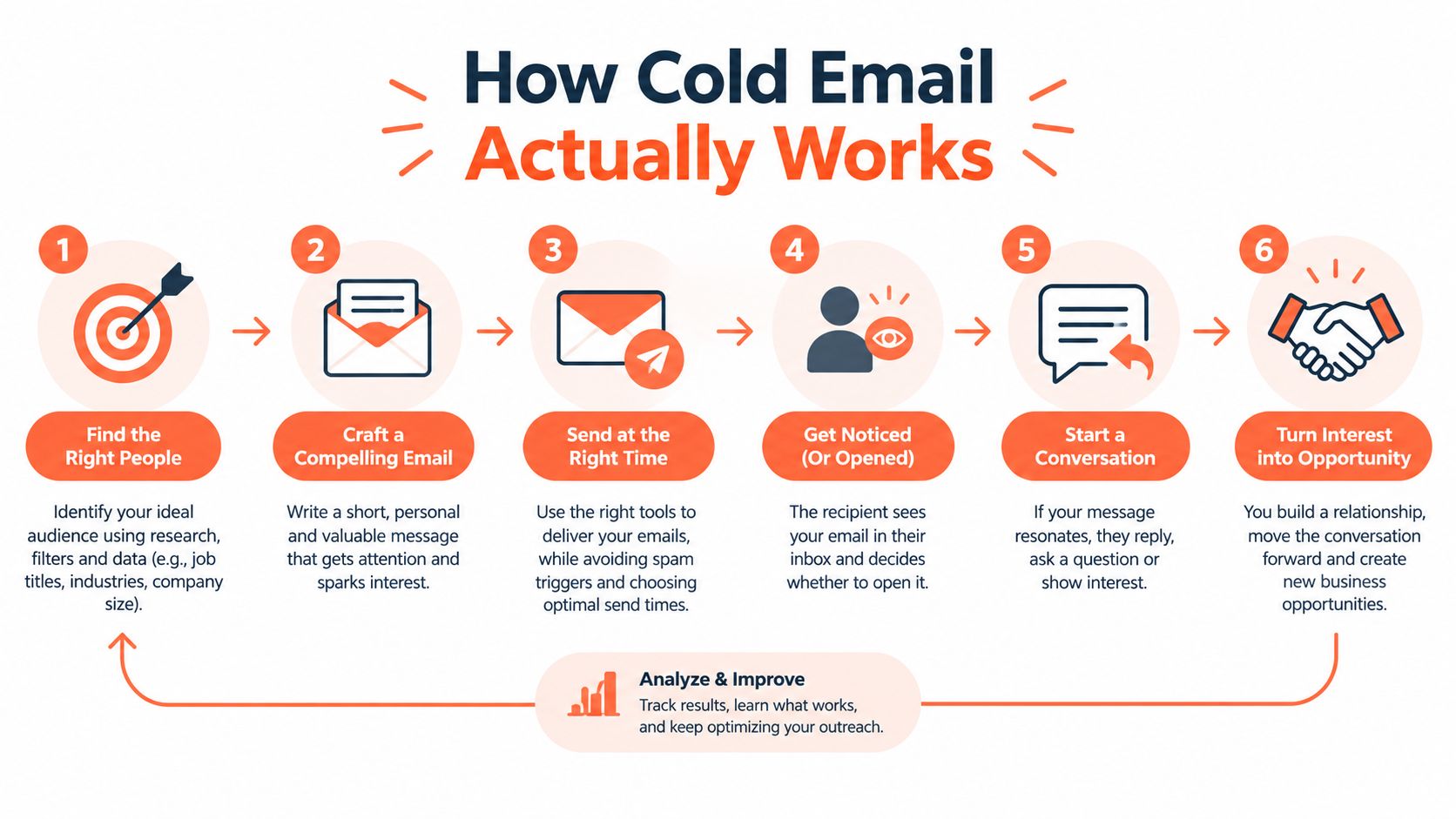
The Lead Printer cold email playbook offers a useful practical reference for teams mapping prospecting, messaging, and follow-up into one workflow. Its value lies in treating outreach as a sequence of operating decisions rather than as copy pasted into a sending tool.
Many marketing teams over-invest in the visible part, usually the email body, and under-invest in list hygiene and domain health. That's backwards. Strong copy can't rescue an address that shouldn't have been contacted, and personalisation can't compensate for an email that never reaches the inbox.
What the 2026 Numbers Say
The 2026 benchmark picture is underwhelming. Average cold email reply rates sit at 3.43%, while stronger campaigns exceed 10%, according to Instantly's 2026 outbound benchmark. That spread matters more than the average. Cold email can produce conversations, but performance depends heavily on whether messages reach the right people and whether the offer fits their current priorities.
Open rates look healthier and are easier to overstate. Reporting places average cold email opens around 27.7% to 44%, with a commonly cited good range of 40% to 60% and excellent campaigns reaching 65% or more (Emailchaser's cold email statistics). Apple Mail Privacy Protection makes open data directional rather than definitive. Use it to investigate delivery and subject-line behaviour, not as the main measure of commercial success.
| Metric | Bottom Quartile | Median or Average | Top Quartile |
|---|---|---|---|
| Reply rate | Below 1% | Around 3.43% | 5.5% or higher, with elite campaigns above 10% |
| Open rate | Directionally low | Around 27.7% to 44% | Can reach 65% or more |
| Business value | Limited conversation volume | Viable only with strong economics | Sufficiently strong to support scalable pipeline |
These figures are not directly comparable across every campaign. A role-targeted list should be judged differently from a company-level list with no identified buyer. A smaller, carefully reviewed campaign may create more useful conversations than a large send to contacts who are valid but commercially irrelevant. Volume can expose patterns. It cannot create fit.
List quality also changes the economics behind the averages. A verified address reduces the risk of sending to an invalid mailbox, but verification does not confirm that the contact owns the problem, works at an active company, or has a reason to respond. Every poorly matched record consumes sending capacity and adds noise to the performance data.
Industry, seniority, and timing create further variation. A message sent to the person responsible for a problem has a clearer route to a reply than one sent to a general company address. Personalisation matters only when it improves relevance. A first name adds little compared with a specific connection to a hiring decision, product launch, or operational constraint.
Follow-up can create more opportunities for recognition, but it cannot compensate for weak targeting or poor inbox placement. Research on large-scale outreach associates personalisation and follow-up with stronger performance, without turning a sequence into a guarantee. Each message should add context instead of repeating “just checking in.”
For operators, reply rate alone isn't enough. Track delivery, inbox placement, positive replies, qualified meetings, show rates, and pipeline attribution separately. Eludic's guide to email deliverability metrics helps distinguish a messaging problem from a campaign that never reached a usable inbox.
Deliverability and Compliance as the Real Gatekeepers
A cold email can't generate a reply if the receiving system doesn't place it where the recipient can see it. Deliverability is therefore a gating condition, not a secondary technical concern for the person managing campaigns.
The baseline authentication layer has three parts:
- SPF helps receiving systems verify which senders are authorised to send for a domain.
- DKIM attaches a cryptographic signature that helps confirm the message wasn't altered and is associated with the sending domain.
- DMARC tells receiving systems how to handle messages that fail authentication checks and aligns the visible sender with authenticated infrastructure.
A 2026 deliverability summary reports global inbox placement at approximately 83.1%, and says fully authenticated domains using SPF, DKIM, and DMARC are 2.7 times more likely to reach the inbox than unauthenticated sends (Shno's email deliverability statistics). The same reporting notes that Microsoft rejects high-volume mail lacking these authentication controls. Authentication doesn't make an irrelevant email welcome, but missing authentication can prevent the message from being evaluated on relevance at all.
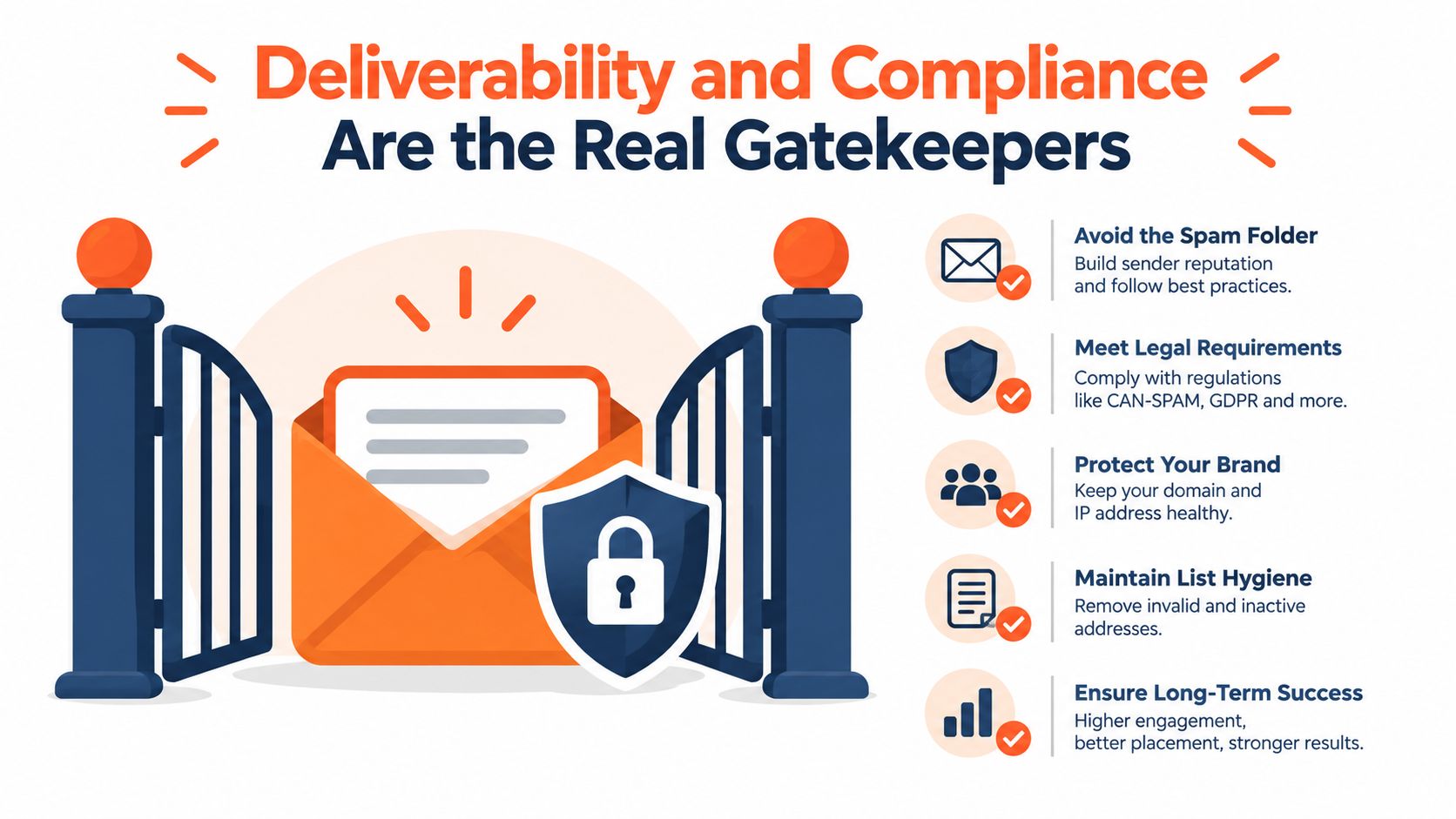
Compliance belongs in campaign operations
Legal compliance isn't solved by adding an unsubscribe link at the end of a launch. The operator needs a documented process for identifying the sender, handling opt-outs, suppressing unsubscribed contacts, and matching the outreach basis to the relevant jurisdiction.
CAN-SPAM, GDPR, and CASL impose different obligations and should not be treated as interchangeable. A practical program needs clear business identification, an easy removal mechanism, and a suppression process that prevents future contact after an opt-out. Teams evaluating the operational side can use this B2B email marketing compliance guide as a reference point.
A pre-launch inbox checklist
Before increasing volume, the sender should confirm:
- Authentication: SPF, DKIM, and DMARC are configured and aligned.
- List quality: Addresses are verified, roles are relevant, and unsuitable contacts are removed.
- Reputation monitoring: Bounces, complaints, and unusual delivery changes trigger review.
- Suppression: Unsubscribed contacts leave every relevant sequence.
- Message relevance: The offer matches the recipient's role and company context.
- Measurement: Reply and positive-reply data are separated from opens.
A report on clean authenticated senders has cited a 98.29% deliverability rate, while also warning that delivery is not the same as inbox placement (Belkins' email deliverability research). That distinction matters. A server can accept a message without placing it in the primary inbox, so “sent” is not evidence that the prospect saw the email.
Cold Email vs the Other B2B Outbound Options
Founders usually compare channels by asking how quickly each can create a qualified conversation without consuming scarce operating capacity. Cold email has an advantage when the target market is identifiable and the offer can be explained directly. It is less effective when the company needs broad category education or long-term trust before a buyer is ready.
| Channel | Time to First Meeting | Average Cost per SQL | Targeting Control | Scalability |
|---|---|---|---|---|
| Cold email | Fast after infrastructure and list preparation | Potentially efficient with a defined list | High at contact level | High, constrained by reputation |
| Inbound content | Slow to compound | Variable and dependent on content performance | Medium | Compounds over time |
| Paid LinkedIn or Google ads | Fast for traffic, variable for meetings | Variable by audience and competition | Medium to high | High, constrained by budget and platform rules |
| Outsourced agency | Fast once launched, dependent on setup | Includes service and management cost | Depends on agency process | Medium to high |
| In-house SDR team | Slower during hiring and ramp-up | Includes salary, tools, management, and training | High | Depends on headcount |
Cold email is often the quickest route when a founder can name the companies, roles, and problem. Paid advertising can win when demand generation needs reach beyond a known account list. Inbound content can win when buyers need education, proof, and repeated exposure before they engage. The right choice depends on whether the business needs immediate conversations or durable market familiarity.
The cost comparison also needs a wider frame. A self-serve stack may look inexpensive because software is visible while research, copywriting, monitoring, reply handling, and calendar coordination are treated as free founder labour. An agency removes much of that work but adds management fees. An internal SDR can create more control, but the company also carries recruiting, training, compensation, supervision, and tooling overhead.
A useful comparison of prospecting platforms should focus on workflow ownership rather than feature counts. For teams comparing outbound automation options, this discussion of why Ploot surpasses Waalaxy provides context on how different tools approach prospecting and execution. Teams that need a broader operating framework can also review B2B outbound sales as a separate planning discipline.
The breakeven question is simple: How much internal time does the program require before it produces a qualified meeting? If a founder or SDR spends hours repairing lists, monitoring reputation, writing variants, and chasing replies, the software bill understates the true cost. Cold email becomes attractive when the business controls a narrow audience and can either run the system efficiently or assign operations to a specialist.
Real-World Results From Named Programs
Named program results can make cold email look more certain than it is, so case studies need to be read as operating examples rather than universal benchmarks. The available Eludic material identifies Ravn, Full Scale, and CIDT as examples of programs that used different combinations of targeting, sequence design, infrastructure, and human review.
Ravn's program focused on a defined ideal customer profile and a 14-touch sequence, with qualified demos booked within 30 days, according to the publisher's supplied case-study information. The operational lesson isn't that every company needs 14 touches. It's that the sequence was built around a specific audience and gave the campaign enough structured opportunities to create a response.
Full Scale took a different path. Its reply rate had stalled at 1% when the program used a broad mass-blast approach, then the team moved toward segmented nurture. The reported improvement followed a change in audience and follow-up logic, not a claim that one rewritten sentence solved the problem.
CIDT's program used warmed domains and human review, and the supplied case-study material reports an 18% reply rate at volume. That result should be treated as a program-specific outcome, not a general forecast. It does, however, highlight why sending infrastructure and quality control can sit alongside copy as core performance variables.
| Program | Reply Rate | Pipeline Outcome | Key Operational Change |
|---|---|---|---|
| Ravn | Not specified in the supplied data | Qualified demos booked within 30 days | Tight ICP and 14-touch sequence |
| Full Scale | Started at 1% before segmentation | Improvement after the program change | Shift from mass blast to segmented nurture |
| CIDT | 18% at volume | Sustained replies in the named program | Warmed domains and human review |
The common thread is operational discipline. Each example treated the audience as a design problem, not a raw contact count. Each used follow-up or review to improve the chances that a relevant contact would recognise the message.
The case-study lesson: A result belongs to the system that produced it. Copy alone doesn't explain the outcome.
Founders should ask what changed before and after each result. Was the list narrowed? Were sending domains separated and authenticated? Did a human validate contacts? Did the team respond quickly? Those questions are more useful than copying a subject line from a successful campaign.
When Cold Email Pays Off and When It Doesn't
Cold email pays off when the business can define a reachable market with enough precision to make each contact plausible. The strongest starting conditions are a clear ICP, a verified contact base, authenticated sending infrastructure, a sequence with more than one touch, and a testing habit that treats every result as evidence rather than proof.
The channel becomes fragile when the team rents or scrapes a broad list, sends from an unauthenticated domain, blasts one message, or expects an exceptional reply rate from a tiny audience. A broad list creates two costs at once. It lowers relevance and can damage reputation, which makes future messages harder to deliver even after the copy improves.
A readiness test for founders
Before scaling, the operating owner should answer these questions:
- Audience: Can the team explain why each selected role has a plausible reason to care?
- Data: Has someone checked whether contacts are current, relevant, and safe to contact?
- Infrastructure: Are SPF, DKIM, and DMARC authenticated and monitored?
- Offer: Does the email describe a specific business problem rather than a list of features?
- Sequence: Does follow-up add context instead of repeating the first message?
- Measurement: Can the team separate replies, positive replies, qualified meetings, and pipeline?
- Ownership: Is one person responsible for replies, opt-outs, testing, and reputation?
A managed partner can make more sense than an internal SDR when sales leadership lacks time to operate the system, no one understands deliverability, or pipeline needs to start without a lengthy hiring and ramp-up process. A self-serve tool may be sufficient for a team that already has those capabilities. Eludic is one managed option that builds authenticated sending infrastructure, researches the audience, writes message variants, manages deliverability and compliance, handles replies, and coordinates meetings for B2B clients.
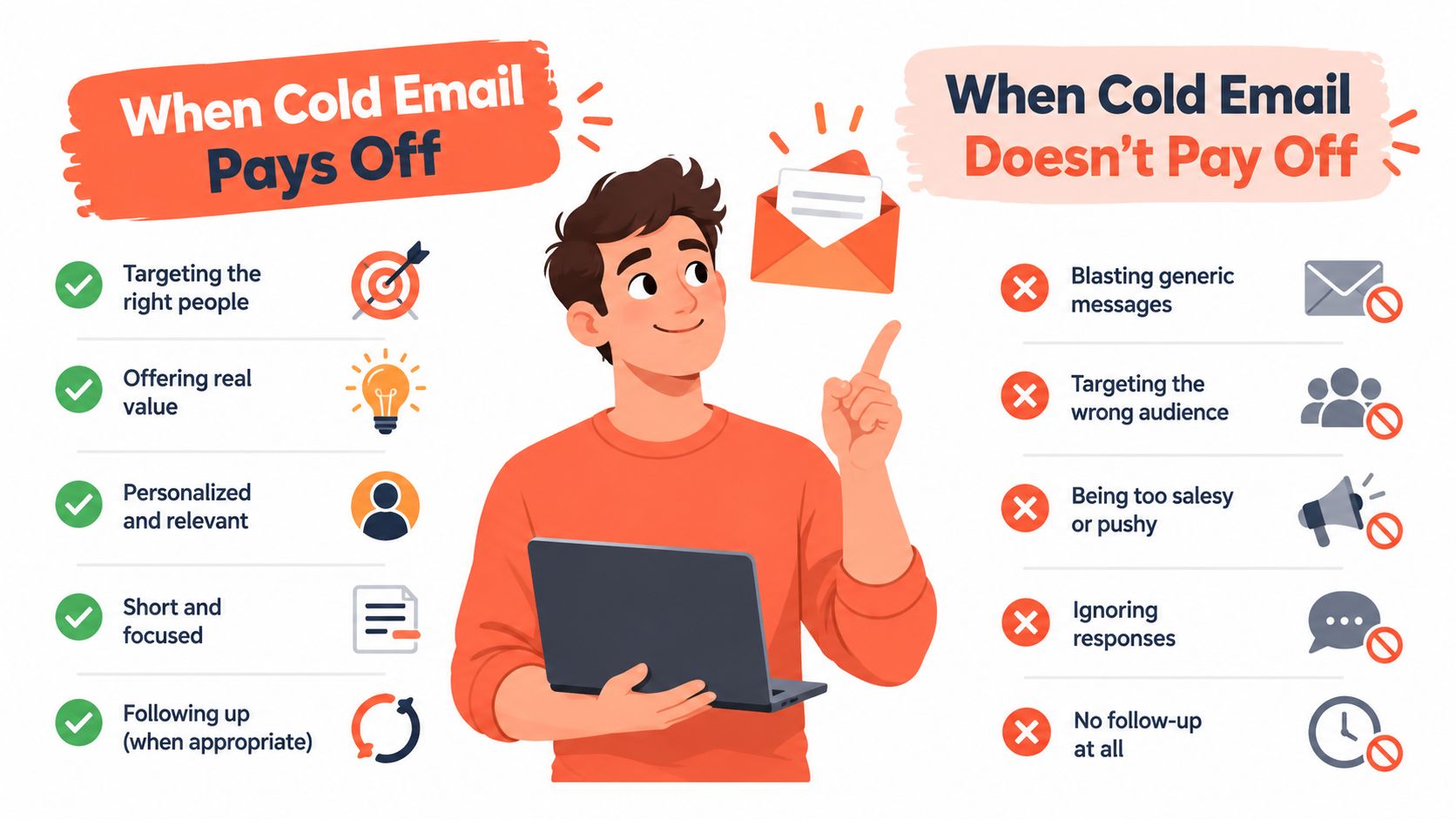
The final decision shouldn't rest on whether cold email works in the abstract. It should rest on whether the company can protect inbox placement, maintain list quality, make a relevant offer, and convert replies into sales conversations. If those conditions aren't present, adding volume only magnifies the weakness.
Eludic builds and manages B2B cold email programs, including authenticated infrastructure, prospect research, personalised campaign variants, deliverability monitoring, reply handling, and meeting coordination. Visit Eludic to submit an initial brief and assess whether a managed outbound program fits the company's pipeline goals.