

A footer link doesn't make a cold email campaign GDPR compliant. It only gives a recipient somewhere to read more after the sender has already decided what data to use, why to use it, which vendors will process it, and how the campaign will handle objections.
A useful GDPR compliance checklist works more like a pre-send and ongoing operating system. It starts with the lawful basis and the source of each contact, then follows the campaign through privacy notices, infrastructure, suppression lists, vendor contracts, rights requests, retention, and incident escalation. Every decision should leave an audit-ready record, not just an assumption that “B2B outreach is allowed.”
GDPR was adopted in 2016 and became enforceable on 25 May 2018, creating a common privacy framework across the EU. Enforcement has since become a material financial and operational risk. By 1 March 2026, the CMS GDPR Enforcement Tracker recorded 2,685 fines across 32 countries, totaling about EUR 6.11 billion. EU, UK, and US requirements can overlap, but they aren't interchangeable. This guide is a campaign-planning aid, not jurisdiction-specific legal advice.
1. Implement Lawful Basis Documentation
Every outbound campaign needs a written answer to one question: why is this organization allowed to process and contact this person? GDPR recognizes several lawful bases, including consent, contract, legal obligation, vital interests, public task, and legitimate interests. For cold B2B email, legitimate interests may be relevant, but it isn't a shortcut around documentation or recipient rights.
The UK ICO advises organizations to review each processing purpose, select the most appropriate lawful basis, and document the decision in its guide to lawful basis. A campaign record should identify the commercial purpose, target audience, source of the data, expected recipient context, privacy impact, and the safeguards that protect individuals.
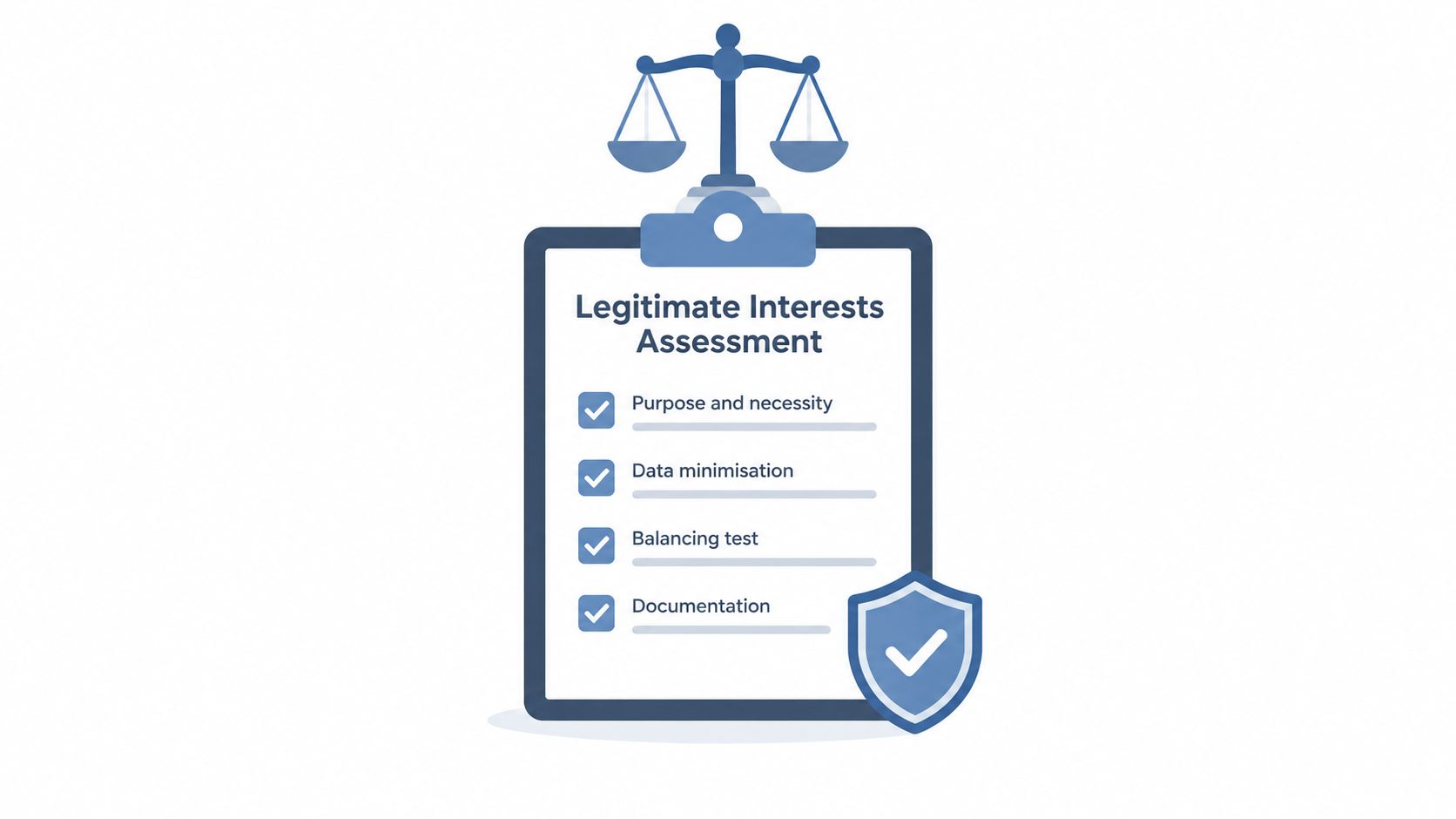
A legitimate interests assessment should address three practical questions:
- Purpose test: Is the purpose specific, such as account-based prospecting or meeting qualified business prospects?
- Necessity test: Is using personal contact data necessary for that purpose, or could a less intrusive approach work?
- Balancing test: Would the recipient reasonably expect the contact, and do the organization's interests outweigh the person's privacy rights?
Cold email to a role-based business address may create a different expectation from outreach to a private address. That distinction should appear in the assessment rather than being left to a salesperson's judgment.
Practical rule: Store the lawful-basis assessment with the campaign brief, source inventory, copy variants, and approval record. A policy statement explains intent. The campaign file proves how the team applied it.
Organizations should also document how recipients can object and how the team will explain the decision during client intake. A managed provider such as Eludic can place this assessment into the discovery and campaign setup workflow, but the client still needs to approve the purpose and remain accountable for its controller decisions. For broader consent operations, teams can review Eludic's consent management guidance.
2. Build Privacy by Design Into Campaign Setup
Privacy by design is a pre-send control system, not a document filed after a complaint. Configure the campaign so it collects less data, limits access, records key decisions, authenticates the sending domain, and gives recipients a direct way to stop processing.
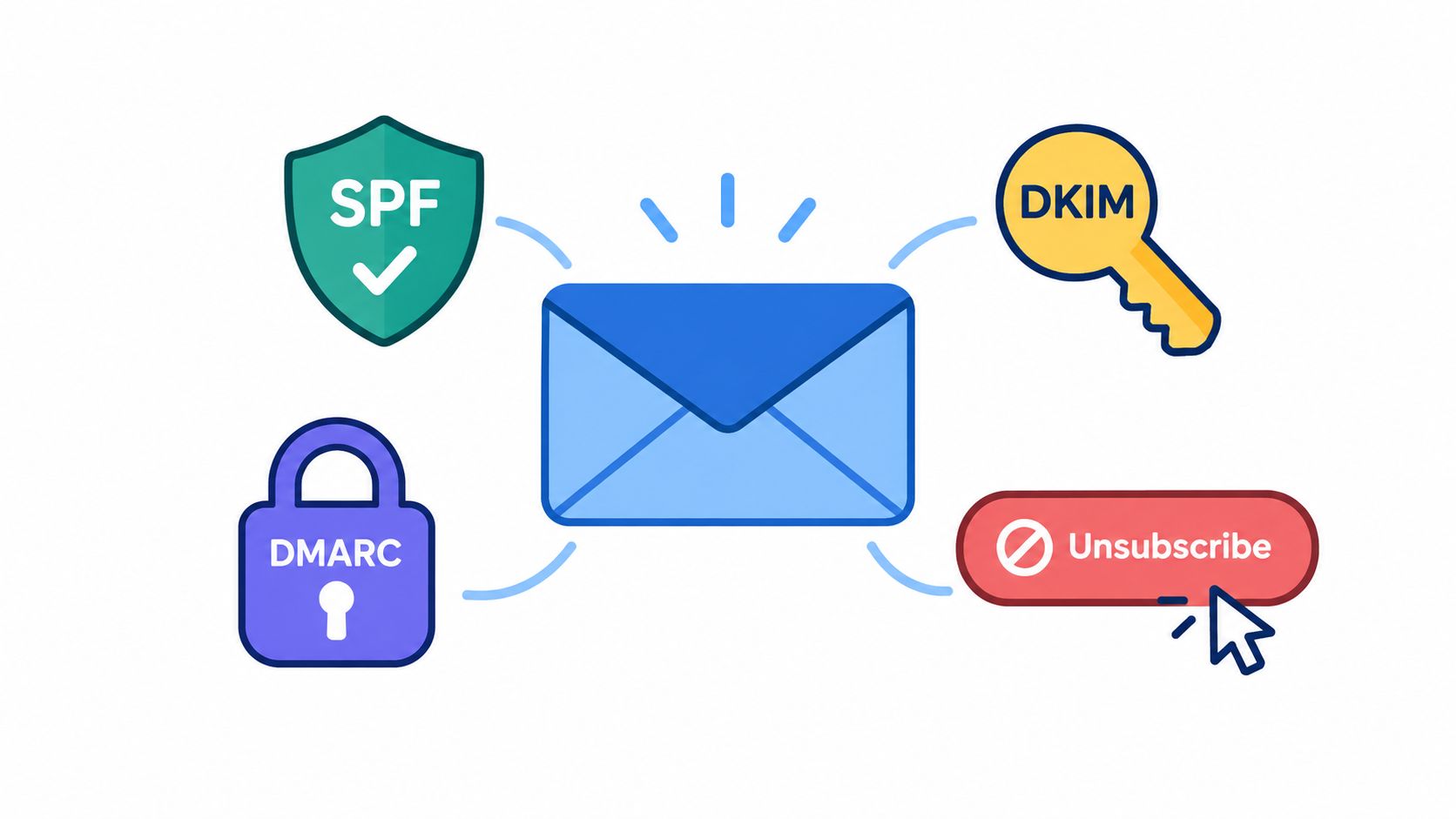
Set up SPF, DKIM, and DMARC before live messages leave the inboxes. These records support email authentication and sender protection, while the configuration and testing results belong in the campaign launch record. Infrastructure choices affect daily operations and give investigators evidence when a delivery or privacy incident occurs.
The recipient experience needs the same discipline. Each template should provide a clear route to the privacy notice and an unsubscribe mechanism that works without a login, extra confirmation, or manual handling. The List-Unsubscribe header can offer compatible email clients a native removal option. A visible message link provides a second route for recipients whose clients do not support that header.
Campaign controls to verify before sending
- Minimize fields: Collect only the information required to select, personalize, send, and administer the campaign.
- Map access: Record which staff members and systems can view recipient records, replies, engagement data, and suppression records.
- Document retention: Specify where lists, replies, logs, and exports are stored, then assign a deletion point to each category.
- Test the exit path: Submit test opt-outs through every available route and confirm that suppression reaches each campaign system.
- Expose status: Give client operators access to suppressed contacts, objection reasons, and campaign-level compliance actions.
Run the suppression test across the entire workflow, including exports and automation rules. A global suppression list prevents a recipient who objects to one sequence from reappearing in another audience export. Eludic's managed setup illustrates this operating model by handling domain configuration, deliverability operations, campaign copy, and unsubscribe processing as connected launch tasks.
The Email compliance guidance from Eludic outlines ways to translate these requirements into campaign controls. The practical test is whether the program can stop processing when a recipient exercises a right, and whether the record shows who approved the change and when.
3. Establish Data Processing Agreements With Email Infrastructure Providers
Cold outbound depends on a chain of systems. Recipient data can move through a CRM, research or enrichment service, sending platform, inbox provider, analytics tool, warm-up service, calendar application, and reporting dashboard. Before sending, document who processes the data, whose instructions they follow, where processing occurs, and which safeguards apply.
The controller should identify each processor before uploading live records and sign the relevant Data Processing Agreements, or DPAs. Review the purpose and duration of processing, data categories, security measures, breach assistance, sub-processors, deletion or return duties, support for data subject requests, and any international transfer mechanism that applies. A signed contract records the control. It does not, by itself, prove that the vendor's setup matches the campaign.
Review the vendor chain, not just the primary platform
A CRM review is incomplete if connected enrichment, analytics, or sending services remain unchecked. The vendor register should include every service that can access recipient information, including providers used indirectly by a managed service.
Before launch, keep these items in the onboarding file:
- Processor identity: Legal entity, service function, and controller or processor role.
- Sub-processor details: Current list, notification process, and vendors supporting warming, analytics, or list building.
- Data location: Storage and processing regions, with transfer safeguards reviewed for the client's operating geography.
- Security commitments: Contractual measures and relevant assurance documentation, where available.
- Rights support: Procedures for exports, corrections, deletion, and objections.
- Exit terms: How data is returned, deleted, or retained when the service ends.
Eludic can provide a DPA to clients while holding agreements with infrastructure partners involved in delivery. That structure clarifies responsibilities, but the client remains accountable for its controller decisions. Teams comparing vendor terms can review Horus DPA terms as a practical contract reference.
The DPA should be signed before the recipient list is uploaded. Record approval, transfer review, and any unresolved vendor limitation in the campaign file, then define who escalates a breach, rights request, or sub-processor change. The contract supports the operating system, while launch checks and ongoing review show whether it works in practice.
4. Create and Maintain a Data Inventory and Recipient Source Documentation
“Found on LinkedIn” isn't a sufficient source record. A defensible campaign file should show where each recipient record came from, what information was collected, why the person matched the audience, and how the team will respond if the person asks for an explanation.
A data inventory can be simple. It can live in a structured CRM field, campaign database, or processing register, as long as the record remains accessible and consistent. The minimum useful fields include source name, source type, acquisition context, date added, processing purpose, lawful basis, retention rule, and campaign association.
Make source documentation part of intake
The source review should happen before list building. A client brief should answer:
- Approved sources: Which company directories, professional networks, referrals, public pages, or data vendors may be used?
- Permitted fields: Which job, company, and contact attributes are necessary for targeting and personalization?
- Regional scope: Which recipients fall within EU or UK processing considerations?
- Vendor assurances: What documentation supports a purchased or enriched record?
- Exception handling: What happens when a record contains a personal address, sensitive inference, or unclear provenance?
Public availability doesn't automatically establish permission for every downstream use. A business contact may be identifiable in a professional context, yet the campaign still needs a purpose, transparency route, objection process, and retention decision.
Purchased lists deserve particular caution. A vendor's claim that a list is “GDPR compliant” isn't a substitute for reviewing its source, lawful-basis reasoning, collection notices, and contractual assurances. If the provider can't explain provenance, the list shouldn't enter the sending workflow.
Source metadata should travel with the campaign. When a recipient asks where the data came from, the answer should be retrievable without searching through individual spreadsheets or relying on a salesperson's memory.
5. Implement Automated Unsubscribe Handling and Suppression List Management
An unsubscribe request should change the recipient's status across the entire outbound system. It shouldn't merely remove the person from one sequence while leaving another campaign, CRM export, or enrichment workflow free to re-add the address.
GDPR's right to object is especially important for direct marketing. The ICO guidance on electronic direct marketing emphasizes that electronic marketing must be fair, lawful, and transparent. Ireland's Data Protection Commission concluded 275 electronic direct-marketing investigations in 2025, an 88% increase from 2024, according to the DPC's published enforcement information. That makes outbound suppression a live operating control, not a footer detail.
A reliable workflow should:
- Capture every route: Process visible unsubscribe links, List-Unsubscribe requests, direct replies, complaints, and client-entered do-not-contact instructions.
- Suppress globally: Block the address across current and future campaigns, including re-imports.
- Record the event: Save timestamp, source, reason, campaign, and system action.
- Stop quickly: Remove the address from queued messages and prevent new enrollment.
- Audit regularly: Compare suppression records against send logs and investigate any mismatch.
The suppression record may need to remain available so the organization can honor the objection. Deleting every trace without preserving a minimal do-not-contact control can create a recontact risk.
Eludic's email marketing compliance guidance is relevant to this campaign-room decision because built-in unsubscribe handling only helps when the suppression state synchronizes across the stack. Teams should test the full path, including CRM imports and external list updates, rather than testing only the link in the email template.
6. Develop a Data Breach Response Plan and Incident Notification Procedure
A breach plan must identify people, decisions, evidence, and deadlines before an incident occurs. “The security team will handle it” leaves too many unanswered questions: who confirms the event, who contacts the controller, who assesses risk, who preserves logs, and who decides whether a regulator or affected person must be notified?
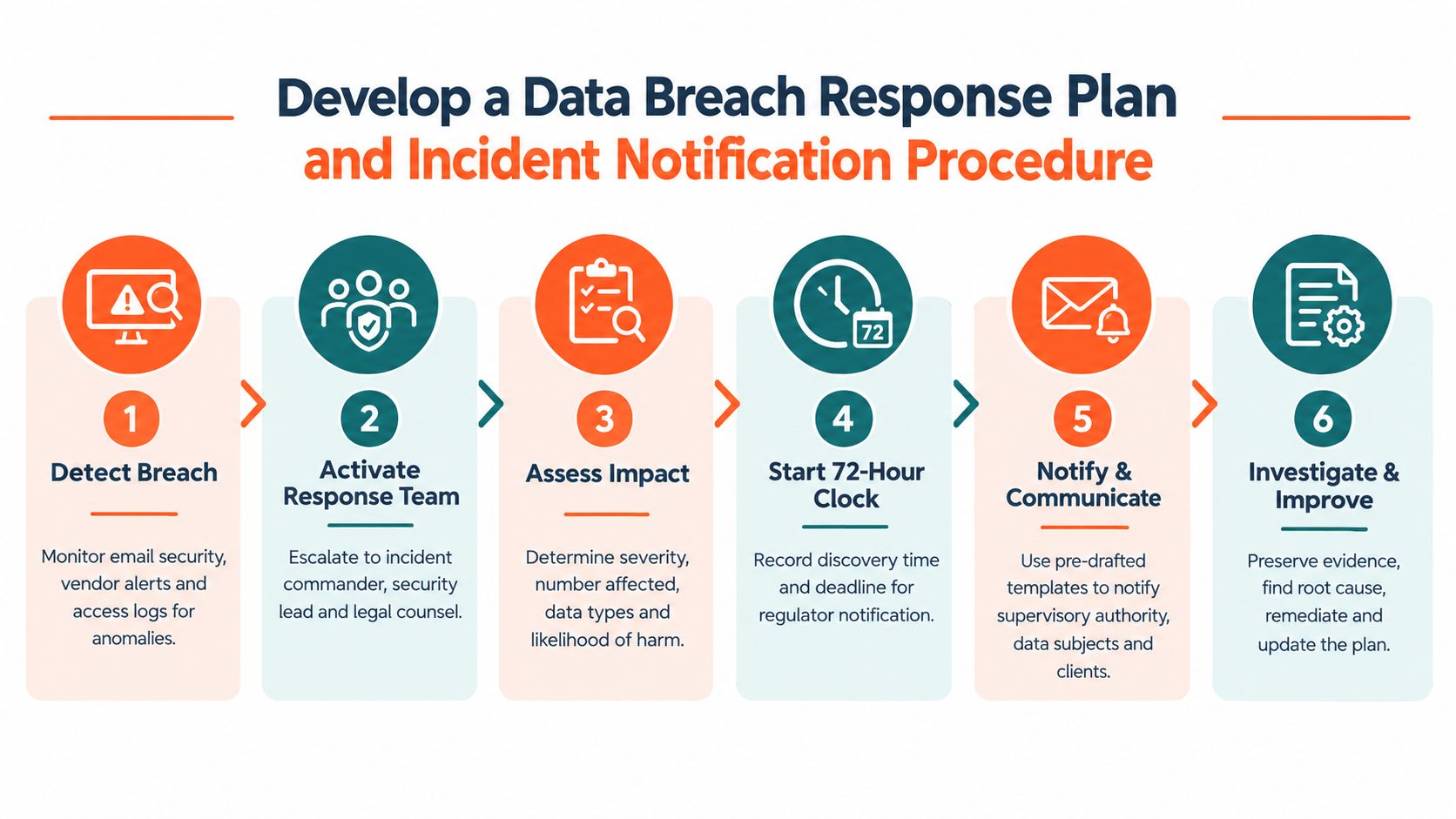
Under GDPR, a controller may need to notify the supervisory authority without undue delay and, where applicable, within 72 hours of becoming aware of a personal data breach. The obligation and timing should be verified with counsel for the relevant jurisdiction, but the operational response should begin immediately.
Define the first response path
A campaign provider and client should agree in writing on:
- Detection: How vendor alerts, access anomalies, lost devices, misdirected exports, and credential events are reported.
- Containment: Who disables access, pauses sending, rotates credentials, and preserves affected systems.
- Assessment: Who determines whether personal data was exposed, altered, lost, or made unavailable.
- Notification: Which party contacts the supervisory authority, and who drafts communications to individuals if required.
- Evidence: Where incident logs, timelines, vendor notices, and decisions are stored.
- Remediation: How the team corrects the control failure and records the follow-up.
The discovery time matters. A team should record when the controller knew or reasonably should have known about the event, not only when the unauthorized access began.
Campaign infrastructure deserves a focused incident playbook. It should cover sending credentials, CRM tokens, inbox access, recipient exports, reply content, suppression lists, and third-party integrations. A vendor's DPA should define how quickly the processor alerts the controller and what assistance it provides.
A post-incident review should update access controls, vendor procedures, training, and campaign launch gates. A plan that exists only in a policy folder won't help an operator make the right decision during a live incident.
7. Conduct Data Protection Impact Assessments for High-Risk Campaigns
A campaign that adds AI enrichment to a large contact list triggers a different risk review than a static list of target accounts. The decision belongs in the campaign workflow before data enters an automation or sending system, not in a generic policy folder.
Start with a documented screening path:
- Are special-category data or sensitive inferences involved? If yes, exclude those fields where possible and escalate the campaign for legal review.
- Does the workflow profile people? Scoring, ranking, or inferring traits beyond what outreach requires may need a fuller assessment.
- Does new technology change the risk? AI personalization, automated enrichment, and behavioral tracking should be reviewed against the actual fields, vendors, and rules used.
- Could the audience face greater harm from unexpected contact? Treat vulnerable groups and persistent outreach as higher-risk conditions.
- Does the campaign monitor activity at scale? Combining behavior across channels can create risks that a single-contact review misses.
- Is the data being reused in a substantially different context? If the original collection purpose does not support the campaign, pause and resolve the purpose and transparency issue first.
A B2B audience still contains individuals with privacy rights. Company affiliation does not remove concerns about profiling, unexpected use, or transparency.
A straightforward audience based on business role and company relevance may pass with a recorded risk screen, subject to legal review. If enrichment reveals sensitive details or personalization relies on inferred behavior, the campaign should not proceed until the team completes a DPIA and records its decision.
The DPIA should describe the processing, explain why it is necessary and proportionate, identify risks, and connect each mitigation to campaign configuration. Controls can include narrower fields, excluded attributes, reduced tracking, restricted access, shorter retention, clearer privacy information, and human review before automated enrollment. If high residual risk remains, obtain jurisdiction-specific advice before sending.
8. Establish Clear Data Retention and Deletion Policies
Retention begins with a campaign decision: what continuing business purpose justifies keeping this record? GDPR's storage-limitation principle requires organizations to remove personal data when it is no longer necessary for the stated purpose. A retention policy therefore belongs in campaign setup and automation, not only in a legal file.
Build the schedule around how records are used:
- Active contacts: Keep them while the approved campaign purpose remains active.
- Engaged prospects: Retain them when an ongoing commercial conversation provides a documented reason.
- Unresponsive contacts: Review and remove them when the campaign ends and further outreach is not justified.
- Objectors: Preserve only the minimum information needed to prevent recontact.
- Expired records: Delete or anonymize them through an automated process, with completion logged.
The period needs a reason and a trigger. “The CRM keeps it indefinitely” describes a vendor setting, not a GDPR necessity. Campaign owners should be able to state why a record remains useful, which event ends that purpose, and who approves exceptions.
Automation makes those decisions executable. Scheduled jobs can remove expired contacts from the sending database. A narrowly scoped legal-hold flag can pause deletion when a rights request, complaint, dispute, or investigation requires preservation. The responsible privacy or legal owner should review each hold rather than allowing it to become permanent by default.
Deletion must reach connected systems. Removing a contact from the sender while leaving copies in enrichment tools, spreadsheets, exports, or analytics logs produces an incomplete result. The deletion record should state what was removed, when, from which system, and under whose approval. If a provider manages the workflow, confirm that its setup records each system action instead of assuming synchronization.
Give clients the retention schedule during onboarding. It should identify what the managed service keeps, what it deletes, what remains for suppression, and how data can be exported before termination. This documentation turns retention from a storage habit into a pre-send control and an ongoing review point.
9. Provide Data Subject Rights Support for Access, Deletion, and Portability
A rights request is a campaign event, not an inbox task. It may arrive through a campaign reply, privacy inbox, website form, or client support channel. Route every entry point to a named owner who can verify the requester, locate records, coordinate processors, and document the decision.
Access requests often reach beyond the original email address. The response team may need to search the sending platform, CRM, campaign notes, reply history, analytics records, enrichment logs, and suppression database. Where the client and managed provider control different systems, the DPA should assign responsibility for collection, review, approval, and delivery.
Turn each request into a controlled workflow
Use a record that can be followed from intake to closure:
- Intake: Log the request, receipt date, requester identity, systems involved, and rights requested.
- Verification: Confirm the requester relates to the stored person record without collecting unnecessary identity data.
- Search: Query relevant campaign systems and connected processors, including managed-service environments.
- Review: Remove information that cannot lawfully be disclosed and check for legal holds or competing obligations.
- Delivery: Send the response in an accessible format through a secure channel.
- Completion log: Record the decision, data supplied or deleted, systems updated, and completion date.
The GDPR response window is commonly described as one month for a standard request. Confirm the applicable rule and any permitted extension with counsel. Set an internal deadline earlier than the legal limit so the team has time to review the result and resolve missing records.
Deletion must propagate across the operating stack. Removing a recipient from the campaign platform while leaving a CRM export or enrichment copy creates an incomplete outcome. The same control applies to portability. A CSV or JSON file helps only when it uses understandable field names and includes information held across the systems processing that person's data.
Define escalation before sending begins. A privacy contact should own requests that arrive through public channels, while campaign owners supply context and system access. Eludic clients should document whether requests sent directly to the provider are handled by Eludic, forwarded to the controller, or managed jointly under the DPA. That decision should be tested during onboarding and recorded with each campaign's compliance evidence.
10. Consolidate Compliance References and Best Practices
GDPR compliance for cold outbound is an operating system, not a folder of legal references. Build one evidence directory that lets a privacy lead reconstruct why a campaign launched, which data it used, which vendors processed it, how objections were handled, and what happened when records expired.
Store the lawful-basis decision, legitimate interests assessment where relevant, source inventory, privacy notice version, campaign brief, DPA register, transfer review, DPIA screen, suppression logs, rights-request records, retention schedule, deletion evidence, incident register, and training records. Assign each record an owner and connect it to the campaign event that created or changed it.
Make the evidence usable during onboarding
Use a control map rather than a loose collection of files:
- Legal basis: Approved by the client or controller before audience activation.
- Source record: Captured during list research and preserved with campaign metadata.
- Transparency: Linked from the message and retained in notice version history.
- Vendor controls: Verified before personal data enters a third-party system.
- Suppression: Tested before launch and monitored throughout sending.
- Rights support: Routed through a named contact with documented escalation.
- Retention: Applied automatically where possible and reviewed at campaign close.
- Incident response: Connected to live alerts, contact details, and decision records.
The CMS Enforcement Tracker figures cited earlier show why documented controls matter more than good intentions. Its reported largest single fine was EUR 1.2 billion against Meta Platforms Ireland in Ireland. That outcome does not predict an individual campaign result, but it demonstrates the practical risk of being unable to explain decisions, processing, or corrective action.
For a separate practitioner reference, teams can review this 2026 GDPR checklist for UK businesses. Treat it as a reference point, then confirm the campaign's jurisdictions, audience, vendors, processing purposes, and escalation path with counsel. In a managed setup such as Eludic, record these decisions during onboarding and keep the resulting evidence tied to the campaign, automation, and regional handling rules.
10-Point GDPR Compliance Comparison
| Item | Implementation Complexity 🔄 | Resource Requirements ⚡ | Expected Outcomes ⭐📊 | Ideal Use Cases 💡 | Key Advantages ⭐ |
|---|---|---|---|---|---|
| Implement Lawful Basis Documentation | 🔄 Moderate, legal review and LIA drafting required | ⚡ Moderate, legal time, documentation storage | ⭐ Strong legal defensibility; 📊 enables compliant B2B outreach without consent | 💡 Cold B2B outreach relying on legitimate interests | ⭐ Demonstrates accountability; reduces enforcement risk |
| Build Privacy-by-Design Into Campaign Setup | 🔄 High, technical + process integration from day one | ⚡ High, engineering, infra, monitoring | ⭐ Improves deliverability and compliance; 📊 reduces manual errors | 💡 New domain launches or scalable multi-client campaigns | ⭐ Structural compliance; better sender reputation |
| Establish DPAs with Email Infrastructure Providers | 🔄 Moderate, contract drafting and vendor negotiation | ⚡ Moderate, legal review, vendor management overhead | ⭐ Contractual clarity on roles; 📊 lowers regulatory exposure | 💡 Using third‑party senders, warm‑up, analytics, CRM vendors | ⭐ Mandatory for GDPR; clarifies responsibilities |
| Create and Maintain a Data Inventory & Recipient Source Documentation | 🔄 Moderate, ongoing documentation and verification | ⚡ Low–Moderate, staff time, CRM fields, templates | ⭐ Improves auditability; 📊 speeds SAR and regulator responses | 💡 Campaigns with mixed or purchased data sources | ⭐ Traceability for lawful‑basis proof and risk spotting |
| Implement Automated Unsubscribe Handling & Suppression List Management | 🔄 Moderate, platform integration and testing | ⚡ Medium, integration, monitoring, audits | ⭐ Prompt opt‑out compliance; 📊 fewer complaints and better inbox placement | 💡 High‑volume sends or multi‑client environments | ⭐ Instant suppression with audit logs; reduces legal risk |
| Develop a Data Breach Response Plan & Incident Notification Procedure | 🔄 High, cross‑functional processes and 24/7 readiness | ⚡ High, security, legal, comms resources and training | ⭐ Rapid documented response; 📊 reduces fines and reputational damage | 💡 Organizations processing significant personal data or using vendors | ⭐ Minimizes legal/reputational harm; meets 72‑hour rule |
| Conduct DPIAs for High‑Risk Campaigns | 🔄 High, structured risk assessment; possible regulator consult | ⚡ Medium–High, legal/security expertise and time (weeks) | ⭐ Identifies/mitigates privacy risks; 📊 required evidence for regulators | 💡 Large‑scale profiling, enrichment, AI personalization campaigns | ⭐ Mandatory when high‑risk; prevents regulatory issues |
| Establish Clear Data Retention and Deletion Policies | 🔄 Low–Moderate, policy + automation and exceptions | ⚡ Medium, scheduled jobs, legal hold support | ⭐ Reduces data‑at‑risk; 📊 lowers storage costs and aids erasure requests | 💡 Ongoing prospect databases and recurring campaigns | ⭐ Demonstrates data minimization; simplifies audits |
| Provide Data Subject Rights Support (Access, Deletion, Portability) | 🔄 Moderate, cross‑system workflows and verification | ⚡ Medium, staff, tooling to compile/export data within 30 days | ⭐ Ensures SAR compliance; 📊 builds trust and reduces complaints | 💡 Organizations receiving direct EU data‑subject requests | ⭐ Meets GDPR deadlines; provides documented fulfillment |
| Consolidated Compliance References & Best Practices | 🔄 Low, compile and maintain guidance | ⚡ Low, documentation upkeep | ⭐ Centralized guidance; 📊 faster onboarding and audit readiness | 💡 Onboarding, audits, client conversations and checklists | ⭐ Single source of truth; reduces implementation gaps |
Turn the Checklist Into Campaign Gates
A GDPR compliance checklist becomes useful when it controls whether a campaign can move forward. The strongest operating model has a documented gate before launch, automated controls during sending, and scheduled reviews after the campaign ends.
The first gate is the purpose and audience approval. The controller should approve the campaign objective, target region, recipient context, and lawful basis. If legitimate interests is being considered, the balancing assessment should address reasonable expectations, necessity, impact, and safeguards. The source inventory should identify where each record came from and which fields the campaign needs.
The second gate is transparency and regional handling. The privacy notice should explain the relevant processing purpose, lawful basis, recipients, retention approach, rights, and transfer information. EU and UK requirements should be reviewed separately where their rules or regulator guidance differ. US compliance, including CAN-SPAM requirements, can support good operational hygiene, but it doesn't replace GDPR analysis for EU or UK contacts.
The third gate is vendor and transfer approval. Every service that handles recipient data should appear in the processor register. DPAs, sub-processor information, security controls, deletion commitments, and international transfer safeguards should be reviewed before live data enters the stack. The controller and processor relationship should be written clearly, including who handles rights requests, breach escalation, and deletion.
The fourth gate is technical readiness. SPF, DKIM, and DMARC should be configured before sending. The campaign should use minimized fields, restricted access, clear privacy links, visible unsubscribe controls, and a global suppression list. Test records should confirm that an opt-out removes the contact from queued messages, active sequences, future imports, and connected systems.
The fifth gate is ongoing monitoring. Operators should review replies, complaints, bounces, suppression events, access changes, vendor alerts, and rights requests. Retention jobs should run against every relevant system, not only the sending platform. Incident contacts should remain current, and the team should know when to pause a campaign and escalate to legal or the incident lead.
Written controller and processor responsibilities prevent confusion when a recipient contacts a managed provider directly. Eludic can illustrate a managed workflow by handling infrastructure, deliverability, compliance workflows, replies, and meeting coordination on behalf of clients. It doesn't replace the client's legal accountability, approve the client's lawful basis, or eliminate the need for jurisdiction-specific legal advice.
The most reliable approach is to treat every campaign change as a possible privacy change. A new enrichment source, new region, new personalization method, new vendor, or longer retention period should trigger a review. That cadence turns GDPR from a static policy into a working control system that follows the data from research to send, reply, suppression, deletion, and incident response.
Eludic designs and manages B2B cold email infrastructure, including SPF, DKIM, DMARC, inbox warming, list building, campaign copy, reply handling, meeting coordination, and built-in unsubscribe workflows. Teams evaluating a managed outbound program can visit Eludic to see how the campaign setup and compliance operations fit together.