

Roughly 33% of cold emails still land in spam, while top performers maintain 93%+ inbox placement through authentication, warm-up, and reputation management. That's why the strongest cold email marketing agency option focuses on deliverability and operations, not just copy.
A founder can spend days approving a polished sequence, reviewing clever subject lines, and debating whether the call to action sounds natural. Then launch day arrives, replies stay flat, and the campaign report reveals the problem: many messages never reached the primary inbox. Worse, an incomplete opt-out process or poorly documented regional targeting can create compliance exposure while the sender reputation deteriorates.
The practical question isn't “Who writes the most persuasive email?” It's “Who owns the system that gets a relevant, compliant message in front of the right buyer and turns the reply into a qualified meeting?” That distinction separates a managed outbound operation from a copywriting package with a sending tool attached.
What Actually Drives Cold Email Results
A SaaS founder can approve a polished sequence and still generate almost no pipeline. The audience may be specific, the opening line may reference a real business trigger, and the offer may be clear. If the contact data is weak, the sending setup is poorly managed, or replies go unanswered, the campaign fails before copy quality can help.
Cold email performance depends on an operating system with three connected parts: the right audience, reliable execution, and disciplined reply handling. A provider that improves only the wording leaves the highest-risk parts with the buyer.
Average cold email reply rates sit around 3.43% to 3.7%, while top-performing campaigns reach 10% or more and the top 25% exceed 5.5% (cold email benchmark data). Those figures apply to messages that reach prospects. They do not show how many messages were filtered, ignored because the contact was irrelevant, or sent without follow-up ownership.

The operating system matters more than the template library
A capable cold email marketing agency should own the workflow across these areas:
- Audience quality: Define the ideal customer profile, verify contacts, segment by relevance, and suppress opted-out recipients.
- Infrastructure: Set up the sending environment, control mailbox usage, and maintain the configuration needed for consistent delivery.
- Campaign control: Adjust cadence, variants, audience groups, and send limits based on performance and feedback.
- Reply operations: Classify responses, answer objections, route qualified interest, and coordinate meetings quickly.
- Compliance records: Document targeting decisions, preserve suppression lists, and process opt-outs permanently.
The trade-off is accountability. A copy-only provider may produce better language, but the buyer still has to run the system and absorb the operational risk. A managed provider costs more and gives the buyer less direct control, yet the arrangement can be justified when it owns data quality, campaign execution, and reply coverage.
Use a practical guide to cold emails that get responses to sharpen messaging, but treat copy as one component of the workflow. A strong template cannot rescue an irrelevant list or an unattended reply queue.
Practical rule: Ask how the provider controls the workflow before reviewing its subject-line portfolio.
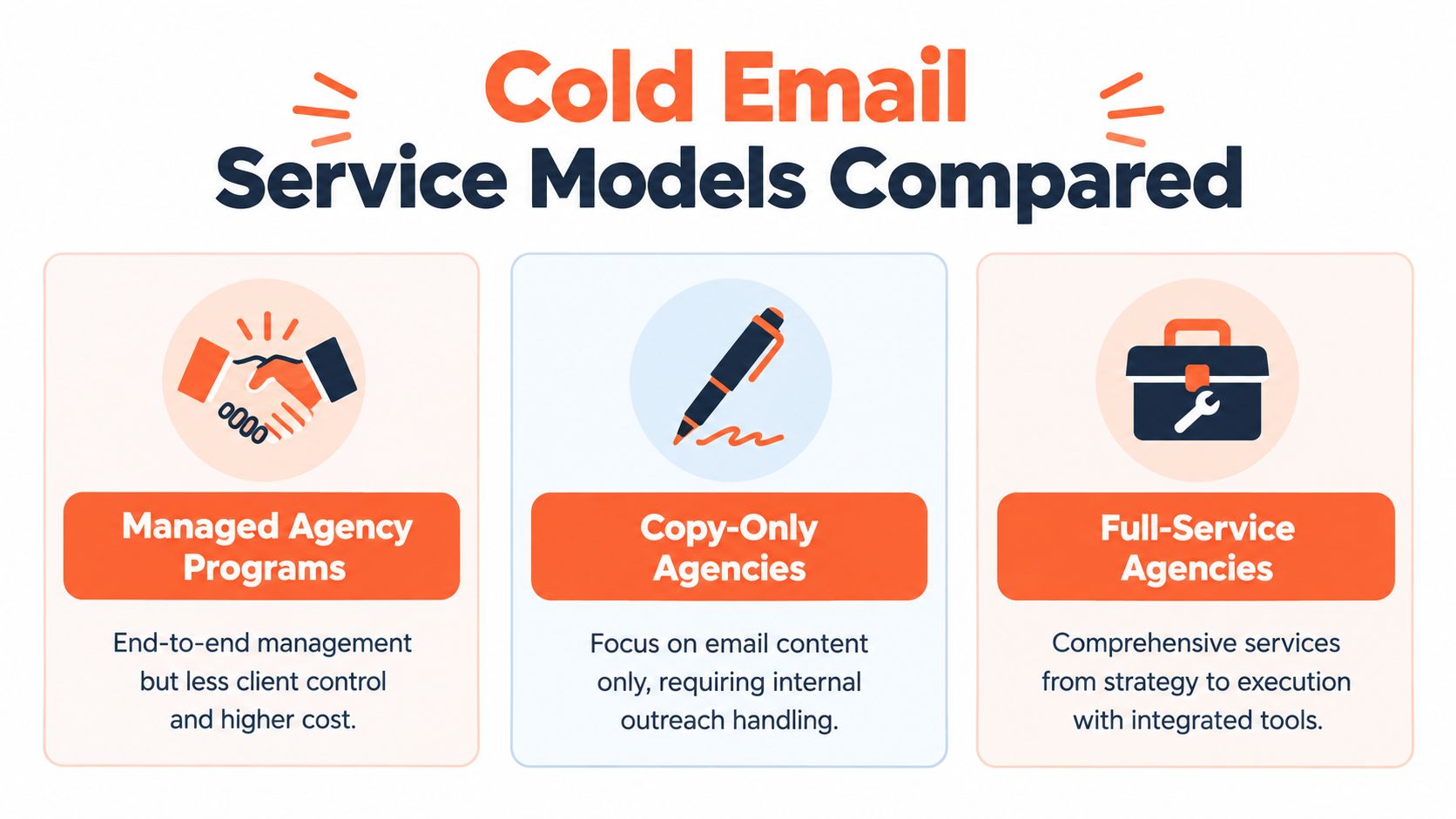
A tool provides capability. A copywriter provides language. A managed agency takes responsibility for connecting targeting, sending, responses, and pipeline. Each model can work when its owner has the staff and controls to operate it properly.
Cold Email Service Models Compared
The right model depends on how much operational work the buying team can absorb. A low subscription price may look attractive until the founder is also purchasing data, configuring domains, monitoring bounces, reviewing replies, and maintaining suppression lists. A higher fee can be rational when it removes those tasks, but only if the provider owns them.
| Service model | Deliverability responsibility | Launch speed | Founder involvement | Main trade-off |
|---|---|---|---|---|
| Managed agency program | Usually handled end to end | Faster than internal buildouts | Limited after briefing | Higher fee and less control |
| Copy-only agency | Often remains with the client | Fast for writing, slower for execution | High | Stronger messaging, unfinished operation |
| In-house SDR team | Built internally over time | Slower while hiring and training | High during setup | More control, heavier management burden |
| Self-serve tool stack | Client owns configuration and monitoring | Variable | Very high | Lower software cost, higher execution risk |
| Full-service agency | Strategy, infrastructure, sending, and replies | Designed for operational speed | Low to moderate | Requires trust and clear reporting |
A copy-only provider can be sensible when a mature sales team already has authenticated domains, clean data, deliverability expertise, and reply coverage. It isn't a full outbound solution for a founder who has none of those resources. Conversely, a self-serve stack can be economical for an experienced operator who wants direct control and has time to troubleshoot every weak signal.
Compare the work, not the feature list
A proposal should make the hidden workload visible. Who buys or configures sending domains? Who checks authentication? Who pauses a campaign when bounce activity rises? Who removes an opted-out contact across all active sequences? Who decides whether a reply is qualified enough for a calendar invitation?
The answer often exposes the true cost. Self-serve tools may charge less, but they shift labour and risk to the buyer. An in-house team offers control, but recruitment, enablement, management, and infrastructure become internal responsibilities. A managed program charges for execution, judgment, and accountability.
Eludic represents one done-for-you route in this market. Its service covers infrastructure, campaign creation, deliverability monitoring, reply handling, and meeting coordination for a flat monthly fee. Buyers comparing it with broader lead generation services should still verify scope, reporting, compliance processes, and who owns the sending assets.
Agency Services Beyond Copywriting
A campaign can contain strong copy and still fail before a prospect reads it. The sending environment, operational controls, and compliance process decide whether the message receives a fair test.
A serious provider handles domain procurement or configuration, SPF, DKIM, and DMARC authentication, mailbox preparation, gradual warm-up, and reputation monitoring. These are operating requirements, not decorative technical tasks. They influence how receiving providers assess the sender and whether later messages reach the inbox.
The technical layer
The agency should monitor hard bounces, spam complaints, authentication status, and inbox placement. Reporting only opens and replies hides the signals that explain performance changes. Ask to see the checks, alert rules, and actions taken when a signal deteriorates.
A reliable operating process usually includes:
- Domain isolation: Sending domains are separated from the primary company domain where appropriate, limiting the effect of a damaged reputation.
- Authentication checks: SPF, DKIM, and DMARC are configured and verified before campaigns begin.
- Warm-up management: New inboxes increase activity gradually instead of moving immediately to full campaign volume.
- Health alerts: Changes in bounce or complaint activity trigger review or pausing.
- List verification: Contacts are checked before upload, and suppression records apply across every active campaign.
These controls reveal whether an agency truly operates the infrastructure or merely connects a sending tool. Confirm who owns the domains and mailboxes, who can pause sending, and how access is transferred if the contract ends.
The audience and message layer
After delivery controls are in place, the agency researches the audience and segments contacts by company profile, role, geography, and business context. It develops several message angles rather than treating one template as a universal answer. Copy remains important, but it is table stakes unless the audience and sending pattern are defined well enough to test it.
Reply handling also separates execution from copy production. An interested prospect can still be lost through a delayed response, a generic answer, or an unsuitable calendar link. The operator needs clear categories for positive replies, objections, referrals, unsubscribe requests, and ambiguous responses, with ownership for each category.
Compliance belongs in the same workflow. GDPR legitimate interest can support B2B outreach in relevant circumstances, but opt-outs must be immediate and permanent. CAN-SPAM provides a 10-business-day opt-out window, while CASL requires consent before the first send, so regional obligations differ (regional cold email compliance guidance). The provider should document the reason for contact, include a working opt-out, and maintain a suppression process. A footer alone is not a compliance system.
Deliverability Benchmarks and Reply Reality
A campaign can contain strong copy and still produce no meetings if messages never reach the inbox. Deliverability and compliance now separate serious cold email operations from agencies that only write sequences. Reply rate matters, but it is downstream of authentication, sender reputation, list quality, and lawful outreach.
Independent reporting in 2026 found roughly 33% of messages in spam, 3% in tabs, and 1% missing or blocked, leaving about 63% in the inbox (independent deliverability reporting). A separate benchmark set reports typical global inbox placement of 83% to 85%, with top performers at 93% or higher. It also places hard bounces below 2%, spam complaints below 0.1%, SPF adoption at 90%, DKIM at 88%, and DMARC at 56% among serious senders (2026 email deliverability benchmarks).
These sources measure different populations and methods, so their figures are not one universal target. They support the same operating conclusion: inbox placement requires ongoing monitoring, technical maintenance, list control, and compliance processes. An agency should be able to identify who owns the domains and mailboxes, what triggers a pause, and how opt-outs remain suppressed.
Why reply benchmarks look disappointing
Reply figures change with the audience, offer, campaign definition, and treatment of automated or unqualified responses. One 2026 outbound report places cold-email-only outreach at a 1.4% median reply rate, with one reply per 135 contacts, or about 0.74%. Another guide reports average reply rates around 3.43%, describes 3% to 5% as good performance, and places elite campaigns above 5%, with strong meeting-booked rates at 1% to 2% (2026 outbound email benchmarks).
The gap makes benchmark definitions part of the buying decision. Ask whether a reply means any response, a positive response, or a qualified conversation, and whether booked meetings exclude no-shows and poor-fit prospects. Segmentation, verified data, controlled cadence, relevant offers, and testing can improve results. Increasing volume cannot repair a weak list or poor sender reputation.
Use a funnel-based reporting stack:
- Inbox placement and authentication health
- Hard bounce and complaint control
- Positive, negative, and neutral reply rates
- Qualified conversations and meetings booked
- Pipeline created and revenue attribution
The email deliverability metrics guide provides terminology for separating visibility measures from commercial outcomes. An agency that reports replies without showing inbox placement, compliance controls, and qualified pipeline is measuring activity, not campaign performance.
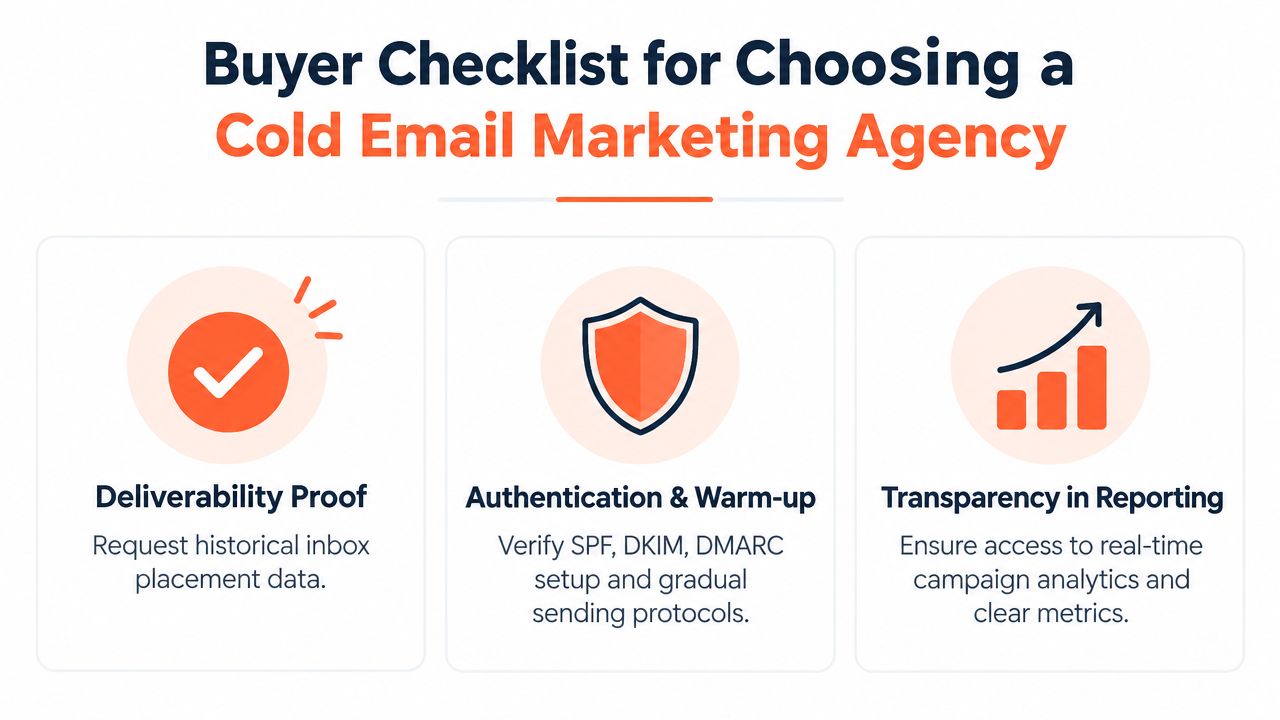
Buyer Checklist for Choosing a Cold Email Marketing Agency
A vendor call should feel less like a copy review and more like an operations audit. The provider's answers should reveal who controls the risk after the contract is signed.
Questions that expose operational maturity
- Deliverability proof: Ask how inbox placement is measured, how often it is checked, and what action follows a deterioration. Vague claims about “warming domains” aren't evidence.
- Authentication ownership: Confirm who configures SPF, DKIM, and DMARC, who receives alerts, and whether the client can access the relevant records and reports.
- List quality: Ask how contacts are sourced, verified, segmented, and removed after an opt-out. Purchased lists without a suppression workflow are a serious warning sign.
- Reply handling: Request the actual process for positive replies, objections, referrals, and unsubscribe requests. A campaign shouldn't stop at the inbox.
- Compliance coverage: Ask how the provider handles CAN-SPAM, GDPR, and CASL when recipients live in different markets. The answer should include documentation, regional rules, and permanent suppression.
- Reporting: Require visibility into inbox placement, bounces, complaints, replies, qualified meetings, and pipeline. Opens alone don't prove commercial value.
Read the proposal for what it leaves out
A low initial quote can conceal setup work, separate data costs, mailbox fees, reply management, or compliance responsibility. A higher quote isn't automatically better either. The buyer needs a line-by-line scope that says what happens before launch, during sending, and after a reply arrives.
Launch promises also need context. “Live quickly” may mean a draft exists, not that domains are authenticated, inboxes are ready, and a monitored campaign is running. Ask for the timeline from intake to first send, the conditions that can delay launch, and the person responsible for each milestone.
Red flag: If a provider promises a reply-rate target but can't show its bounce, complaint, and inbox-placement controls, the promise rests on the wrong part of the funnel.
Finally, check exit terms. The client should understand who owns domains, contact data, campaign assets, reply history, and suppression lists if the relationship ends. Good governance protects the company even when the vendor relationship doesn't continue.
When to Use Agencies, In-House Teams, or Tools
A managed agency makes sense when the company has a clear offer but lacks the capacity to build and supervise outbound infrastructure. It also fits teams facing an urgent pipeline gap, founders who don't want to become deliverability specialists, and sales leaders testing a market before committing to permanent headcount.
The trade-off is control. A client must share strategic context, approve positioning, and trust the provider with sensitive operational work. That risk can be reduced through transparent reporting, clear asset ownership, and defined approval points.
When internal ownership wins
An in-house SDR function becomes more attractive when the company already has sales management, stable messaging, enough lead flow to support a dedicated role, and the patience to train and improve the team. Internal staff can learn objections and coordinate closely with account executives. They also require recruiting, management, tooling, quality control, and deliverability ownership.
Self-serve tools suit an operator who already understands list quality, authentication, segmentation, and reply workflows. The software can be the right choice when the team values control and has someone available to monitor campaigns every day. It becomes a poor fit when the founder buys the tool to save money but has no time to operate it.
A hybrid model often works well. Strategy, positioning, and qualification rules stay internal, while a specialist handles domain setup, sending health, list operations, and campaign execution. That arrangement preserves strategic control without forcing the sales team to learn every technical discipline at once.
| Situation | More suitable model |
|---|---|
| No outbound operator and urgent testing need | Managed agency |
| Strong sales leadership and hiring capacity | In-house team |
| Experienced operator with time for daily management | Self-serve tools |
| Internal strategy, limited technical capacity | Hybrid delivery |
The decision should follow the bottleneck. If the problem is positioning, hire strategic or copy support. If messages aren't reaching buyers, technical help comes first. If replies are being missed, coverage and workflow matter more than another template.
Key Takeaways for Buyers
Cold email should be bought as an operating discipline, not as a bundle of persuasive paragraphs. The message matters, but its value depends on authenticated infrastructure, a relevant audience, controlled sending, compliant opt-out handling, and someone responsible for the response after the prospect writes back.
The most useful comparison is between managed outcomes and transferred workload. A provider that builds domains, monitors reputation, verifies lists, tests angles, handles replies, and reports on qualified meetings is selling an operating function. A provider that sends copy and software access is selling ingredients. Neither model is flawed by design, but the buyer shouldn't confuse them.
Three principles keep the evaluation grounded:
- Inbox first: Ask whether the provider can demonstrate delivery health and explain its response to bounce or complaint changes.
- Compliance by process: Confirm that regional rules, documentation, and permanent suppression are built into daily operations.
- Capacity fit: Choose managed support, internal hiring, self-serve tooling, or a hybrid according to the team's time, expertise, urgency, and tolerance for operational risk.
The benchmark range matters less than the explanation behind it. Average reply rates can sit well below strong campaign performance, and inbox placement can vary by provider, mailbox, and sender reputation. A credible agency won't hide that variability. It will define the baseline, identify controllable levers, test carefully, and connect campaign activity to qualified conversations.
The memorable rule is straightforward: copy earns attention, deliverability earns the opportunity, and reply operations turn that opportunity into pipeline. Buyers should select the cold email marketing agency that can manage all three without leaving compliance work hidden in the fine print.
Eludic designs, launches, and manages done-for-you outbound programs, including sending infrastructure, authentication, warm-up, campaign variants, deliverability monitoring, reply handling, and meeting coordination. Visit Eludic to review the service and see whether its managed model fits the company's pipeline goals and internal capacity.