
Cold email open rates are still treated as a scoreboard, even though the scoreboard changed halfway through the game. A reported open can mean that a recipient read the message, but it can also mean that Apple Mail Privacy Protection or another mailbox system loaded the tracking pixel automatically. At the same time, published benchmarks vary so widely that a “good” result often says more about measurement than message quality.
The practical consequence is uncomfortable: operators can improve open rates without improving attention, replies, or meetings. The sensible approach is to treat opens as a directional diagnostic, then move the centre of measurement toward inbox placement and pipeline.
Why Cold Email Open Rates Are a Controversial Metric
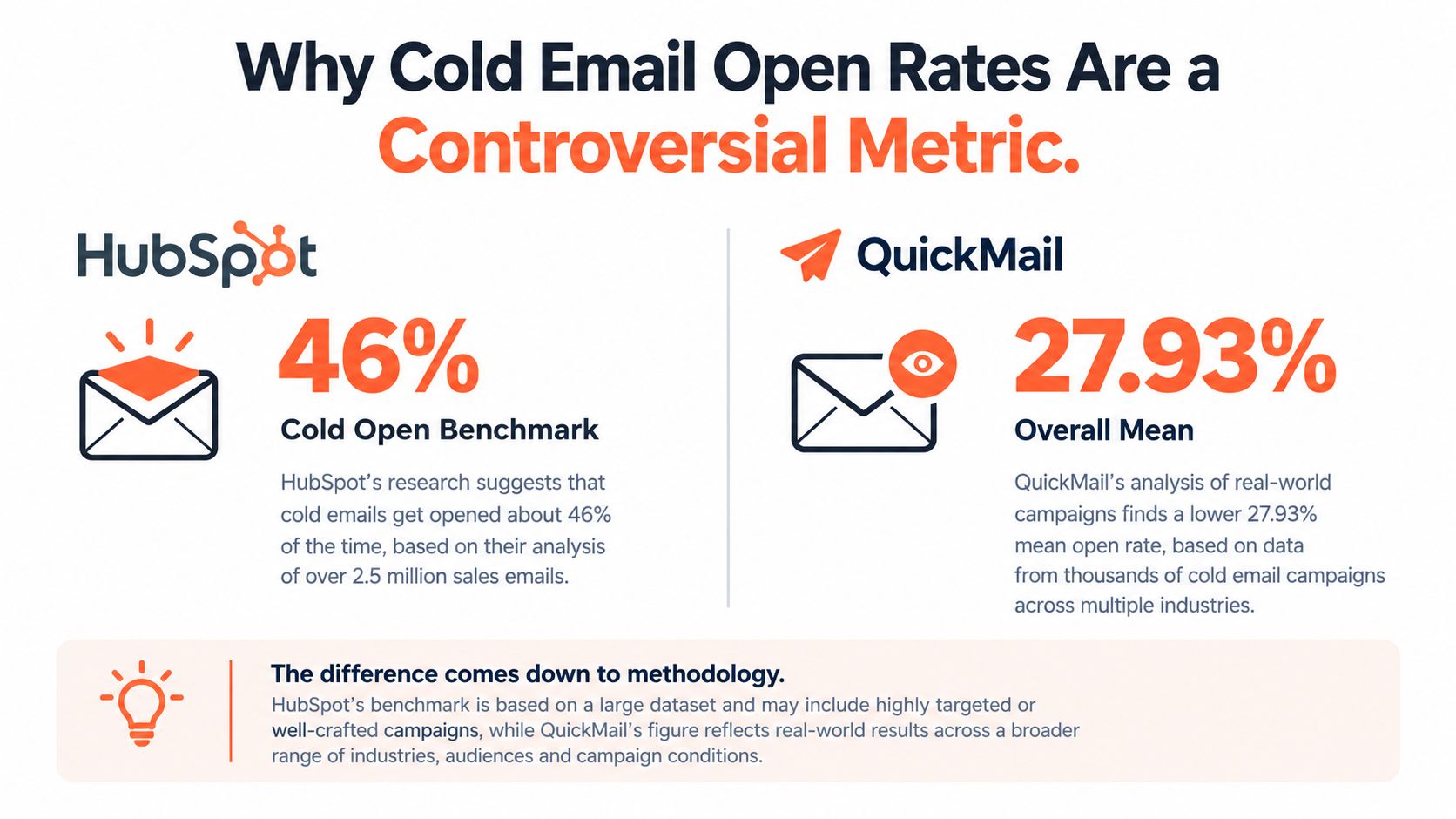
The most popular advice says that a high open rate proves a strong subject line. That assumption is no longer safe. Apple Mail Privacy Protection can trigger an open event without a human reading the message, so a campaign may appear to perform well while actual attention remains unknown. A 2026 B2B study reported a median open rate of 23.4%, but estimated the true engaged-open rate at 13.4%, with raw opens overstating attention by roughly 43% in Apple-heavy audiences. The study's methodology and findings make the central problem clear: the metric mixes human behaviour with automated image loading.
Benchmark disagreement adds another layer of noise. One recent analysis reports an average cold email open rate of 27.7% in both 2024 and 2026, while another 2026 benchmark roundup reports a median of 26% across 37,000 campaigns. A separate benchmark source says averages can range from 21% to 44%, depending on how opens are counted. Those figures aren't interchangeable. They can reflect different industries, mailbox ecosystems, list quality, authentication practices, and tracking rules.
The historical trend is harder to read than it looks
The long-term trend appears to show a dramatic rise. Sopro-referenced B2B open rates moved from 18.7% in 2016 and 19.6% in 2019 to 31.8% in 2022, 33.5% in 2023, and 35.9% in 2024. But Apple Mail Privacy Protection is a major reason pre-2022 and post-2022 figures aren't directly comparable. The historical benchmark comparison should therefore be read as a history of tracking conditions as much as a history of recipient interest.
Practical rule: A rising open rate doesn't automatically mean a more interested audience. It may mean that more mailbox systems are reporting an event.
Open rates still have limited diagnostic value. A sudden collapse can indicate a deliverability problem, a broken tracking setup, or a change in list composition. A strong result can confirm that messages are being rendered somewhere in the mailbox ecosystem. It can't, by itself, confirm that the right people noticed the message.
What a Cold Email Open Rate Actually Measures
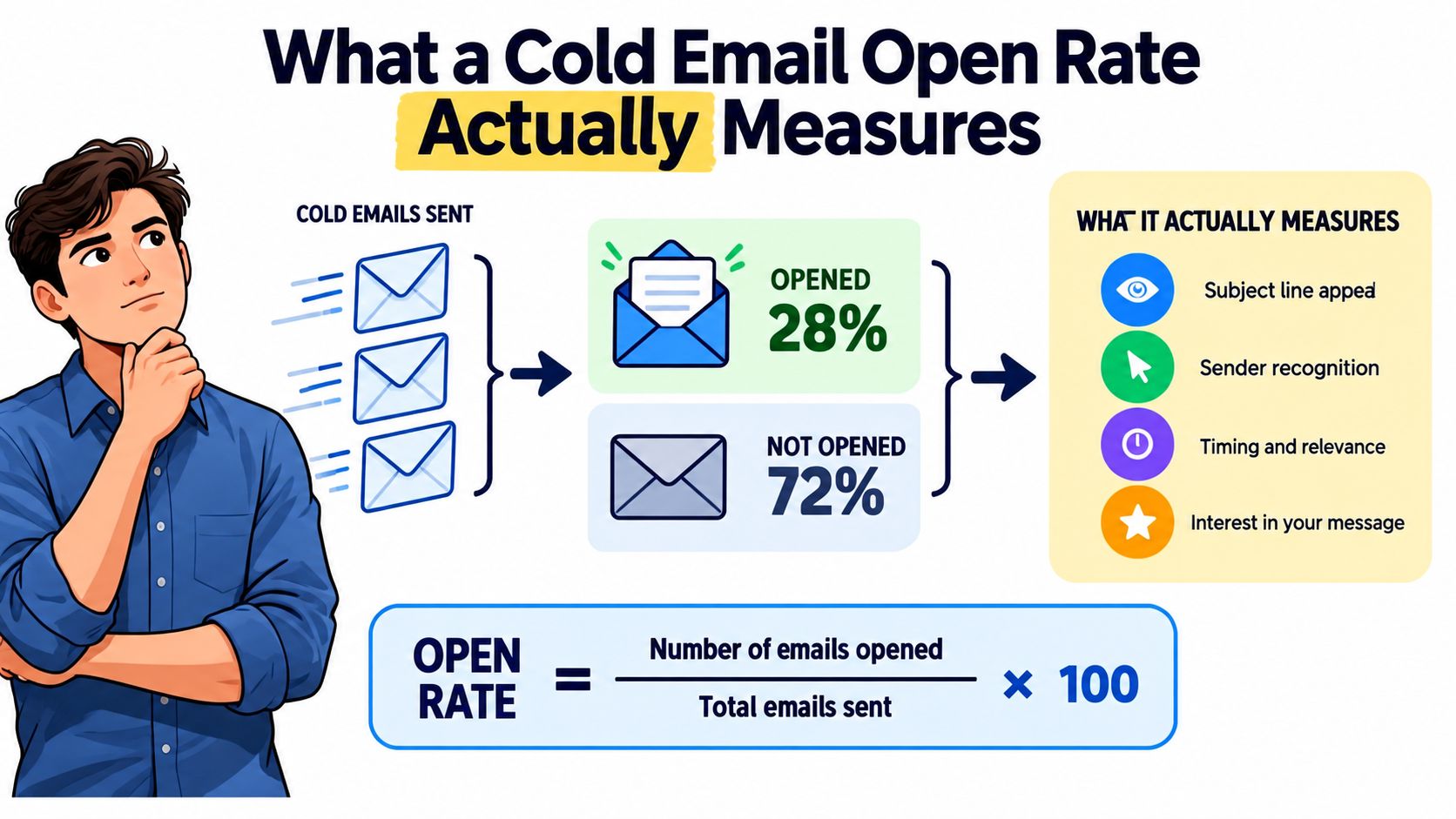
A cold email open rate is generally calculated as tracked opens divided by delivered emails. The denominator matters. Messages that never reach a recipient's mailbox can't produce a meaningful human open, so using sent emails instead of delivered emails can make the metric look weaker for reasons unrelated to copy.
Most tracking systems place a tiny, invisible image in the email. When the recipient's mail client requests that image, the platform records an open. A tracked link click may also be treated as evidence that the message was opened, depending on the platform's reporting rules. The event confirms that a remote asset loaded or an interaction occurred. It doesn't prove that the recipient read the body.
Why the same campaign can look different in different inboxes
Apple Mail Privacy Protection can preload remote images, including tracking pixels, before the recipient engages with the message. That creates an automated open event. A human may later read the email, ignore it, delete it, or never notice it, while the dashboard still records an open.
Other mailbox environments create the opposite problem. Image blocking, privacy settings, security scanning, and preview behaviour can prevent a pixel from loading even when a person reads the message. The result is a metric with both false positives and false negatives.
Cold email open rates therefore capture a narrow technical event, not a complete engagement event. They can indicate that a message was rendered or scanned, but they can't reliably establish:
- Attention: The recipient may not have read the message.
- Interest: An open doesn't indicate that the offer was relevant.
- Intent: An open doesn't show that a buyer wants a conversation.
- Qualification: An open says nothing about fit, authority, or urgency.
This is why raw opens should sit below replies, positive replies, meetings booked, and complaint rates in an outbound measurement hierarchy. The closer a metric is to a deliberate human action, the more useful it becomes for commercial decisions.
Cold Email Open Rate Benchmarks You Can Trust
A cold email open-rate benchmark is only as credible as its measurement design. List definition, sample scope, tracking method, delivery conditions, and reporting period can shift the result substantially. Treat the number as a reference range, not a universal target.
The available figures span a wide range. One dataset reports an average cold email open rate of 27.7% in both 2024 and 2026. It also reports 20.79% for personalized cold emails versus 14.96% for non-personalized messages, with software at 47.1%, consumer goods at 19.3%, and banking at 19.7%. The dataset and its industry comparisons makes the practical limitation clear: industry mix and personalization can matter more than a supposedly universal benchmark.
A separate roundup reports that senders with SPF, DKIM, and DMARC configured achieved open rates 36% to 44% higher than average. It also reports 82% of opens within 24 hours and 93% within 48 hours. These figures can help with campaign monitoring, but they remain tracked events rather than verified reading. The benchmark roundup reports a 26% median across 37,000 campaigns, with two-word subject lines at a 32% median and eleven-word subjects at 24%.
The operational question is not whether a campaign reaches an industry average. It is whether the number is comparable to your own baseline and useful for a decision. A high raw open rate can reflect privacy-driven image loading, while a lower rate can reflect blocked images despite genuine reading. Open rate should therefore guide investigation, not serve as the main success criterion.
A benchmark-reading checklist
Before comparing a campaign with a published figure, check:
- List definition: Is the sample genuinely cold, or does it include opted-in and existing contacts?
- Scope: Does the source cover one industry, one platform, or a broad mix?
- Tracking method: Were Apple-generated opens filtered, modelled, or left in the total?
- Delivery assumptions: Were authentication, bounce handling, and inbox placement controlled?
- Time window: Does the result describe a short campaign or a longer reporting period?
| Source | Reported open rate | Sample or scope | MPP adjusted | Notes |
|---|---|---|---|---|
| Snov.io dataset | 27.7% | Cold email benchmark for 2024 and 2026 | Not stated | Industry and personalization variation reported |
| Visionary Marketing study | Reported median | 2026 B2B study | Estimated engaged-open rate reported | Raw opens may overstate attention in Apple-heavy audiences |
| SearchLab roundup | 26% median | 37,000 campaigns | Not stated | Subject length and authentication comparisons included |
| Sopro-referenced history | Historical benchmark | B2B historical benchmark | Not directly comparable across periods | Later figures were affected by Apple Mail Privacy Protection |
The table supports a narrower conclusion than a single target: benchmark quality depends on comparability. Use raw opens to spot delivery or messaging changes, then judge performance through replies, positive replies, meetings, and complaints. The future of pixel-based reporting is uncertain, so operators should not plan around projections that lack a clearly identified source.
Deliverability Foundations That Make Opens Possible
Subject lines can't rescue a message that never reaches the inbox. Deliverability is the foundation because an open event only becomes useful after the sender has confidence that messages are being accepted, authenticated, and delivered to the intended mailbox environment.
Authentication comes before experimentation
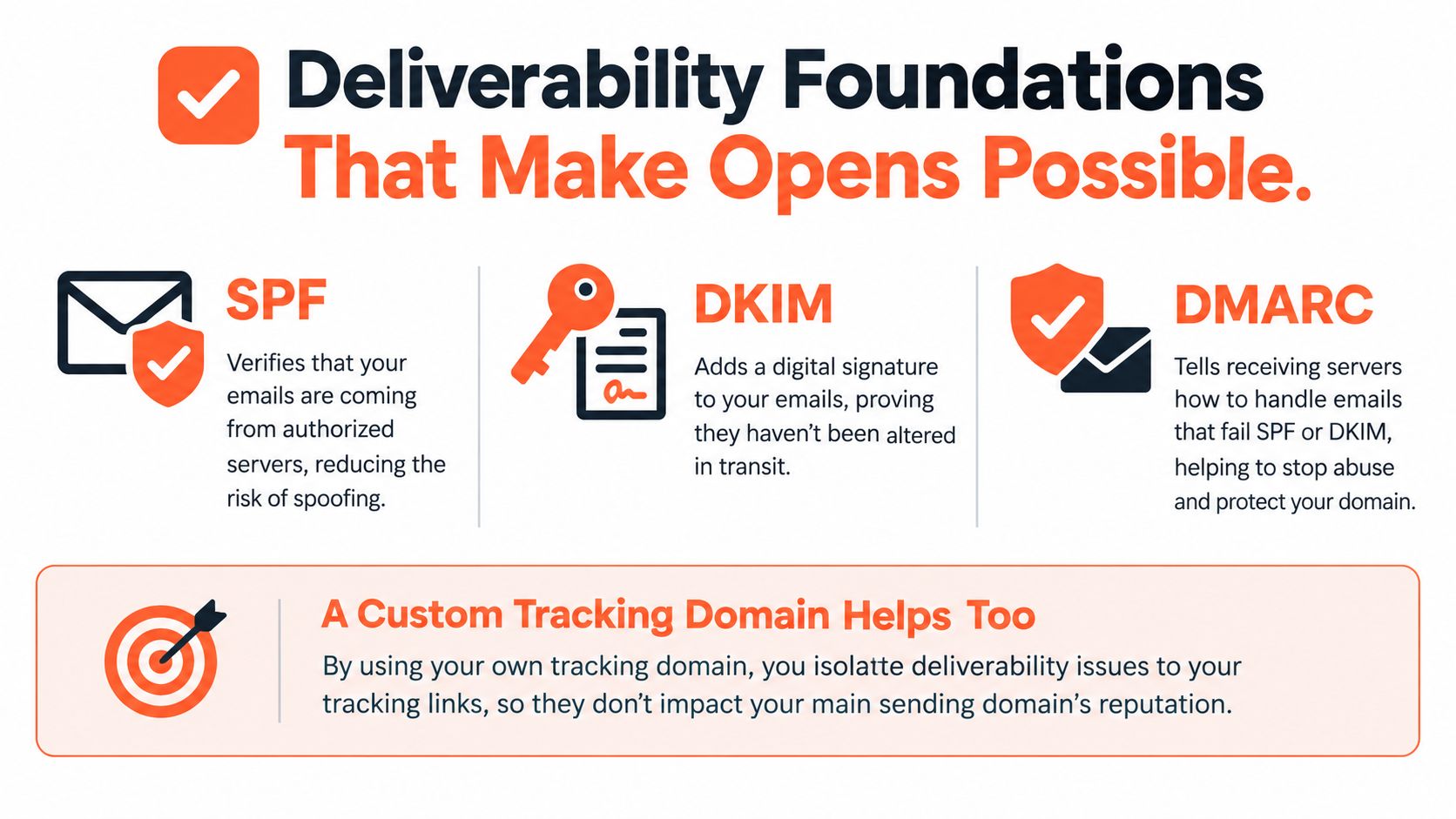
SPF identifies authorised sending infrastructure. DKIM adds a verifiable signature to the message. DMARC gives mailbox providers a policy and alignment framework for handling messages that fail authentication checks. Together, these controls help establish that the sender is legitimate and reduce the likelihood that mailbox providers treat the campaign as suspicious.
A custom tracking domain separates tracking infrastructure from the main sending identity. That separation doesn't guarantee inbox placement, but it makes diagnosis cleaner. If tracking behaviour changes, operators can investigate the tracking layer without confusing it with the reputation of the root domain.
The operational foundation should include:
- Domain authentication: Configure SPF, DKIM, and DMARC before scaling any campaign.
- List hygiene: Remove invalid and risky addresses before sending. Teams that need a clear workflow can describe email verification job to understand how verification work fits into list preparation.
- Warm-up discipline: Increase sending gradually, seed legitimate replies where appropriate, and avoid sudden volume spikes across new mailboxes.
- Reputation monitoring: Review Google Postmaster Tools, Microsoft SNDS, and relevant blocklists for emerging issues.
- Complaint control: Stop weak segments quickly instead of allowing poor targeting to damage the whole sending setup.
The benchmark evidence supports this sequencing. Authenticated senders with SPF, DKIM, and DMARC were reported to achieve open rates 36% to 44% higher than average, although those figures still describe tracked opens rather than confirmed reading. The result is best interpreted as a deliverability signal, not a promise that authentication alone will create interest.
Warm-up is a risk-control process
Warm-up isn't a ritual that makes every message valuable. It gives a new sending identity time to establish normal behaviour while operators inspect bounces, complaints, replies, and placement. A gradual cadence, clean list, and monitored response pattern are more defensible than immediately sending a large sequence.
The email deliverability optimization guide provides a useful reference point for connecting authentication, list quality, tracking choices, and monitoring into one operating process. The principle is simple: technical controls should be in place before copy tests begin, because otherwise a subject-line result may only reflect changing inbox placement.
Copy and Timing Levers That Move Open Rates
Once delivery is stable, copy can influence tracked opens, but the useful question is whether that activity leads to qualified replies. Open rate is partly a measurement artifact, especially in mailboxes affected by Apple Mail Privacy Protection. A recorded open may reflect a privacy proxy fetching an image, not a prospect reading the message. Copy should therefore be judged by the quality of the response it generates, not by pixel activity alone.
Personalization works only when it improves relevance. A first-name token is weak evidence of understanding. Stronger personalization connects the message to a recipient-specific trigger, role, account change, or operational problem. That distinction matters because a personalized message can still be inaccurate, poorly segmented, or irrelevant. Rather than chasing a benchmark gap, run a controlled comparison where the only change is a recipient-specific trigger line, then judge the result on positive replies and meetings.
Subject lines need a reason to exist
Specific subject lines give recipients a clearer reason to inspect a message than vague curiosity bait. A subject can reference a visible business trigger, a narrow operational issue, or the relationship between the recipient's role and the message. It should match the body closely. A misleading subject may raise the tracked open rate while lowering reply quality and increasing negative signals.
Subject-length data from the benchmark roundup above belongs in a test plan, not a rigid rulebook. Short wording can reduce cognitive load, but it can also become vague. Longer wording can add context, but unnecessary detail may make the message harder to classify quickly. The right length depends on the audience, the trigger, and whether the subject gives the reader a credible reason to continue.
Useful variants include:
- A concrete trigger: A recent hiring pattern, product change, or market movement.
- A role-specific problem: An issue that belongs to the recipient's responsibilities.
- A restrained question: A question that can be answered without a long explanation.
- A plain continuation: A subject that sounds like a normal business note rather than an automated campaign.
The guidance on B2B cold email subject lines is most useful as a source of hypotheses. Test whether the wording attracts the right prospects, not merely whether it produces more tracked opens. A subject that earns attention from poorly matched recipients can make the dashboard look healthier while weakening pipeline efficiency.
Timing is mainly a measurement window
Tracked opens tend to cluster soon after delivery, so early activity can serve as a diagnostic signal. Weak early activity should prompt checks on inbox placement, mailbox distribution, list quality, and audience fit before the subject line receives the blame. Delayed opens can also reflect work patterns, forwarding, automated scanning, or privacy systems rather than a clear change in interest.
Send-time optimisation should remain subordinate to inbox placement and relevance. A well-timed message with a weak reason to respond still produces no useful conversation. Conversely, strong timing cannot compensate for a message that reaches the wrong role or asks for an unclear next step.
Operators should record opens as a directional input, alongside delivery outcomes, positive replies, negative replies, meetings, and qualified opportunities. That combination separates copy that attracts inspection from copy that creates commercial movement. The practical objective is not the highest open rate. It is a measurement process that identifies which message, audience, and timing combination earns credible engagement.
Testing Open Rates Without Fooling Yourself
A serious test begins by deciding what the result is supposed to change. If the question concerns subject lines, the test should not also change the offer, audience, first sentence, and send schedule. When several variables move together, the winning result can't be attributed to any one decision.
Build a clean test cell
A workable structure uses one variable per test:
- Subject test: Keep the audience, body, sender, and schedule stable.
- Opening-line test: Keep the subject and offer stable while changing only the first line.
- Timing test: Keep the copy and segment stable while changing the send window.
- Measurement rule: Define the primary metric before reviewing the dashboard.
The plan notes call for a fixed holdout of 1,000 to 2,000 recipients per arm and a 48 to 72 hour read window. Those should be treated as operating requirements for sufficiently large lists, not universal statistical guarantees. Smaller campaigns may need to aggregate comparable tests, while larger campaigns can use percentage-based splits so each arm scales with the available audience.
A percentage split also protects the testing process from a common mistake. Fixed counts can make a test too small for one campaign and unnecessarily expensive for another. The allocation should be decided before launch, then preserved until the read window closes.
Use open rate as a secondary result
Apple Mail Privacy Protection makes raw opens particularly vulnerable to automation. The more dependable question is whether the variant produced a better reply rate, positive-reply rate, or meeting outcome. Open rate can remain a supporting signal, especially when a dramatic fall suggests a delivery problem, but it shouldn't determine the winner alone.
A subject line that creates more opens and fewer qualified replies is not a winning subject line.
Operators should record the test hypothesis, audience definition, send window, delivery issues, replies, positive replies, meetings, and complaints. The campaign performance analysis framework can help teams separate a copy decision from a deliverability decision.
When a variant wins, it should enter the sequence template only after the full read window and downstream outcomes are available. The old version should remain documented as a control. Otherwise, every new campaign changes the baseline and makes future comparisons less reliable.
Operational Models for Running Cold Email at Scale
Outbound execution has four common shapes, and each moves responsibility rather than eliminating it.
Self-serve platforms such as Instantly, Lemlist, and Smartlead reduce the software barrier. They can support sending, sequencing, and basic reporting, but the operating burden remains with the team. Someone still has to configure authentication, warm mailboxes, verify lists, inspect bounces, write variants, classify replies, and protect sender reputation.
An in-house SDR model provides tighter control over positioning and conversations. It also requires recruiting, management, infrastructure, enablement, and quality assurance. A new SDR can own the relationship with prospects, but still needs a reliable technical system and a clear testing process.
Boutique agencies add strategic and execution support, though buyers should examine who owns the domains, who handles replies, how deliverability is monitored, and whether reporting stops at opens. A low sending fee can conceal substantial internal work if the agency supplies copy but not inbox management.
Done-for-you services consolidate list building, infrastructure, copy testing, sending, and reply handling under one accountable operator. That model suits teams without a dedicated deliverability function, provided the service reports on qualified pipeline rather than presenting tracked opens as the final outcome.
A practical comparison looks like this:
| Model | Launch burden | Expertise required | Work ownership |
|---|---|---|---|
| Self-serve software | Team configures and operates the system | Deliverability, copy, data, and reply handling | Internal team |
| In-house SDR team | Hiring and infrastructure setup | Sales management plus technical operations | Internal team |
| Boutique agency | Briefing and vendor management | Strategic oversight and quality control | Shared |
| Managed outbound service | Vendor builds and runs the programme | Clear positioning and approval input | Vendor, with client oversight |
The right model depends less on software features than on ownership. If nobody owns inbox placement, list quality, reply classification, and measurement, another sending seat won't solve the operational gap.
Turning Open Rate Insight Into Pipeline
Cold email open rates belong in the diagnostic layer, not the revenue layer. The stronger measurement stack starts with delivery and continues through reply rate, positive reply rate, meetings booked, and cost per meeting. Open rate can help identify a sudden change, but booked conversations show whether the campaign created commercial movement.
The operator's checklist should be direct:
- Audit authentication: Confirm SPF, DKIM, and DMARC before scaling.
- Warm every new sending identity: Use a controlled ramp and monitor the response pattern.
- Segment before writing: Group prospects by trigger, persona, industry, or clear business context.
- Test against replies: Compare subject lines and openings using positive replies and meetings as the decision metrics.
- Review placement regularly: Inspect reputation, bounces, complaints, and mailbox behaviour rather than waiting for a campaign to fail.
- Track economics: Calculate cost per meeting and pipeline contribution, not just activity volume.
Lead scoring can improve the handoff between outreach and sales by helping teams prioritise prospects according to fit and intent. A practical resource on LinkedIn lead scoring strategies can support that layer, especially when a campaign generates responses from prospects with different levels of relevance.
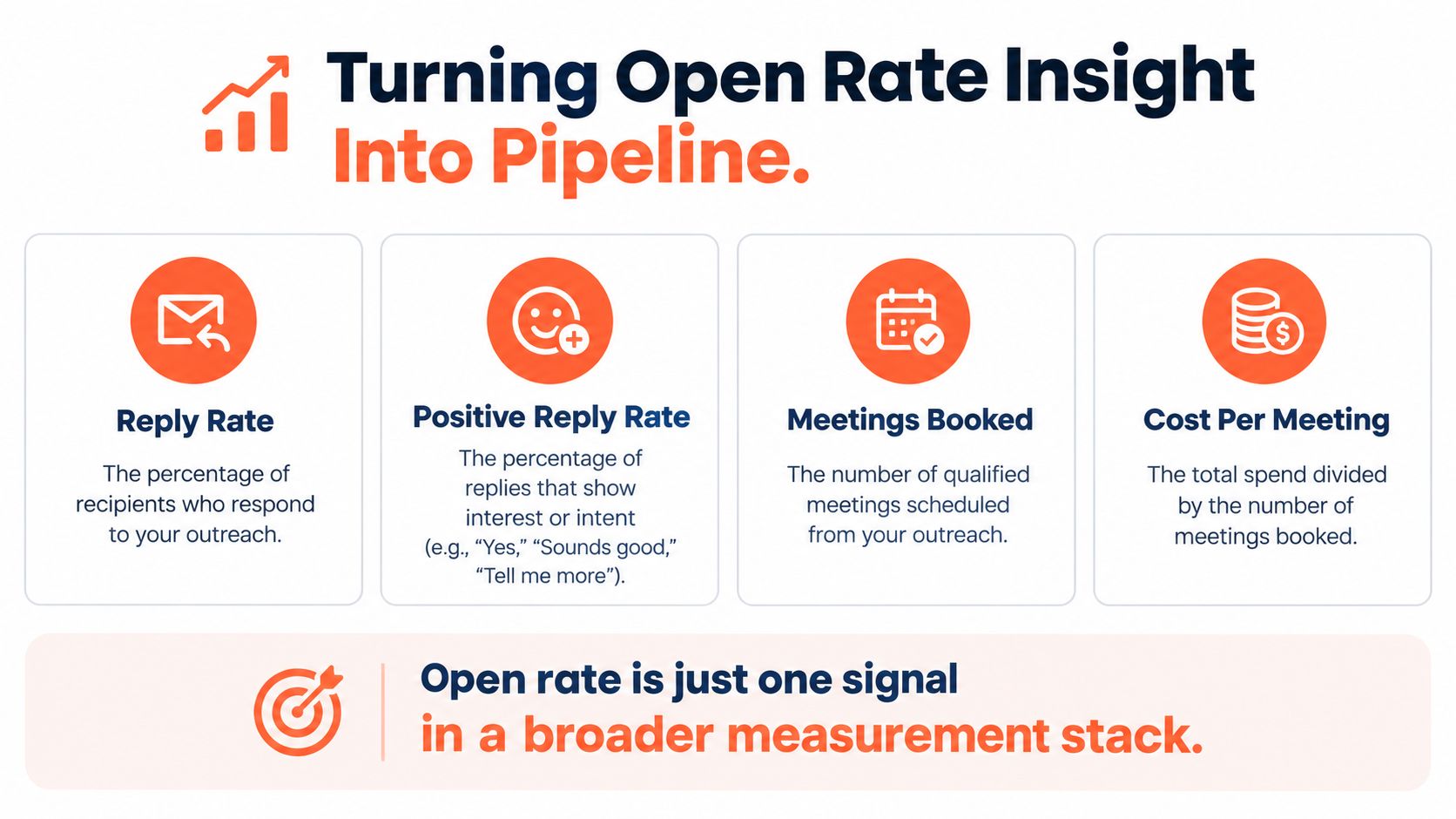
The useful north-star measure is booked meetings per 1,000 prospects sent, supported by positive-reply quality and cost per meeting. That framing prevents teams from rewarding campaigns that generate automated opens but no human response. It also makes copy, targeting, deliverability, and follow-up decisions answerable to the outcome that matters.
For B2B teams that want this system operated rather than assembled internally, Eludic designs and runs cold email programmes, including authenticated sending infrastructure, list research, personalised copy variants, deliverability management, reply handling, and meeting coordination. Teams can visit Eludic to assess whether a managed outbound model fits their pipeline goals and internal capacity.